

Understanding the concepts of interstate and intrastate supply significantly impacts the Goods and Services Tax (GST) in India. These terms dictate the applicable tax structure and establish compliance requirements for businesses. Many taxpayers frequently seek the definition of interstate in GST, as it directly influences how businesses issue invoices, the taxes they apply, and how they claim credits. A clear grasp of these concepts enables businesses to maintain compliance, avoid penalties, and effectively manage their tax liabilities.
“Don’t risk penalties or compliance issues. Reach out to GST Registration Consultants for step-by-step guidance.”
What does Inter-State Supply mean in GST?
Interstate supply refers to the provision of goods or services when the supplier and the location of supply are in two distinct states or union territories.
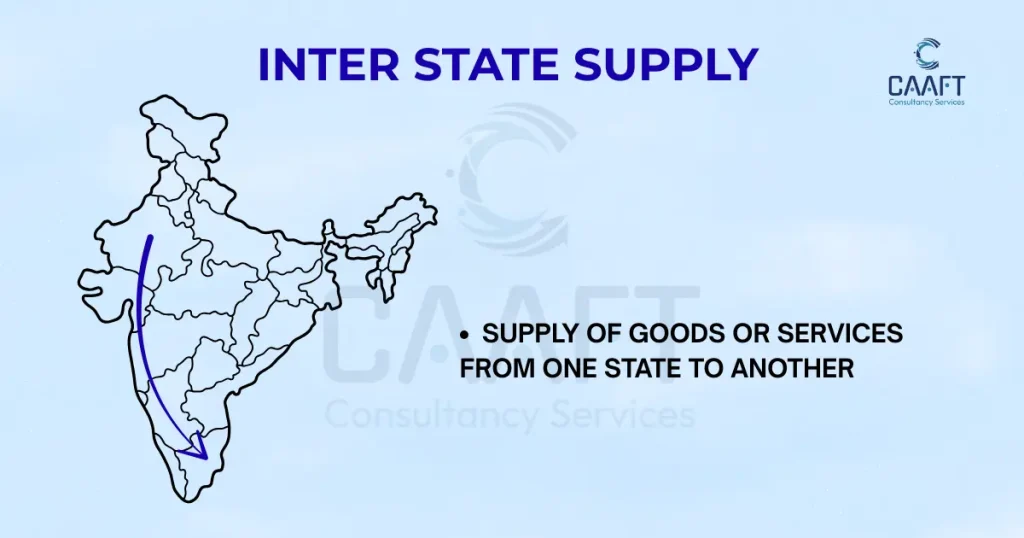
- Example 1: A manufacturer in Delhi sells machinery to a company in Haryana. This transaction qualifies as an interstate supply because the buyer and the supplier operate in different states.
- Example 2: A digital marketing agency in Karnataka provides services to a client in Kerala. This service is classified as an interstate supply since the provider and the recipient are located in different states.
In these cases, the transaction incurs Integrated GST (IGST), which is later distributed between the central and state governments.
What does Intrastate Supply mean in GST?
Intrastate supply occurs when both the provider and the recipient are in the same state or union territory.
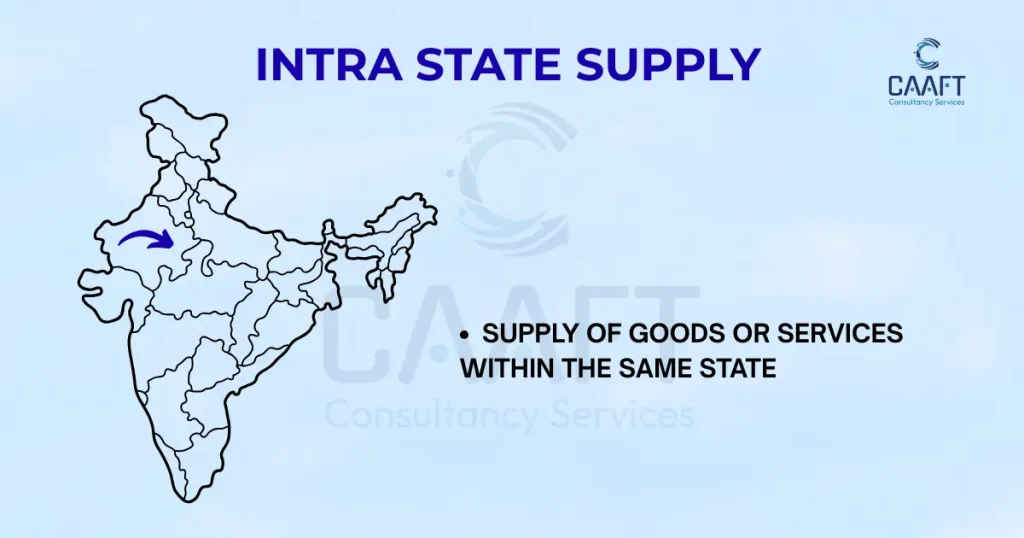
- Example 1: A retailer in Tamil Nadu sells clothing to a customer in Chennai. Since both the supplier and recipient are in the same state, this transaction is an intrastate supply.
- Example 2: A consultancy firm in Pune provides services to a business also located in Pune. This transaction is also classified as intrastate.
In these situations, the central government and state governments share the Integrated GST (IGST) fee.
Understanding the concepts of interstate and intrastate supply significantly impacts the Goods and Services Tax (GST) in India. These terms dictate the applicable tax structure and establish compliance requirements for businesses. Many taxpayers frequently seek the definition of interstate in GST, as it directly influences how businesses issue invoices, the taxes they apply, and how they claim credits. A clear grasp of these concepts enables businesses to maintain compliance, avoid penalties, and effectively manage their tax liabilities.
Before diving deeper into the comparison of interstate and intrastate supply, it’s important to understand the benefits of GST registration, as registration is the foundation for availing GST advantages.
Detailed Difference Between Interstate and Intrastate Supply
Here’s a comprehensive comparison:
| Aspect | Interstate Supply | Intrastate Supply |
|---|---|---|
| Definition | Supplier and place of supply are in different states/UTs | Supplier and place of supply are in the same state/UT |
| Applicable Tax | IGST (Integrated GST) | CGST + SGST |
| Revenue Distribution | IGST collected by the Centre, then shared with the destination state | The State receives SGST, while the Center receives CGST. |
| Example | Delhi → Haryana supply | Delhi → Delhi supply |
| Invoice Type | Shows IGST | Shows CGST and SGST separately |
| ITC Utilization | IGST credit can be used for IGST, CGST, and SGST liabilities | CGST credit for CGST/IGST, SGST credit for SGST/IGST |
| Impact on Pricing | Uniform tax rate across India | Tax split between Centre and State |
| Relevance | Cross-border trade within India | Local/state trade only |
GST Law and Place of Supply Rules
The place of supply rules under GST determine whether a transaction qualifies as interstate or intrastate, which in turn dictates the application of IGST or CGST + SGST. Businesses must understand these rules, as they directly impact tax liability, input tax credit claims, and compliance requirements.
For Goods:
- If the supplier’s location and the place of supply are in separate states or union territories, the transaction is considered an interstate supply and is subject to IGST.
- If the supplier and place of supply are in the same state or union territory, the transaction is classified as an intrastate supply and is subject to CGST + SGST.
- For the import and export of goods, the transaction is always treated as interstate, regardless of the supplier’s location within India.
For Services:
- The nature of the service largely determines the place of supply. For B2B (business-to-business) transactions, the place of supply typically aligns with the recipient’s location.
- For B2C (business-to-consumer) transactions, the place of supply usually corresponds to the service provider’s location, unless specific rules apply (e.g., for telecom, transportation, or immovable property-related services).
- If the service recipient is in a different state from the service provider, it qualifies as an interstate supply, attracting IGST.
- If both the service provider and recipient are in the same state, the supply qualifies as intrastate and is subject to CGST + SGST.
By clearly identifying the location of supply for both goods and services, the GST legislation eliminates uncertainty and ensures consistency across states. This clarity is vital for businesses to accurately interpret the meaning of interstate transactions in GST, helping them avoid compliance issues and disputes during audits.
Practical Examples of Interstate vs Intrastate Supply
- Online Sale of Goods:
- A seller in Rajasthan delivers to a customer in Uttar Pradesh – Interstate (IGST).
- A seller in Jaipur delivers within Rajasthan – Intrastate (CGST + SGST).
- Transportation Services:
- A logistics company in Delhi transports goods to Mumbai – Interstate.
- A logistics company moves goods within Delhi – Intrastate.
- E-commerce Transactions:
- A seller registered in Karnataka sells through an e-commerce portal to a buyer in Telangana – Interstate.
- The same seller delivers to a customer in Bengaluru – Intrastate.
Tax Implications of Interstate and Intrastate Supply
Interstate Supply (IGST): The supplier charges Integrated GST, and the credit can be utilized against IGST, CGST, and SGST liabilities in a prescribed order.
Intrastate Supply (CGST + SGST): Both CGST and SGST are charged equally. Input Tax Credit (ITC) of CGST can only be used against CGST or IGST, and ITC of SGST can only be used against SGST or IGST.
Understanding these rules ensures proper invoicing, prevents penalties, and helps businesses maximize ITC benefits.
Why Businesses Must Know the Difference
- Correct Tax Invoicing: Using the wrong GST type (IGST instead of CGST+SGST) can lead to compliance issues.
- ITC Management: Businesses need to track the type of GST paid to claim input tax credits effectively.
- Avoiding Penalties: Misclassification of supply can result in interest, penalties, and disputes during audits.
- Better Planning: A clear understanding of the interstate meaning of GST aids in optimizing distribution and procurement plans.
Common Mistakes to Avoid
- Treating all online sales as interstate when local deliveries can still be intrastate.
- Failing to thoroughly inspect the supply location for services.
- Incorrectly updating invoices using IGST or CGST+SGST.
- Ignoring changes in the recipient’s GSTIN location, which may alter supply classification.
Conclusion
The interstate meaning in GST revolves around the location of the supplier and the place of supply being in different states or union territories, while intrastate supply occurs within the same state. Knowing this distinction is crucial for correct invoicing, tax payment, and input credit claims.
By mastering the rules of interstate and intrastate supplies, businesses can ensure compliance, avoid penalties, and manage their GST obligations efficiently. Whether you are a manufacturer, service provider, or e-commerce seller, a clear understanding of these concepts will keep your business GST-compliant and tax-efficient.
Frequently Asked Questions
Interstate supply occurs when the supplier and the place of supply are in different states or Union Territories, attracting IGST. Intrastate supply takes place within the same state or Union Territory and is subject to CGST and SGST. Understanding this distinction ensures accurate GST compliance and invoicing.
Interstate transactions are taxed under Integrated GST (IGST), while intrastate transactions attract Central GST (CGST) and State GST (SGST). Applying the correct tax structure helps businesses avoid filing errors, penalties, and input tax credit issues.
The classification depends on the supplier’s location and the place of supply as defined under GST law. Businesses must correctly identify the place of supply for goods and services to determine whether IGST or CGST and SGST should be charged.
Incorrect classification can lead to wrong tax payments, delayed Input Tax Credit (ITC), GST notices, and additional compliance costs. Proper classification ensures accurate invoicing, smooth GST return filing, and compliance with GST regulations.
No. Online sales are not automatically interstate transactions. The applicable GST depends on the seller’s location and the place of supply. If both are in the same state, CGST and SGST apply; otherwise, IGST is charged.
The type of GST charged directly impacts how businesses claim and utilize Input Tax Credit. Proper GST classification and accurate return filing help maximize eligible ITC while reducing compliance risks and tax mismatches.
GST professionals help businesses determine the correct place of supply, apply the appropriate GST, prepare compliant invoices, reconcile Input Tax Credit, and file accurate GST returns. Expert guidance minimizes tax risks and keeps businesses fully compliant with evolving GST regulations.