

Income tax decisions directly affect how much of your hard-earned income stays with you at the end of the year. For FY 2025–26 (AY 2026–27), Indian taxpayers once again face an important choice between the new tax regime and the old tax regime. While both regimes operate under the same Income Tax Act, they follow very different approaches to taxation.
The government designed the new tax regime to simplify tax compliance and reduce dependency on investment-based deductions. At the same time, the government retained the old regime to continue supporting taxpayers who follow disciplined saving habits through insurance, provident funds, pension schemes, and housing loans. As a result, no single regime suits everyone.
Understanding how each regime works, how slab rates apply, and how deductions affect your final tax liability is essential before you file your income tax return.
Need help choosing the right tax regime? Get expert assistance at CAAFT
How Income Tax Slabs Function in India
India uses a progressive taxation structure, meaning tax rates increase as income levels rise. The law divides taxable income into tax brackets, and each bracket attracts a different tax rate. Only the income that falls within a particular slab gets taxed at that slab’s rate, ensuring fairness across income levels.
Income tax slabs apply to:
- Salary and pension
- Interest income from savings and fixed deposits
- Rental income from property
- Business or professional income
- Capital gains
Progressive taxation ensures that higher earners contribute more in absolute terms while providing relief for lower-income groups.
Who needs to consider tax slabs?
- Salaried individuals and pensioners
- Freelancers, consultants, and self-employed professionals
- Business owners
- Investors earn interest, dividends, or rental income
A careful evaluation of slabs and deductions can save thousands or even lakhs in taxes.
New Income Tax Slabs for FY 2025–26 (AY 2026–27)
The government has introduced a broader and more progressive slab structure under the new tax regime. These slabs apply uniformly to all individuals, regardless of age or residential status.
New Tax Regime Slab Rates
| Annual Taxable Income | Tax Rate |
| Up to ₹4,00,000 | Nil |
| ₹4,00,001 to ₹8,00,000 | 5% |
| ₹8,00,001 to ₹12,00,000 | 10% |
| ₹12,00,001 to ₹16,00,000 | 15% |
| ₹16,00,001 to ₹20,00,000 | 20% |
| ₹20,00,001 to ₹24,00,000 | 25% |
| Above ₹24,00,000 | 30% |
After computing the tax based on these slabs, a Health and Education Cess of 4% is applied to the total tax amount.
Why Many Taxpayers Prefer the New Tax Regime
The new tax regime focuses on simplicity and lower tax rates rather than investment-driven deductions. It provides benefits to taxpayers who do not want to lock money into tax-saving instruments purely to reduce tax liability.
Some key reasons taxpayers prefer the new regime include:
- The government raises the Basic Exemption Limit to ₹4 lakh, providing immediate relief for low and middle-income earners.
- The regime implements Gradual Slab Progression, which reduces sudden tax jumps as income crosses specific thresholds.
- The regime offers Lower Tax Liability for Middle-Income Individuals, allowing income up to ₹12 lakh to be practically tax-free due to increased rebate under Section 87A.
- The regime ensures Simplified Compliance with minimal paperwork and no need to maintain records for multiple deductions.
The new regime suits taxpayers with few or no deductions, such as salaried professionals who primarily rely on standard deductions and NPS contributions.
Old Income Tax Slabs for FY 2025–26 (AY 2026–27)
The old tax regime remains unchanged and continues to provide age-based slab benefits along with a wide range of deductions and exemptions.
Individuals Below 60 Years and HUF
| Annual Taxable Income | Tax Rate |
| Up to ₹2,50,000 | Nil |
| ₹2,50,001 to ₹5,00,000 | 5% |
| ₹5,00,001 to ₹10,00,000 | 20% |
| Above ₹10,00,000 | 30% |
Resident individuals earning up to ₹5 lakh can claim a rebate under Section 87A, which reduces their tax liability to zero.
Resident Senior Citizens (60 to 80 Years)
| Annual Taxable Income | Tax Rate |
| Up to ₹3,00,000 | Nil |
| ₹3,00,001 to ₹5,00,000 | 5% |
| ₹5,00,001 to ₹10,00,000 | 20% |
| Above ₹10,00,000 | 30% |
Resident Super Senior Citizens (80 Years and Above)
| Annual Taxable Income | Tax Rate |
| Up to ₹5,00,000 | Nil |
| ₹5,00,001 to ₹10,00,000 | 20% |
| Above ₹10,00,000 | 30% |
Deductions and Exemptions Available Under the Old Tax Regime
The biggest strength of the old tax regime comes from its ability to reduce taxable income through deductions and exemptions. Taxpayers who invest regularly or incur eligible expenses can significantly lower their tax outgo.
Key deductions include:
- Section 80C investments such as PPF, EPF, ELSS, LIC premiums, and NSC
- Section 80D deductions for health insurance premiums
- House Rent Allowance (HRA) exemption for salaried individuals
- Home loan benefits, including interest and principal repayment
- Additional NPS contribution under Section 80CCD(1B)
- Leave Travel Allowance (LTA) and eligible donation deductions
Taxpayers who follow disciplined financial planning often benefit more under the old regime.
Old vs New Tax Regime: Key Differences Explained
Beyond slab rates, the two regimes differ significantly in structure and intent.
| Basis of Difference | Old Tax Regime | New Tax Regime |
| Deductions & exemptions | Offers multiple deductions and exemptions | Allows very limited deductions |
| Ideal taxpayer profile | Individuals with planned investments | Individuals with minimal deductions |
| Default status | Optional; requires selection | Default tax regime |
| Standard deduction | ₹50,000 | ₹75,000 |
| Rebate under Section 87A | Limited to ₹12,500 | Higher rebate, making income up to ₹12 lakh tax-free in many cases |
Tip: Taxpayers should calculate liability under both regimes to determine which option is most beneficial.
Unsure whether the old or new regime suits you? Consult tax experts at CAAFT
How to Reduce Tax Liability Under the New Tax Regime
Although the new regime restricts traditional deductions, taxpayers can still plan efficiently using the limited options available.
Employer’s Contribution to NPS Under Section 80CCD(2)
Employer contributions to the National Pension System (NPS) remain fully deductible under the new regime.
- Employers can contribute up to 14% of basic salary and dearness allowance
- The entire contribution qualifies as a deduction
- This benefit does not fall under the Section 80C limits
This option works particularly well for salaried individuals in higher income brackets.
Standard Deduction on Salary Income
The new tax regime allows a standard deduction of ₹75,000 for salaried individuals and pensioners.
This deduction:
- Requires no investment or documentation
- Applies automatically
- Reduces taxable salary directly
For many middle-income earners, this deduction alone makes a meaningful difference.
Optimising Salary Structure and Perquisites
Certain employer-provided benefits continue to remain tax-efficient even under the new regime:
- Car leasing arrangements offered by employers
- Official mobile phone and internet reimbursements
- Transport facilities provided by specific employers
- Allowances incurred wholly for official duties
Employees who structure their compensation smartly can reduce taxable income without relying on traditional deductions.
Detailed Tax Comparison Examples
Example 1: Salary Income of ₹12 Lakh
An individual earns ₹12,00,000 during FY 2025–26 and invests in PPF while paying health insurance premiums.
- New Tax Regime: After applying the standard deduction and slab rates, the rebate under Section 87A eliminates the entire tax liability. Final tax payable: ₹0.
- Old Tax Regime: Despite claiming deductions, the tax payable works out to approximately ₹1.10 lakh.
Outcome: Income up to ₹12 lakh remains practically tax-free under the new regime in most cases.
Example 2: Salary Income of ₹25 Lakh With High Deductions
A taxpayer earns ₹25,00,000, pays rent, claims HRA, services a home loan, and avails deductions under Sections 80C, 80D, and 80CCD(1B).
- New Regime Tax Payable: Around ₹3.20 lakh
- Old Regime Tax Payable: Around ₹3.04 lakh
Outcome: The old regime proves more beneficial due to substantial deductions.
Example 3: Salary Income of ₹20 Lakh With No Deductions
A taxpayer earns ₹20,00,000 and does not claim any deductions.
- Old Regime Tax Payable: Around ₹4.20 lakh
- New Regime Tax Payable: Around ₹1.97 lakh
Outcome: The new tax regime significantly reduces tax liability for taxpayers without deductions.
Changes Introduced in FY 2025–26
The government introduced several changes to simplify taxation and reduce compliance burden:
- Slab Rate Relaxation: The highest tax rate of 30% now applies above ₹24 lakh (previously ₹15 lakh).
- Rebate Increase: ₹60,000 rebate makes income up to ₹12 lakh effectively tax-free under the new regime.
- TDS Threshold Relaxation: Higher payment thresholds reduce unnecessary deductions.
- Extended Tax Benefits: NPS Vatsalya account withdrawals are now exempt, and start-up incentives under Section 80-IAC have been extended to 2030.
These changes make the new regime more attractive for middle-income earners, reducing tax liability without complicated planning.
Choosing the Best Regime for You
To determine which regime suits you best:
- Estimate total income from all sources.
- Consolidate all eligible deductions (80C, 80D, HRA, NPS, etc.).
- Calculate tax payable under both regimes.
Understanding the Break-Even Point Between Old and New Regimes
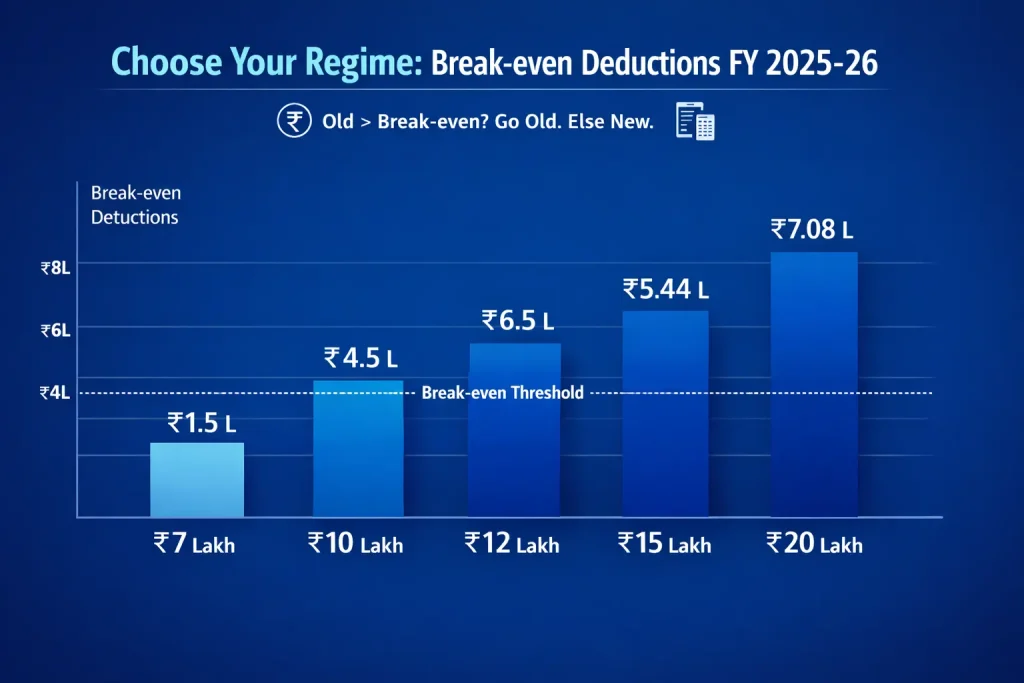
The break-even point shows how much deduction you need under the old regime to match the tax payable under the new regime.
Break-even Deduction Table
| Gross Income (₹) | Break-even Deductions (₹) |
| 7 lakh | 1,50,000 |
| 10 lakh | 4,50,000 |
| 12 lakh | 6,50,000 |
| 15 lakh | 5,43,750 |
| 20 lakh | 7,08,330 |
If your deductions exceed the break-even point, the old regime is more beneficial; otherwise, the new regime is preferable.
Conclusion
As far as FY 2025-26 (AY 2026-27) is considered, both tax systems are applicable, catering to different taxpayers. The new tax system is quite attractive with simplicity, low taxes, and significant tax reliefs for the middle class. The old tax system rewards taxpayers with continuous investments and multiple deductions.
There is no one-size-fits-all system that suits all taxpayers. It is necessary that taxpayers calculate the tax liability on them as per both the systems every year and then opt for the one that results in lower tax liability.
Frequently Asked Questions
An income tax slab is a range of taxable income that is taxed at a specific rate under the Income Tax Act. India follows a progressive tax system, where higher income levels attract higher tax rates, helping taxpayers calculate their tax liability accurately.
The new tax regime offers lower tax rates with fewer exemptions and deductions, while the old tax regime allows taxpayers to claim benefits such as Section 80C, Section 80D, HRA, and home loan interest. Choosing the right regime depends on your income, investments, and eligible deductions.
The new tax regime is generally suitable for salaried individuals and professionals who claim fewer deductions and prefer a simplified tax structure. Comparing both regimes before filing your Income Tax Return helps determine which option offers greater tax savings.
You can reduce your tax liability through eligible deductions, exemptions, tax-saving investments, retirement contributions, and proper tax planning based on the applicable tax regime. Professional tax advice helps maximize legitimate tax benefits while ensuring full compliance with income tax laws.
Income tax slabs may change based on announcements made in the Union Budget or amendments to tax laws. Taxpayers should always refer to the latest slab rates before filing their Income Tax Return to ensure accurate tax calculation and compliance.
Income tax slabs determine the amount of tax payable based on taxable income under the chosen tax regime. Understanding the applicable slab rates helps salaried employees, professionals, and business owners plan investments, estimate tax liability, and improve overall financial planning.
Professional tax consultants help calculate tax accurately, compare the old and new tax regimes, identify eligible deductions, prepare error-free Income Tax Returns, and respond to tax notices when required. Expert guidance minimizes compliance risks and helps maximize legitimate tax savings.