
Access to business credit in India has widened considerably. Credit to micro and small enterprises grew 24.6% year-on-year in November 2025, with overall MSME credit rising 21.8% according to the Economic Survey 2025-26. Lending is expanding – but approval is not automatic, and a wider credit pipeline has not loosened the criteria applied to individual files.
Most rejected applications fail on the same handful of checks. Banks assess a business loan through a structured credit appraisal: repayment capacity, credit conduct, financial documentation, and the quality of the proposal itself. Understanding what the credit officer is actually looking at before the file reaches them is the difference between an approval and a query letter.
This guide sets out the 10 factors banks check when assessing business loan eligibility in India, and what each one means in practice.
Key Takeaways
- Credit score and repayment history carry the most weight in the initial screen, and poor conduct on an existing facility is harder to explain than a thin file.
- Banks test repayment capacity through ratios, principally the Debt Service Coverage Ratio, rather than turnover alone.
- Business vintage and filing consistency matter: three years of matching ITRs, GST returns and audited financials are the baseline for most term loans.
- Collateral-free lending is available under CGTMSE, where the guarantee ceiling has been raised to ₹10 crore.
- Documentation quality is a genuine eligibility factor – a well-prepared CMA report or project report changes how the proposal is appraised.
How Banks Assess Business Loan Eligibility
A business loan application is not approved on a single number. Credit appraisal weighs the borrower’s past conduct, present financial position and projected ability to repay, then tests the proposal against the bank’s own exposure norms for that sector and ticket size.
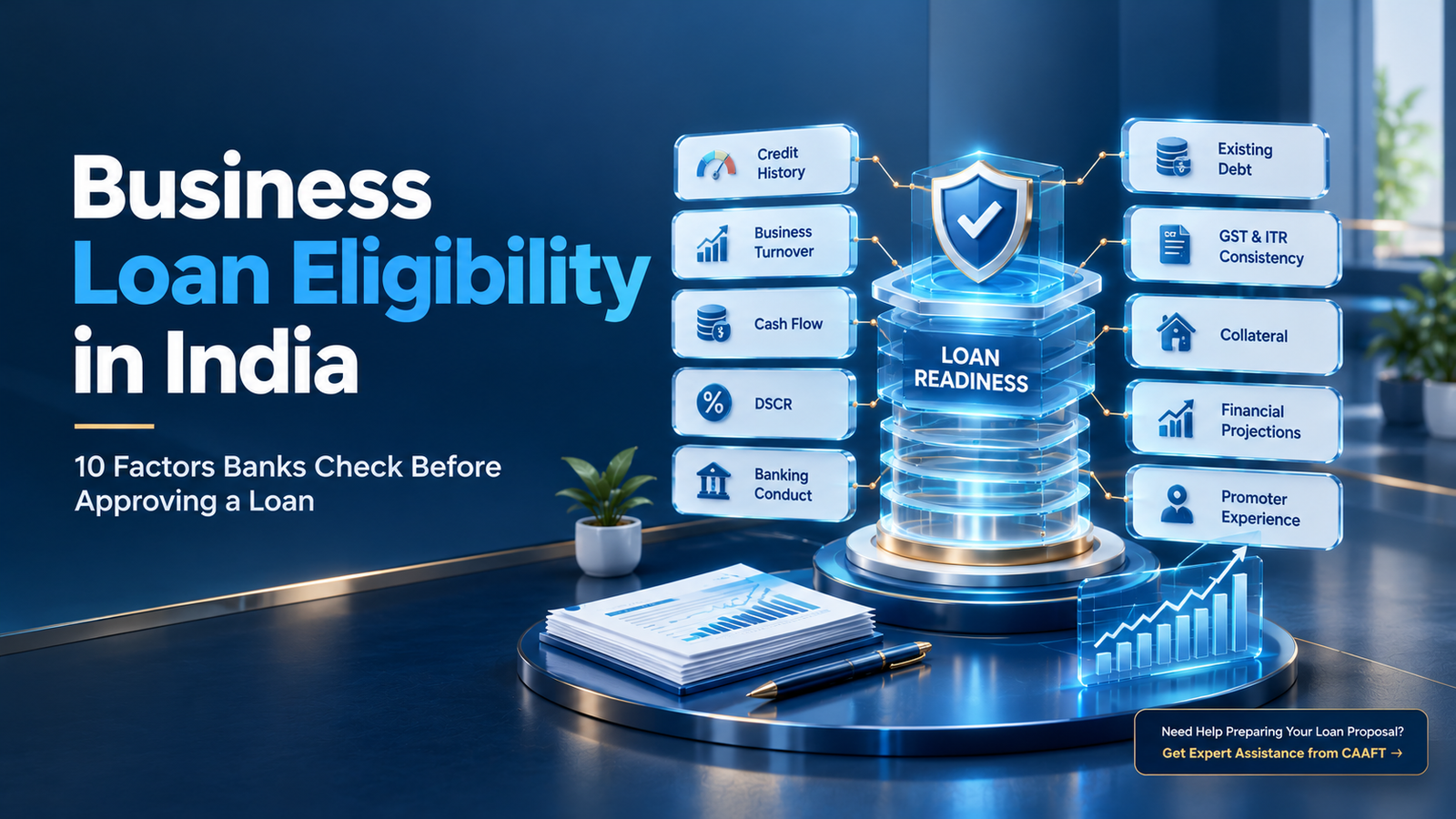
Broadly, the assessment runs across four areas: the promoter’s credit behaviour, the business’s financial health, the quality and consistency of documentation, and the structure of the proposal itself. The 10 factors below sit within those four areas.
10 Factors Banks Check Before Approving a Business Loan
1. Credit Score and Credit History
The credit score is the first filter. Banks check both the business credit report and the promoter’s personal score, because in proprietorships and closely held companies the two are closely linked.
What matters beyond the number itself is conduct: cheque bounces, delayed EMIs, settled accounts and high credit utilisation all register. A single settlement on a past loan can outweigh an otherwise strong score, because settlement indicates the lender accepted less than the full amount. Applicants should check their report well before applying and allow time for any genuine error to be corrected.
2. Business Vintage
Most banks require a minimum operating history – commonly two to three years for term loans, though some working capital products and government schemes accept less.
Vintage demonstrates that the business has survived a full business cycle and generated verifiable financials. Newer businesses are not excluded, but they typically route through startup-focused products, government grants and schemes, or collateral-backed facilities rather than standard credit.
3. Annual Turnover and Revenue Stability
Turnover establishes scale, but stability matters more than size. A business with ₹3 crore of steady annual revenue is often a stronger file than one that moved from ₹1 crore to ₹6 crore and back.
Lenders look at the trend across three years, seasonal patterns, and concentration risk — whether a large share of revenue depends on one or two customers. Declining turnover is not fatal, but it requires explanation in the proposal rather than being left for the credit officer to discover.
4. Profitability and Debt Service Coverage Ratio
This is the core repayment test. The Debt Service Coverage Ratio measures whether cash generated by the business covers the proposed repayment obligations, and most lenders look for a ratio comfortably above 1.
A business can be profitable on paper and still fail this test if existing debt already absorbs available cash flow. Accurate financial statements and analysis are what allow a borrower to present this position credibly rather than leaving the bank to compute it from incomplete figures.
5. Banking Conduct and Cash Flow
Banks typically review six to twelve months of statements, and they read them closely. The things that draw attention are inward cheque returns, frequent overdrafts, balances that fall to zero before month-end, and cash deposits that do not reconcile with declared turnover.
Consistent credits matching reported revenue build confidence. Businesses that route significant transactions through personal accounts weaken their own file, because the business banking record then understates actual activity.
6. Existing Debt and Credit Exposure
Lenders assess total existing obligations, not just the new request. This includes term loans, working capital limits, equipment finance, and any guarantees the promoter has given for other entities.
High existing leverage reduces headroom for new borrowing. Where a business already carries substantial debt, lenders look at whether the new facility improves the position – financing revenue-generating capacity – or simply adds to the burden.
7. Income Tax Returns and GST Filing Consistency
Banks cross-check declared turnover against filed returns, and mismatches are a common reason for rejection. Turnover reported in the loan application should reconcile with income tax return filing and with GST data for the same period.
Late or irregular filings signal weak financial discipline even when the underlying business is sound. Consistent GST return filing over three years is now effectively part of the eligibility profile, because lenders increasingly pull GST data directly as part of appraisal.
8. Collateral, Security and Guarantee Cover
Secured facilities are assessed on the nature, ownership and realisable value of the security offered – commonly property, plant and machinery, or receivables.
Collateral-free lending is genuinely available for eligible MSMEs. Under the Credit Guarantee Fund Trust for Micro and Small Enterprises, the guarantee coverage ceiling has been raised to ₹10 crore, allowing qualifying borrowers to access substantial credit without pledging property. Eligibility for such schemes usually requires Udyam MSME registration, which is free on the government portal.
9. Quality of the Loan Proposal and Financial Projections
This factor is within the applicant’s control and is frequently underestimated. For working capital limits above prescribed thresholds and for larger term loans, banks require a CMA report preparation setting out past performance, current position and projections in the format credit departments work with, including MPBF computation under Tandon Committee norms.
For capital-intensive proposals, lenders generally expect a detailed project report covering technical feasibility, cost of project, means of finance, and multi-year projections with DSCR, IRR and break-even analysis. A proposal that answers the credit officer’s questions in advance moves faster than one that generates a round of queries.
10. Promoter Profile, Experience and Business Structure
Lenders assess the people behind the business: relevant sector experience, management depth, and track record with previous ventures. Business structure also affects how the file is viewed. A private limited company with audited accounts and clear governance typically faces a different appraisal path than a proprietorship, where the promoter’s personal finances and the business are legally the same. Structure does not determine approval, but it shapes the documentation expected and the exposure a lender is willing to take.
Business Loan Eligibility Factors at a Glance
| Factor | What banks look for | Common reason for rejection |
| Credit score and history | Consistent repayment conduct | Settlements, cheque returns, high utilisation |
| Business vintage | Two to three years of operations | Insufficient verifiable history |
| Turnover | Stable, growing revenue | Volatile or declining trend |
| DSCR and profitability | Cash flow comfortably covering repayment | Existing debt absorbing available cash |
| Banking conduct | Credits matching declared turnover | Returns, zero balances, unexplained deposits |
| Existing debt | Headroom for new exposure | Over-leverage across facilities |
| ITR and GST consistency | Figures reconciling across filings | Mismatch between declared and filed turnover |
| Collateral or guarantee | Clear title and realisable value | Disputed ownership, inadequate cover |
| Proposal quality | CMA or project report in lender format | Incomplete or unrealistic projections |
| Promoter profile | Relevant experience, sound structure | Weak management depth or unclear structure |
How to Strengthen Your Eligibility Before Applying
Most of these factors can be improved, but not quickly – which is why preparation should begin well before the application.
- Check business and personal credit reports and resolve discrepancies early.
- Reconcile turnover across books, ITR and GST filings so the figures match.
- Route business transactions through the business account consistently.
- Maintain accurate books through the year rather than reconstructing them at application time, since bookkeeping and accounting quality determines how credible the financials look.
- Reduce avoidable existing exposure where possible before seeking new credit.
- Complete Udyam registration if eligible, to open scheme-based and collateral-free options.
- Prepare projections that are defensible rather than optimistic.
Common Mistakes That Lead to Rejection
- Applying to several lenders simultaneously, which generates multiple credit enquiries
- Declaring turnover in the application that does not match filed returns
- Submitting projections with no stated basis
- Treating the CMA report or project report as a formality
- Ignoring a low DSCR rather than restructuring the request
- Applying for a facility size the cash flow cannot support
- Leaving adverse items in the credit history unexplained
How CAAFT Supports Business Loan Applications
Preparing a bankable proposal is a specific discipline. CAAFT’s startup funding advisory practice covers eligibility assessment against the business profile and funding need, scheme mapping including CGTMSE and MUDRA, CMA and project report preparation in lender format, document structuring, lender identification, application submission support, and management of post-submission queries.
Because the same firm handles accounting, GST and taxation, the financial data presented to a lender reconciles with what has actually been filed, which removes one of the most common sources of queries and delay.
Preparing to apply for a business loan and unsure where your file stands? – Get expert Business Loan Assistance, CMA Reports and Project Reports from CAAFT
Final Thoughts
Business loan eligibility in India rests less on any single qualifying number than on coherence. Credit score, turnover, filings, banking conduct and projections must tell the same story, and a file where they conflict invites scrutiny regardless of how strong the underlying business is. With MSME credit expanding and collateral-free guarantee cover now extending to ₹10 crore, the environment for creditworthy businesses is favourable. The applicants who benefit are those who prepare the file before approaching the lender rather than after the first query.
Frequently Asked Questions
Most lenders look for a healthy score on both the business credit report and the promoter’s personal report, but conduct matters as much as the number. Settlements, cheque returns and high utilisation can weaken an application even where the headline score appears acceptable.
There is no universal threshold – requirements vary by lender, product and ticket size. Stability and consistency across three years generally carry more weight than turnover size alone.
It affects the documentation expected and the appraisal path rather than eligibility in principle. A company with audited accounts is assessed differently from a proprietorship, where sole proprietorship compliance records and the promoter’s personal position carry more weight.
It is harder through standard credit products, but possible via startup-focused schemes, government-backed facilities and collateral-backed lending. A robust project report becomes more important when trading history is limited.
A CMA report presents financial history, current position and projections in the structured format bank credit departments use. It is typically required for working capital limits and term loans above prescribed thresholds, though lenders may request CMA data at smaller limits at their discretion.
Yes, for eligible micro and small enterprises under CGTMSE, where guarantee coverage now extends up to ₹10 crore. Eligibility depends on the borrower, the lender and the facility, and Udyam registration is generally required.
GST filings provide an independent record of turnover that lenders can verify against the application. Mismatches between declared and filed turnover are among the most common triggers for rejection or additional scrutiny.
Ideally, several months. Credit report corrections, filing consistency and banking conduct all take time to establish, and none can be improved in the weeks before an application.