

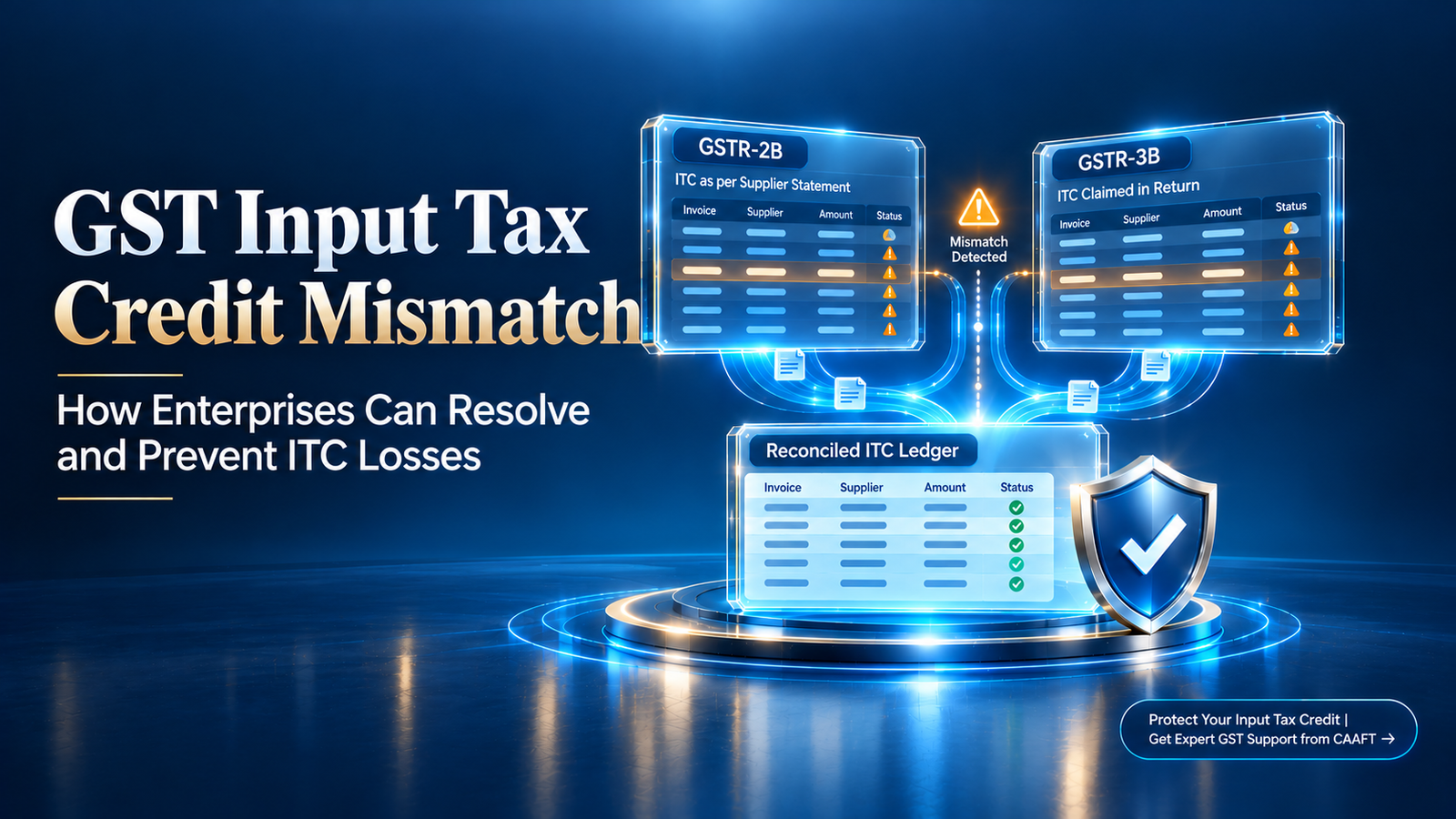
India now has roughly 1.65 crore registered GST taxpayers, up from 66.5 lakh when GST was introduced. That scale is the root of the input tax credit problem; every rupee of ITC an enterprise claims depends on a counterparty filing correctly and paying tax on time. An ITC mismatch arises when the credit claimed in GSTR-3B does not agree with the credit reflected in GSTR-2B. The consequences are not merely administrative. Under Rule 88D, the portal issues an automated intimation, unanswered intimations can block your next GSTR-1, and under Rule 37A, credit must be reversed outright where a supplier has failed to file. Each of these turns a reconciliation gap into a cash loss.
This guide explains why ITC mismatches occur, how to resolve them within the prescribed timelines, and the controls that prevent recurrence.
Key Takeaways
- ITC is available only where the invoice appears in GSTR-2B and the supplier has actually paid the tax – your own invoice copy is not sufficient evidence of entitlement.
- Rule 88D triggers an automated DRC-01C intimation when GSTR-3B ITC exceeds GSTR-2B ITC beyond the notified limits, with a seven-day response window.
- Rule 37A requires reversal by 30 November where the supplier has not filed GSTR-3B by 30 September following the financial year.
- Rule 37 requires reversal where the supplier is not paid within 180 days of the invoice date, with re-availment allowed on payment.
- Most mismatches are preventable through monthly reconciliation and disciplined use of the Invoice Management System, not through year-end correction.
What an ITC Mismatch Actually Is
A mismatch is any difference between the credit an enterprise has taken and the credit the GST system recognises as available. In practice, it appears in three forms:
Credit claimed but not reflected: The purchase exists and the invoice is held, but the supplier has not reported it, has reported it late, or has reported it with errors. GSTR-2B therefore shows nothing.
Credit reflected but not claimed: The supplier has reported correctly, but the recipient missed the entry – commonly where purchase records are incomplete or the invoice never reached accounts.
Credit claimed in the wrong period or wrong amount: Figures are transposed, GSTIN is incorrect, place of supply is wrong, or the tax head is misallocated between IGST and CGST/SGST.
Only the first category is genuinely the supplier’s doing. The other two are internal control failures, and they are the ones an enterprise can fix without depending on anyone else.
Why ITC Mismatches Occur in Businesses
- Supplier files GSTR-1 late, so the invoice lands in a later GSTR-2B
- Supplier reports an incorrect recipient GSTIN, sending credit to another taxpayer
- Supplier files GSTR-1 but not GSTR-3B, meaning tax was declared but not paid
- Credit notes issued by the supplier are not reflected in the recipient’s books
- Invoices received late from branches or field locations
- Data entry errors in purchase registers
- Claims made on blocked credits under Section 17(5)
- Reverse charge transactions recorded inconsistently
The common thread is timing and dependency. GST makes the recipient’s credit contingent on the supplier’s compliance, which is why monitoring supplier behaviour is now part of tax management rather than procurement alone.
The Statutory Position Enterprises Must Work Within
| Provision | What it requires | Timeline |
| Section 16(2)(aa) | Invoice must be furnished by the supplier and appear in GSTR-2B | Condition for claiming |
| Section 16(2)(c) | Supplier must have actually paid tax to the government | Condition for claiming |
| Section 16(4) | Time limit for claiming ITC on an invoice or debit note | 30 November following the financial year, or filing of annual return, whichever is earlier |
| Rule 37 | Reversal where supplier not paid within 180 days of invoice | Reverse with interest; re-avail on payment |
| Rule 37A | Reversal where supplier has not filed GSTR-3B by 30 September following the FY | Reverse by 30 November of that year |
| Rule 88D | Automated intimation where GSTR-3B ITC exceeds GSTR-2B beyond notified limits | Respond within 7 days |
Rule 88D is triggered where the excess crosses the notified limits, commonly cited as ₹25 lakh or 20% of the ITC available in GSTR-2B. These limits have been revised over time, so the figures notified for the relevant period should be confirmed before relying on them.
How to Resolve an Existing ITC Mismatch in Enterprises
Step 1: Reconcile GSTR-2B against the purchase register
Work at invoice level, not summary level. Match on GSTIN, invoice number, date, taxable value and tax amount. Summary comparison hides offsetting errors that cancel out in total but fail individually.
Step 2: Classify every difference
Separate items into timing differences that will resolve on their own, supplier defaults requiring follow-up, internal errors requiring correction, and ineligible credits that should never have been claimed. Each category has a different remedy.
Step 3: Act on supplier defaults promptly
Where an invoice is missing from GSTR-2B, contact the supplier before the period closes. Where a supplier has filed GSTR-1 but not GSTR-3B, the exposure is Rule 37A reversal — track these separately, because the consequence arrives months later.
Step 4: Respond to a DRC-01C intimation within seven days
A Part A intimation under Rule 88D requires either an explanation in Part B or payment of the excess with interest through DRC-03. Ignoring it is the costliest option: an unanswered intimation can block the filing of your next GSTR-1 under Rule 59(6), which halts outward compliance entirely. Where the position is contested, GST assessment and appeal support is warranted before the matter escalates to a demand.
Step 5: Reverse what is genuinely not available
Where credit is ineligible or the supplier has defaulted beyond the statutory cutoff, reverse it with interest rather than defending it. Rule 37A credit can be re-availed later if the supplier files, so reversal is not a permanent loss in those cases.
Preventing ITC Losses: Controls That Work
- Use the Invoice Management System actively: The IMS allows recipients to accept, reject or keep invoices pending before GSTR-2B is generated. Treating it as a monthly review rather than ignoring it means errors are caught before they enter the return. Inaction results in deemed acceptance, which is an administrative default rather than confirmation that the credit is eligible.
- Reconcile monthly, not annually: Monthly reconciliation keeps differences small and within correction windows. Annual reconciliation discovers problems after the Section 16(4) deadline has passed, at which point the credit is simply lost.
- Build supplier compliance into vendor management: Check filing behaviour before onboarding and monitor it afterwards. Where a supplier has a pattern of late or non-filing, that is a commercial risk, not just a tax one.
- Link payment release to compliance: Rule 37 requires reversal where the supplier is not paid within 180 days, so disciplined accounts payable management protects credit directly. Some enterprises also withhold the tax component until the invoice appears in GSTR-2B.
- Maintain accurate purchase records: Reconciliation is only as reliable as the register it runs against, which makes consistent bookkeeping and accounting a prerequisite rather than a separate activity.
- Watch the calendar: Section 16(4), Rule 37A and the seven-day DRC-01C window are all hard deadlines. Tracking them on a compliance calendar prevents avoidable losses.
Common Errors That Convert Mismatches Into Permanent Losses
- Claiming credit on the strength of the invoice alone, without checking GSTR-2B
- Reconciling at summary level, which conceals offsetting errors
- Waiting until the annual return to investigate differences
- Letting a DRC-01C intimation lapse unanswered
- Failing to track suppliers who file GSTR-1 but not GSTR-3B
- Claiming blocked credits under Section 17(5) in error
- Missing the 30 November cutoff for the financial year
- Treating IMS inaction as acceptance of eligibility
How CAAFT Helps Enterprises Protect Input Tax Credit
Protecting ITC is a monthly discipline rather than a year-end exercise. Accurate GST return filing matters less in isolation than whether the credit claimed reconciles with what the portal actually reflects for the same period. Where differences have already produced an intimation or notice, having the reconciliation and the response handled by the same team avoids reconstructing records under a seven-day deadline.
Losing input tax credit to reconciliation gaps and supplier defaults? – Get expert support for GST Reconciliation, ITC Protection and Advisory from CAAFT
Final Thoughts
ITC mismatch is a structural feature of GST, not an occasional accident. Credit depends on counterparties, and the statutory framework places the consequence of their failure on the recipient. Enterprises that reconcile monthly, use the IMS deliberately and monitor supplier filing lose very little credit. Those that reconcile annually discover their losses after the deadlines that would have allowed recovery.
The deadlines are the point. Seven days for a DRC-01C response, 30 November for Rule 37A reversal and for Section 16(4) claims, 180 days for supplier payment. None of them extend.
Frequently Asked Questions
An ITC mismatch is a difference between the input tax credit claimed in GSTR-3B and the credit reflected in GSTR-2B for the same period. It arises when a supplier has not reported an invoice, has reported it incorrectly, has reported it in a different period, or when the recipient has recorded the purchase inaccurately. Under Rule 88D, an excess claim beyond notified limits triggers an automated DRC-01C intimation from the government GST portal.
DRC-01C is an automated intimation issued under Rule 88D when ITC claimed in GSTR-3B exceeds the ITC available in GSTR-2B beyond the notified limits. The taxpayer has seven days to respond, either by explaining the difference in Part B of the form or by paying the excess with interest through Form DRC-03. If no response is filed, the taxpayer may be blocked from filing the next GSTR-1 under Rule 59(6). Replying to such intimations is covered under GST notice response procedures.
No. Under Section 16(2)(aa) of the CGST Act, input tax credit is available only where the supplier has furnished the invoice details and they appear in the recipient’s GSTR-2B. Holding a tax invoice is necessary but not sufficient. Section 16(2)(c) further requires that the supplier has actually paid the tax to the government.
Under Section 16(4), ITC on an invoice or debit note must be claimed by 30 November following the end of the financial year, or the date of filing the annual return for that year, whichever is earlier. Credit not claimed by that date is permanently lost and cannot be recovered through later returns or reconciliation.
Under Rule 37A, if the supplier has not filed GSTR-3B for the relevant period by 30 September following the financial year, the recipient must reverse the corresponding ITC in a GSTR-3B filed on or before 30 November of that year. Failure to reverse by that date makes the amount payable with interest under Section 50. The credit can be re-availed in a later return if the supplier subsequently files.
Rule 37 requires a recipient to reverse input tax credit where payment to the supplier is not made within 180 days of the invoice date. The reversal is made with interest, and the credit may be re-availed once payment is made. This makes supplier payment timelines a direct GST compliance matter, not only a cash flow decision.
No. The IMS allows recipients to accept, reject or keep invoices pending before GSTR-2B is generated, which improves accuracy, but it does not determine eligibility. Taking no action results in deemed acceptance, which is an administrative default only. Statutory conditions under Section 16 and the blocked credit restrictions under Section 17(5) continue to govern whether credit is actually available.
Monthly, at invoice level rather than summary level. Monthly reconciliation keeps differences small enough to correct within statutory windows, while annual reconciliation typically surfaces problems after the Section 16(4) deadline has passed. Regular GST filing and reconciliation discipline is what prevents mismatches from becoming permanent losses.
The most frequent are claiming credit not reflected in GSTR-2B, claiming blocked credits under Section 17(5), misallocating tax between IGST and CGST/SGST, and failing to reverse credit where a supplier has defaulted. These overlap substantially with the common bookkeeping errors that lead to GST compliance issues and tax notices more broadly.