

The Directorate General of Foreign Trade (DGFT), under the Ministry of Commerce and Industry, Government of India, issues a unique identification number known as the Import-Export Code (IEC). Any person or business that wants to participate in international trade by importing or exporting goods, and in specific regulated instances, services, must secure an IEC as a compulsory registration.
Multiple regulatory bodies, including customs authorities, authorized dealer banks, and trade policy institutions, govern India’s foreign trade system. The IEC acts as a central reference number across these frameworks, enabling:
- Identification of importers and exporters
- Monitoring of trade flows
- Regulatory and policy compliance
- Lawful movement of goods and foreign currency
This 10-digit alphanumeric code serves as your business passport in the international trade arena. Without this code, businesses cannot legally clear shipments through customs or receive payments from international buyers through banking channels.
Once issued, the holder uses the IEC as the primary reference number for all import and export transactions. For anyone planning to participate in cross-border trade from India, understanding the IEC – its meaning, applicability, application process, and compliance requirements – is essential.
When is the IEC Code Required?
You must obtain an IEC code before undertaking any commercial import or export activity governed by India’s foreign trade regulations. The requirement typically arises when regulatory oversight applies, most commonly at:
- The stage of customs clearance
- The time of receiving or remitting foreign exchange through authorized banks
You require an IEC when:
- Goods physically cross India’s borders for commercial purposes
- Indian banking channels route payments related to imports or exports.
This requirement applies even if you are involved in a transaction that is:
- Occasional
- Low in value
- The first international transaction you undertake as a business
Importantly, business size, turnover, or transaction frequency do not affect the requirement. Any commercial engagement you have with international markets under Indian law triggers the need for an IEC. Even if you are a small entrepreneur testing international markets, you must obtain this code before initiating trade activities.
Situations Where an Import-Export Code is Mandatory
The IEC code mandates most routine international trade scenarios, covering both traditional and modern business models. The digital transformation of global commerce has expanded the scope of IEC applicability.
Businesses must obtain an IEC when they:
- Import raw materials, components, machinery, or capital goods for commercial use
- Export finished goods, semi-finished products, or traded items to overseas buyers
- Operate through international e-commerce platforms involving cross-border shipments
In addition, an IEC is required when:
- Export proceeds are received in foreign currency
- Import payments are remitted abroad through authorized dealer banks
In each of these situations, authorities use the IEC to track transactions, enforce trade policy controls, and ensure compliance with customs and foreign exchange regulations.
Who is Required to Obtain an IEC Code?
Any individual or entity intending to act as an importer or exporter must obtain an IEC code. This requirement applies uniformly across industries and sectors.
Entities that require an IEC include:
- Manufacturers exporting goods produced in India
- Traders importing goods for resale
- Exporters supplying goods directly to foreign buyers
- Businesses integrated into global supply chains
The requirement applies equally to:
- Proprietorships
- Startups
- Partnerships and LLPs
- Large corporate entities
Businesses that operate solely within India, with no involvement in international trade, do not need to obtain an IEC. However, once they plan or initiate cross-border trade, they must register for an IEC. It’s advisable to obtain the IEC before entering into contracts with foreign buyers or suppliers.
Eligibility Criteria for IEC Code
The eligibility criteria for IEC registration are intentionally broad to promote ease of entry into international trade.
An applicant is eligible if they:
- Possess a valid Permanent Account Number (PAN) issued in India
- Maintain an active bank account
- Have a verifiable business or residential address supported by documents
There are no statutory requirements relating to:
- Minimum turnover
- Capital investment
- Prior import-export experience
Since the IEC authorities issue it on a PAN basis, only one IEC is allotted per PAN. This single code applies to all branches, offices, and units linked to that PAN. Therefore, businesses operating from multiple locations don’t need separate IECs for each branch.
Steps to Obtain an Import Export Code in India
The IEC application process is conducted entirely online through the DGFT portal, making it standardized and accessible nationwide.
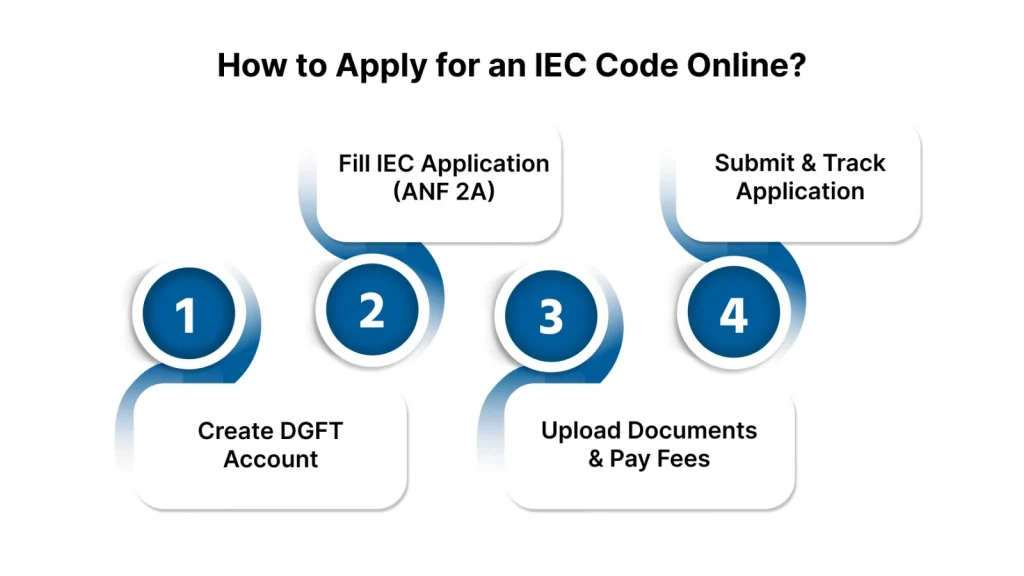
The process involves the following steps:
- Creating a DGFT user account using PAN, mobile number, and email ID
- Filling out the IEC application form with identity, address, and bank details
- Uploading the required supporting documents
- Paying the prescribed application fee online
Once submitted, the DGFT verifies the details electronically and issues the IEC code, which they make available for download. In most cases, the DGFT issues the IEC within one to two working days.
IEC Code Application Process Overview
| Stage | Description |
| Registration | Create a DGFT account using PAN |
| Application | Complete the IEC application form |
| Documentation | Upload required documents |
| Fee Payment | Pay the application fee online |
| Verification | DGFT verifies submitted details |
| Issuance | IEC issued electronically |
Documents Required to Apply for an IEC Code
Accurate and complete documentation is essential for successful IEC registration, as it forms the basis of DGFT’s verification process.
The commonly required documents include:
- PAN card of the individual or business entity
- Proof of address (electricity bill, telephone bill, rent agreement, sale deed, or GST registration certificate)
- Bank account proof, such as a cancelled cheque or bank-issued certificate
Companies and LLPs require additional documents, such as the certificate of incorporation and constitutional documents.
All documents must be valid, clearly legible, and consistent with the information provided in the application. Even minor discrepancies may result in delays or clarification requests.
How the IEC Code is Used in Import and Export Transactions
Once issued, the IEC becomes an integral part of import and export operations. It is quoted on key trade documents such as:
- Shipping bills
- Bills of entry
- Customs declarations
Customs authorities use the IEC to identify the responsible importer or exporter, assess duties, and enforce trade policy provisions. Banks rely on the IEC to process import payments and export proceeds in compliance with foreign exchange regulations. Beyond individual transactions, the IEC also enables authorities to aggregate trade data and monitor compliance patterns.
Validity of IEC Code and Update Requirements
The IEC is issued with lifetime validity and does not require renewal. However, IEC holders must comply with ongoing update obligations.
Any changes relating to:
- Business address
- Bank account details
- Ownership or constitution
must be updated on the DGFT portal within the prescribed timeframe. Additionally, DGFT mandates annual confirmation or updating of IEC details, even if no changes have occurred.
Failure to comply may result in the temporary deactivation of the IEC, during which import-export activities cannot be undertaken.
Difference Between IEC Code and Import-Export License
The IEC code and an import-export license serve different regulatory purposes.
IEC Code: Acts as a basic identification number enabling participation in international trade
Import-Export License: A specific authorization required only for certain restricted or regulated goods
While an IEC is mandatory for most trade activities, licenses apply only in product-specific or policy-controlled cases. Holding an IEC does not exempt an individual from obtaining a license where one is required.
Cases Where the IEC Code Is Not Required
IEC is not required in limited and clearly defined situations, such as:
- Imports made for personal use, not connected to trade, manufacture, or resale
- Certain transactions by government departments or public institutions are under specific exemptions
These exemptions are narrowly applied. For most commercial import-export activities, obtaining an IEC remains mandatory.
Conclusion
India’s international trade framework relies on the Import Export Code (IEC) as a cornerstone. To participate legally and efficiently in global trade, businesses must understand the full form of the IEC, know when they need it, prepare the correct documents, and comply with updated obligations.
The IEC serves as a unified identifier across customs, banking, and regulatory systems, promoting transparency, compliance, and structured growth in international commerce. Therefore, any individual or business planning to engage in cross-border trade from India must obtain and maintain an active IEC before initiating import or export operations.
Frequently Asked Questions
IEC stands for Import Export Code, a unique identification number issued by the Directorate General of Foreign Trade (DGFT). It is mandatory for businesses and individuals involved in importing or exporting goods and certain services from India.
Any business, startup, manufacturer, trader, or individual planning to import or export goods generally requires an IEC before starting international trade. Without a valid IEC, customs clearance and international trade transactions cannot be completed.
IEC registration generally requires a PAN card, Aadhaar or identity proof, business address proof, bank account details, and other supporting documents based on the business entity. Providing accurate documents helps ensure faster approval through the DGFT portal.
An IEC enables businesses to legally import and export goods, receive international payments, clear customs efficiently, and access various government export promotion schemes. It also enhances business credibility in global markets and supports international expansion.
IEC is generally not required for exporting services unless it is specifically needed to receive benefits under the Foreign Trade Policy or for other regulatory purposes. Businesses should evaluate their export activities and applicable DGFT requirements before applying.
An IEC has lifetime validity, but businesses are required to update their IEC details on the DGFT portal within the prescribed period whenever applicable. Keeping IEC information updated helps ensure uninterrupted import and export operations.
Professional IEC consultants assist with document verification, DGFT application filing, compliance guidance, and post-registration support. Expert assistance minimizes application errors, speeds up the approval process, and helps businesses begin international trade with confidence.