
Filing an income tax return starts with one deceptively simple question: which ITR form applies to me? Get it wrong, and your return can be marked defective under Section 139(9), delaying your refund and inviting a notice you didn’t need. Get it right, and ITR filing becomes a smooth, once-a-year formality.
This year brings an added layer of change. With the Income Tax Act, 2025 now in force, India has retired the old “Financial Year / Assessment Year” system in favour of a single, unified Tax Year. So, income earned between 1 April 2026 and 31 March 2027 – what would previously have been called FY 2026-27, assessed in AY 2027-28 – is now simply referred to as Tax Year 2026-27. Many taxpayers and even search engines still use the familiar “AY 2027-28” label out of habit, which is why you’ll see both terms used together in this guide. The latest ITR forms also introduce new disclosures for F&O trading, MSME interest, and partners’ remuneration, adding to the reporting details taxpayers need to consider.
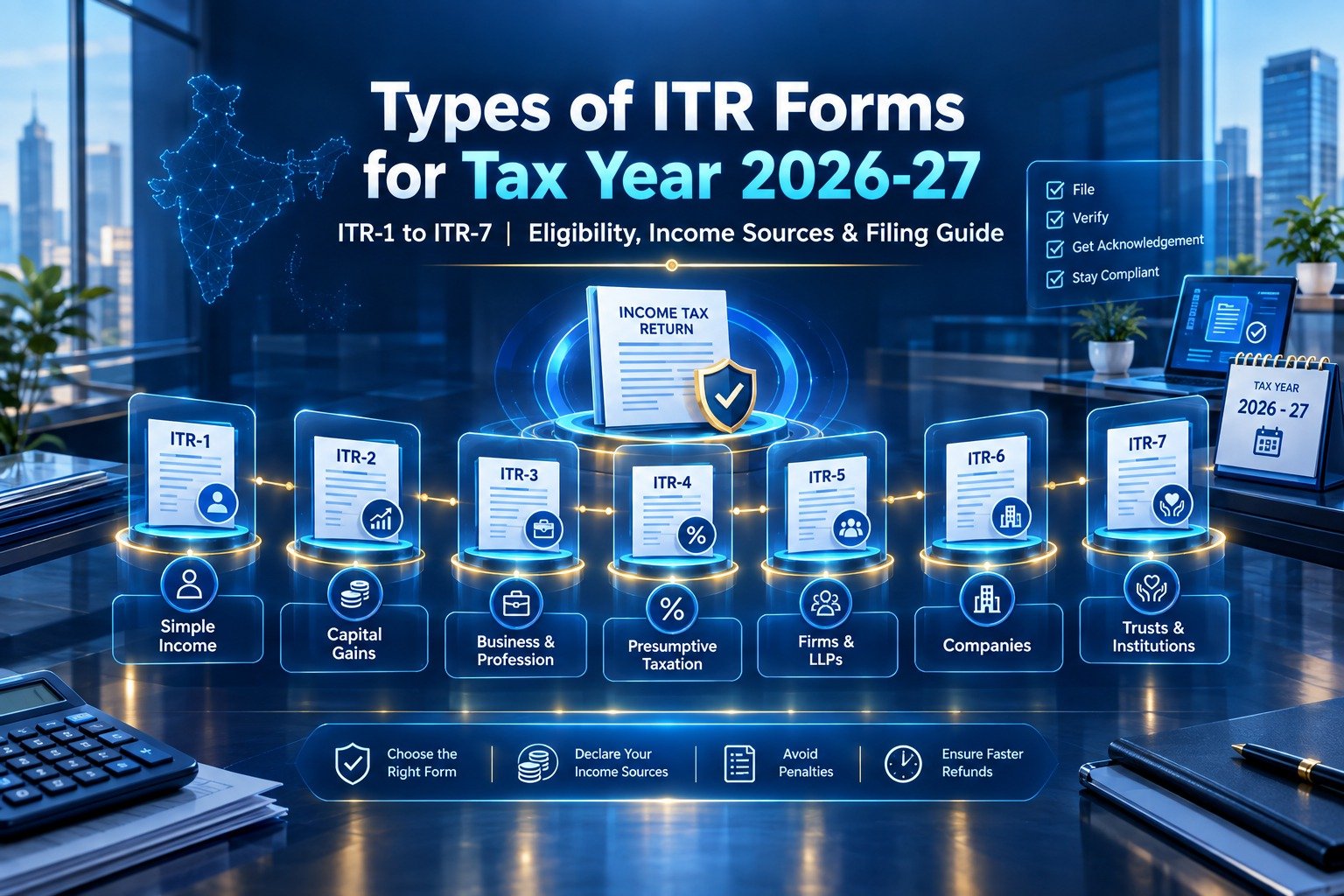
Whatever you call it, the fundamentals haven’t changed: there are still income tax return forms numbered ITR-1 through ITR-7, each designed for a specific category of taxpayer. This guide breaks down every ITR form, who should use it, and how to avoid the most common form-selection mistakes.
Key Takeaways
- ITR stands for Income Tax Return – the annual statement of income, deductions, and tax paid, filed with the Income Tax Department.
- Under the Income Tax Act, 2025, “Financial Year” and “Assessment Year” are being replaced by a single Tax Year – Tax Year 2026-27 is what was previously called AY 2027-28.
- There are 7 types of ITR forms (ITR-1 to ITR-7), each meant for a specific taxpayer category and income profile.
- ITR-1 and ITR-4 suit simple, small-income cases; ITR-2 and ITR-3 suit individuals/HUFs with more complex income; ITR-5 to ITR-7 are for firms, companies, and trusts – not individuals.
- The right form depends on who you are, your income sources, and how complex your finances are – not your profession or income level alone.
- Filing the wrong ITR form can get your return marked defective under Section 139(9), delaying refunds and inviting scrutiny.
- Exact ITR forms for Tax Year 2026-27 (AY 2027-28) will be notified by the CBDT closer to the filing season – the eligibility framework in this guide will still apply.
What is ITR?
ITR (Income Tax Return) is a form through which a taxpayer declares their total income earned, deductions claimed, and taxes paid or payable to the Income Tax Department for a given tax year. It is filed under the Income Tax Act and applies to individuals, HUFs, firms, LLPs, companies, and trusts whose income exceeds the prescribed exemption limit – or who meet certain other conditions requiring mandatory filing regardless of income level.
Filing an ITR isn’t just a compliance formality. It:
- Creates a legally recognised record of your income and financial standing
- Lets you claim a refund of any excess tax deducted at source (TDS)
- Allows carry-forward of losses (business, capital, or house property losses) to be set off against future income
- Acts as proof of income for loan applications, visa processing, and credit assessments
- Helps avoid penalties and interest under Sections 234A, 234B, and 234F for late or non-filing
Since 1961, India has used two separate terms – the year you earned income (Previous Year / Financial Year) and the year it was assessed (Assessment Year). Under the Income Tax Act, 2025, both are merged into a single Tax Year, so income earned and reported now sit within the same 12-month reference period.
Once you know what an ITR is, the next question is which ITR form – of the seven available – actually applies to your income profile.
What Are ITR Forms?
An Income Tax Return (ITR) form is the official document prescribed by the Income Tax Department through which a taxpayer reports income earned, deductions claimed, taxes paid, and any refund due for a tax year. It is filed under the Income Tax Act and forms the legal record of your financial year with the department. The department publishes the applicable forms and offline utilities each year on the official e-filing portal.
The form you’re required to use depends on three things:
- Who you are – an individual, HUF, firm, LLP, company, or trust
- What your income sources are – salary, house property, business/profession, capital gains, or other sources
- How complex your financial profile is – residential status, foreign assets, directorships, unlisted shares, and turnover thresholds all matter
Selecting the correct income tax return form isn’t optional paperwork – it directly affects whether your return is accepted, how quickly your refund is processed, and whether your losses can be carried forward.
The 5 Heads of Income That Decide Your ITR Form
Every rupee you earn falls under one of five heads, and your combination of these determines which ITR form you need:
- Income from Salary – wages, allowances, bonuses, and perquisites from an employer
- Income from House Property – rent or notional income from owned property
- Income from Business or Profession – self-employment, freelancing, consulting, or trading income
- Income from Capital Gains – profit from selling shares, mutual funds, property, or other capital assets
- Income from Other Sources – interest, dividends, lottery winnings, and anything not covered above
Types of ITR Forms: ITR-1 to ITR-7 Explained
Seven ITR forms currently apply to individual and non-individual taxpayers. Here’s what each one covers.
ITR-1
The simplest of all income tax return forms, built for resident individuals with a straightforward financial profile.
Who can file:
- Resident individuals (not RNOR or NRI) with total income up to ₹50 lakh
- Income from salary or pension, up to two house properties, and other sources (excluding lottery or race-horse income)
- Long-term capital gains under Section 112A up to ₹1.25 lakh
- Agricultural income up to ₹5,000
Who cannot file: NRIs, directors in a company, holders of unlisted equity shares, individuals with foreign assets, business income, capital losses, or capital gains beyond the ITR-1 threshold.
ITR-2
For individuals and HUFs with a richer financial profile than ITR-1 allows, but no business or professional income.
Who can file: Salary/pension income, more than two house properties, capital gains of any size, foreign assets or income, directorships, unlisted equity holdings, and agricultural income above ₹5,000. There’s no ₹50 lakh income cap on ITR-2.
Who cannot file: Anyone with income from business or profession, or a partner drawing income from a partnership firm.
ITR-3
For individuals and HUFs earning business or professional income who don’t opt for presumptive taxation.
Who can file: Business owners and professionals maintaining regular books of account (and getting them audited where applicable), partners in a firm, plus everything covered under ITR-2. Taxpayers whose accounts require statutory audit should also review tax audit applicability before filing.
Who cannot file: Companies, LLPs, trusts, AOPs, BOIs, and other non-individual entities.
ITR-4
Designed for small businesses and professionals opting for presumptive taxation.
Who can file: Resident individuals, HUFs, and firms (other than LLPs) with total income up to ₹50 lakh, computing business/professional income under Sections 44AD, 44ADA, or 44AE. Includes up to two house properties and LTCG under Section 112A up to ₹1.25 lakh.
Who cannot file: Anyone with capital gains beyond the ITR-1/4 threshold, more than two house properties, directorship, unlisted shares, foreign assets, or turnover exceeding the presumptive scheme limits (generally ₹2 crore, extendable to ₹3 crore where cash receipts stay within 5% of turnover).
ITR-5
For entities that aren’t individuals, HUFs, or companies.
Who can file: Firms, LLPs, AOPs, BOIs, investment funds, business trusts, and estates – essentially any entity not covered by ITR-1 to ITR-4, ITR-6, or ITR-7.
ITR-6
For companies not claiming exemption under Section 11 (charitable or religious purposes).
Who can file: All companies other than those eligible to claim Section 11 exemption.
ITR-7
For persons and entities required to file under Sections 139(4A) to 139(4D) – typically charitable and religious trusts, political parties, scientific research associations, educational institutions, hospitals, and news agencies claiming exemptions.
ITR Form Applicability at a Glance
| ITR Form | Best suited for |
| ITR-1 (Sahaj) | Salaried individuals, simple income, income up to ₹50 lakh |
| ITR-2 | Individuals/HUFs with capital gains, multiple properties, or foreign assets |
| ITR-3 | Business owners and professionals with regular books of account |
| ITR-4 (Sugam) | Small businesses/professionals under presumptive taxation |
| ITR-5 | Firms, LLPs, AOPs, BOIs, investment funds, trusts (non-ITR-7) |
| ITR-6 | Companies not claiming Section 11 exemption |
| ITR-7 | Trusts, political parties, institutions claiming exemption |
How to Choose the Right ITR Form
If you’re unsure which of the various ITR form types applies to you, work through this quick logic:
- Start with your status – individual, HUF, firm, company, or trust
- Check your income sources – salary-only points to ITR-1; add capital gains or foreign assets and you move to ITR-2; add business income and you’re in ITR-3 or ITR-4 territory
- Check the exclusions – a single mutual fund redemption, a directorship, or unlisted shares can knock you out of ITR-1 or ITR-4 even if everything else fits
- Check your turnover and income limits – thresholds decide whether presumptive taxation (ITR-4) or regular filing (ITR-3) applies
When in doubt, it’s worth having a professional review your income profile before you file – a wrong form costs more time to fix than it would have taken to get right the first time.
Why the Right ITR Form Matters for Tax Year 2026-27
The shift to the Income Tax Act, 2025 brings updated section references, restructured schedules, and revised reporting requirements woven into each ITR form. While the broad categories – ITR-1 through ITR-7 – remain unchanged, the fine print inside each form is evolving as CBDT notifies forms for each filing cycle. A few things to keep in mind as Tax Year 2026-27 (AY 2027-28) returns approach:
- Terminology will shift on the portal. Notices, forms, and acknowledgements will increasingly reference “Tax Year” instead of “Assessment Year.”
- Presumptive taxpayers face added disclosure. Recent form updates have required Section 44AD/44ADA/44AE filers to disclose investments made during the year.
- Capital gains, crypto (VDA), and foreign asset reporting continue to get more granular with each filing cycle – don’t assume last year’s schedule structure will carry over unchanged.
- Exact ITR forms for Tax Year 2026-27 will be notified by the CBDT closer to the filing season. Treat form numbers and eligibility criteria in this guide as the framework that applies, and confirm final specifics when forms are officially released.
Consequences of Filing the Wrong ITR Form
Choosing an incorrect income tax return form isn’t a minor slip:
- Your return can be treated as defective under Section 139(9), with 15 days given to refile correctly
- Processing and refunds get delayed
- Incorrect reporting increases the chance of scrutiny
- If a revised return isn’t filed within the window, your original filing may be treated as if it was never furnished
- Excess TDS deducted during the year can only be claimed back through accurate filing – errors here directly delay TDS-related refunds
Missed the Deadline or Made an Error? Here’s What Still Works
Even after the original due date, taxpayers aren’t left without options:
- A belated return can be filed up to the deadline prescribed for the relevant tax year, though most losses (barring house property loss) can no longer be carried forward
- A revised return can correct genuine errors before the assessment window closes
- An updated return (ITR-U) allows missed income or corrections to be reported up to 4 years from the end of the relevant tax year, subject to additional tax
- If the department flags your return as defective, professional income tax assessment and appeal support can help resolve notices without escalation
Why Professional ITR Filing Support Makes a Difference
Between changing thresholds, new disclosure requirements, and the terminology shift under the Income Tax Act, 2025, self-filing has become more error-prone – not less. This is exactly where structured, professional ITR filing pays off.
A structured Income Tax Return (ITR) Filing service can remove this guesswork entirely:
- Accurate income computation and correct ITR form selection for your exact profile
- Deduction planning across Sections 80C, 80D, 80G, HRA, and home loan interest – as part of broader tax planning and advisory
- Support for NRIs, freelancers, business owners, and high-value transaction cases
- End-to-end filing with prompt ITR-V acknowledgement and post-filing support for notices or rectifications
Whether you’re a salaried professional with a second income, a freelancer navigating presumptive taxation, or a business owner managing capital gains and audit requirements, choosing the right form is the first – and most important – step to a clean, compliant, on-time return.
Need help with ITR filing and choosing the right income tax return form? – Get professional support for ITR Filing and Income Tax Services from CAAFT.
Final Thoughts
The right ITR form depends on your taxpayer status, income sources, and financial activities. While ITR-1 and ITR-4 are designed for relatively straightforward income profiles, ITR-2 and ITR-3 cover individuals and HUFs with more complex income. ITR-5, ITR-6, and ITR-7 apply to specific non-individual entities.
For Tax Year 2026-27 (AY 2027-28), taxpayers should also keep an eye on the final ITR forms and instructions notified by the CBDT. Before filing your return, review your income sources, capital gains, foreign assets, business activities, and applicable deductions to make sure you select the correct form.
If you’re unsure which income tax return form applies to your situation, professional guidance can help you avoid form-selection errors and filing-related issues.
Frequently Asked Questions
ITR-1 suits salaried individuals with simple income up to ₹50 lakh. ITR-2 covers individuals with capital gains, multiple properties, or foreign assets but no business income. ITR-3 is for those with regular business or professional income. ITR-4 is for small businesses and professionals opting for presumptive taxation.
There are seven ITR forms – ITR-1 through ITR-7 – each scoped to a specific category of taxpayer, from individuals to companies and charitable trusts.
Yes. If you discover you’ve used the wrong form before the filing deadline, you can file a revised return in the correct form. After the deadline, the department may issue a defective return notice under Section 139(9), giving you a window to correct it.
NRIs typically use ITR-2 or ITR-3, depending on whether they have business or professional income in India.
Yes. The CBDT notifies updated ITR forms each filing cycle to reflect changes in tax law, reporting requirements, and – starting with the Income Tax Act, 2025 – the shift to Tax Year terminology.
Rather than guessing, it’s safer to consult a tax professional. An incorrect ITR form filing can lead to processing delays, defective return notices, or missed deductions – all avoidable with the right guidance.