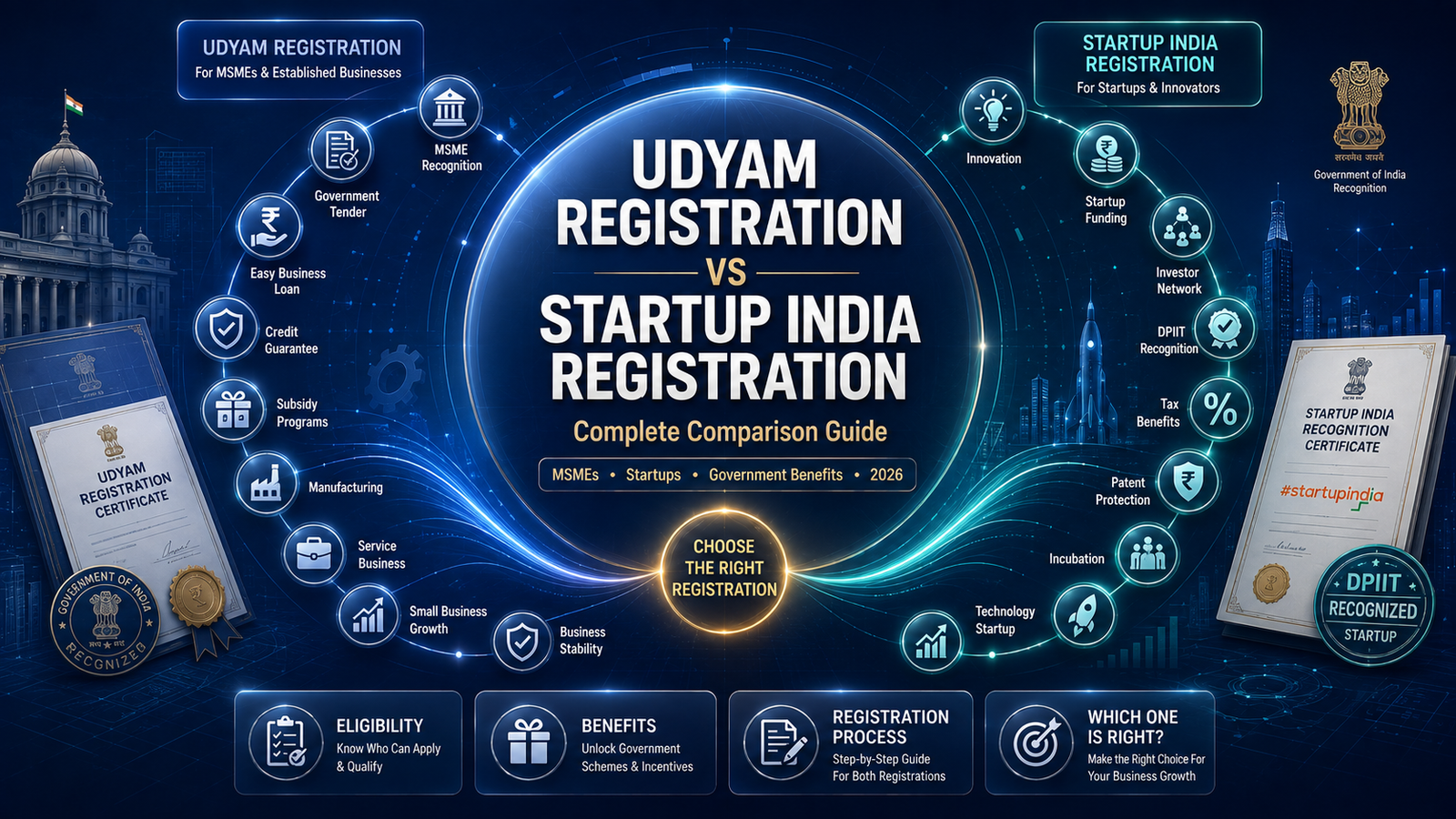
Choosing the right government registration is one of the first and most important decisions for entrepreneurs starting a business in India. Two of the most commonly discussed registrations are Udyam registration and Startup India Registration. While both initiatives are designed to support business growth, they serve different purposes, offer distinct benefits, and have separate eligibility criteria. Understanding these differences is essential for selecting the registration that aligns with your business goals.
Udyam registration is primarily intended for Micro, Small, and Medium Enterprises (MSMEs), enabling them to access government incentives, easier credit, and various MSME Benefits. In contrast, Startup India Registration is aimed at innovative startups seeking tax exemptions, funding opportunities, intellectual property support, and benefits under the Startup India Scheme. Since many businesses qualify for both registrations, understanding how they complement each other can help entrepreneurs maximize available government support.
Key Takeaways
- Udyam Registration and Startup India Registration serve different purposes, and choosing the right registration depends on your business model, eligibility, and long-term growth objectives.
- Udyam Registration helps eligible MSMEs access government schemes, easier financing, public procurement opportunities, and valuable MSME Benefits, while Startup India Registration supports innovative startups through the Startup India Scheme.
- Understanding the eligibility criteria, required documents, and registration process before applying helps reduce delays, avoid application rejections, and ensure faster government recognition.
- Businesses that qualify for both registrations can maximize government incentives, improve business credibility, and unlock greater opportunities for funding, tax benefits, and sustainable growth.
- Reviewing your business structure, turnover, and future expansion plans before registering helps you select the most suitable registration and make the most of available government support.
What Is Udyam Registration?
Udyam Registration online is the official registration system introduced by the Ministry of Micro, Small and Medium Enterprises (MSME) to recognize eligible businesses as Micro, Small, or Medium Enterprises. It is designed to simplify the registration process and enable MSMEs to access a wide range of government schemes, financial assistance, and business development opportunities.
Obtaining Udyam Registration allows eligible businesses to avail themselves of various MSME Benefits, including easier access to bank loans, priority sector lending, government tenders, subsidy programs, protection against delayed payments, and support under various central and state government initiatives. Whether you operate as a proprietorship, partnership, LLP, private limited company, or any other eligible business entity, Udyam Registration helps strengthen your business’s credibility and supports long-term growth.
What Is Startup India Registration?
Startup India Registration is a government recognition granted to eligible startups under the Startup India Scheme, an initiative launched by the Government of India and administered by the Department for Promotion of Industry and Internal Trade (DPIIT). The program aims to promote innovation, entrepreneurship, and job creation by supporting startups with scalable and technology-driven business models.
Businesses recognized through Startup India Registration can access several government incentives, including tax exemptions (subject to eligibility), startup funding opportunities, intellectual property support, self-certification under specified labour and environmental laws, mentorship programs, and networking opportunities. For innovative entrepreneurs looking to build high-growth businesses, Startup India Registration services provide valuable support that helps accelerate business expansion while improving investor confidence and market competitiveness.
Udyam Registration vs Startup India Registration: Key Differences
Although both Udyam Registration and Startup India Registration are Government of India initiatives that support business growth, they differ in terms of eligibility, objectives, incentives, and long-term advantages. Understanding these differences helps entrepreneurs choose the right registration based on their business model, stage of growth, and future expansion plans. The comparison below provides a clear overview of the key features and benefits of each registration.
| Parameter | Udyam Registration | Startup India Registration |
| Purpose | Recognition as a Micro, Small, or Medium Enterprise (MSME) | Recognition as an eligible innovative startup under DPIIT |
| Governing Authority | Ministry of Micro, Small and Medium Enterprises (MSME) | Department for Promotion of Industry and Internal Trade (DPIIT) |
| Eligible Businesses | Micro, Small & Medium Enterprises meeting MSME criteria | Startups with innovation, scalability, and growth potential |
| Primary Objective | Promote MSME development and ease of doing business | Encourage innovation, entrepreneurship, and startup ecosystem growth |
| Eligibility Basis | Investment and annual turnover limits | Innovation, incorporation period, turnover, and DPIIT recognition criteria |
| Key Benefits | Easier access to loans, government tenders, subsidies, and MSME Benefits | Tax exemptions, startup funding, intellectual property support, mentorship, and networking opportunities |
| Financial Support | Priority sector lending, collateral-free loans, credit guarantee schemes | Startup funding schemes, investor access, incubator and accelerator support |
| Government Procurement | Eligible for MSME procurement benefits and tender preferences | No specific procurement preference under the Startup India scheme |
| Tax Benefits | Access to selected MSME incentives and subsidy schemes | Eligible startups may claim tax exemptions subject to applicable conditions and approvals |
| Innovation Requirement | Not mandatory | Mandatory for DPIIT recognition |
| Business Age Limit | No specific age restriction | Must satisfy Startup India eligibility conditions |
| Ideal For | Traditional businesses, manufacturers, traders, service providers, and MSMEs | Technology startups, innovative businesses, and high-growth ventures |
| Can You Apply for Both? | Yes, if eligible | Yes, if eligible |
Businesses should evaluate their eligibility, long-term objectives, and operational requirements before applying. In many cases, entrepreneurs can benefit from both Udyam Registration and Startup India Registration, allowing them to leverage MSME Benefits and access incentives under the Startup India Scheme. This combined approach can strengthen business growth, improve funding opportunities, and enhance overall competitiveness.
Eligibility Criteria and Documents Required for Udyam and Startup India Registration
Before applying, businesses should determine whether they qualify for Udyam Registration, Startup India Registration, or both. While Udyam Registration is intended for eligible Micro, Small, and Medium Enterprises (MSMEs), Startup India Registration is designed for innovative startups recognized by DPIIT. Understanding the eligibility criteria and having the necessary documents ready can help ensure a smooth, hassle-free registration process.
Eligibility Comparison for Registration
| Criteria | Udyam Registration | Startup India Registration |
| Eligible Entities | Proprietorship, Partnership Firm, LLP, Company, Trust, Cooperative Society | Private Limited Company, LLP, or Registered Partnership Firm |
| Primary Requirement | Must qualify as an MSME based on investment and annual turnover | Must be recognized by DPIIT as an eligible startup |
| Business Focus | Manufacturing, trading, and service enterprises | Innovative products, services, or scalable business models |
| Objective | Access MSME Benefits, government schemes, and financial support | Avail benefits under the Startup India Scheme, including tax incentives and startup support |
Documents Required for Registration
Although the documentation may vary depending on the type of business and registration, applicants generally need the following:
- Aadhaar Card of the proprietor or authorized signatory
- PAN Card of the individual or business entity
- Certificate of Incorporation, LLP Agreement, or Partnership Deed (if applicable)
- Business address proof
- Bank account details
- GST Registration details (where applicable)
- Information about business activities
- Additional documents required for DPIIT recognition under the Startup India Scheme, if applicable
Choosing the appropriate registration depends on your business structure, turnover, and long-term growth plans. Preparing accurate information and complete documentation before applying not only speeds up the approval process but also reduces the chances of delays or rejection, allowing businesses to start benefiting from government support sooner.
Which Registration Is Right for Your Business?
Selecting the right government registration is an important step that can influence your business’s growth, funding opportunities, and long-term compliance. While both Udyam Registration and Startup India Registration are designed to support entrepreneurs, they cater to different business needs. Understanding the purpose and advantages of each registration will help you choose the option that aligns with your business objectives and future expansion plans.
Quick Comparison: Which Registration Should You Choose?
| If Your Business Needs… | Recommended Registration |
| Government recognition as an MSME | Udyam Registration |
| Access to MSME Benefits, subsidies, and easier bank loans | Udyam Registration |
| Participation in government tenders and procurement | Udyam Registration |
| Tax exemptions for eligible startups | Startup India Registration |
| Startup funding, incubation, and investor recognition | Startup India Registration |
| Intellectual Property (IPR) support and faster patent filing | Startup India Registration |
| Innovation-driven business growth | Startup India Registration |
| Access to both MSME and startup incentives | Apply for Both (if eligible) |
Choosing the right registration ultimately depends on your business model, stage of growth, and long-term goals. If your primary focus is securing financial assistance, government procurement opportunities, and other MSME Benefits, Udyam Registration is the ideal choice.
However, if your business is built for innovation and scalability, Startup India Registration can unlock valuable incentives under the Startup India Scheme, including tax benefits, funding support, and mentorship. Businesses that qualify for both registrations should consider applying for both to maximize government support, strengthen business credibility, and accelerate sustainable growth.
“Register your business with confidence-Get end-to-end support for Udyam Registration and Startup India Registration from CAAFT”
Final Thoughts
Both Udyam Registration and Startup India Registration play an important role in supporting entrepreneurs, but they are designed for different purposes. Udyam Registration services help MSMEs strengthen their operations through financial assistance, government procurement opportunities, and other MSME Benefits, while Startup India Registration empowers innovative businesses with tax incentives, funding support, and benefits available under the Startup India Scheme.
Before applying, carefully assess your business model, eligibility, and long-term growth objectives. In many cases, businesses can benefit from both registrations, enabling them to access a wider range of government initiatives while building a strong foundation for future growth.
Frequently Asked Questions
Udyam Registration provides official recognition to eligible MSMEs, enabling them to access government schemes, easier financing, and other MSME Benefits. Startup India Registration, on the other hand, is intended for innovative startups seeking tax exemptions, funding opportunities, intellectual property support, and benefits under the Startup India Scheme.
Yes. If a business satisfies the eligibility criteria for both programs, it can obtain both Udyam Registration and Startup India Registration. This allows eligible businesses to benefit from MSME incentives as well as startup-specific schemes, improving access to government support and growth opportunities.
Businesses classified as Micro, Small, or Medium Enterprises based on the prescribed investment and turnover criteria can apply for Udyam Registration. Proprietorships, partnership firms, LLPs, companies, trusts, and cooperative societies are generally eligible under the MSME framework.
Businesses incorporated as eligible entities with innovative products, services, or business models that meet the DPIIT criteria can apply for Startup India Registration. The startup should demonstrate innovation, scalability, or the potential to generate employment and economic value.
Registered MSMEs can access collateral-free loans, priority sector lending, government tenders, protection against delayed payments, subsidy schemes, and various financial assistance programs offered by central and state governments.
The Startup India Scheme offers eligible startups several advantages, including tax exemptions (subject to approval), easier compliance, startup funding opportunities, intellectual property support, self-certification under certain laws, and access to incubation and mentorship programs.
The right choice depends on your business goals. If your focus is on accessing MSME Benefits and government support for small businesses, Udyam Registration is suitable. If your business is innovation-driven and aims to scale rapidly, Startup India Registration may be the better option. Businesses meeting both eligibility criteria can consider applying for both registrations to maximize available benefits.