

India has become one of the fastest-growing startup ecosystems in the world, with thousands of new businesses launching every month across industries ranging from technology and e-commerce to manufacturing, consulting, retail and food services.
But launching a business is not just about having a great idea. Before any company can legally operate, open a bank account, hire employees, raise investment, or issue invoices, it must complete several mandatory registrations and obtain the licenses required under Indian law.
Missing even one important registration can create compliance issues, lead to penalties, delay operations, or create legal complications as the business grows.This is why understanding business registration in India is one of the most important steps for every entrepreneur.
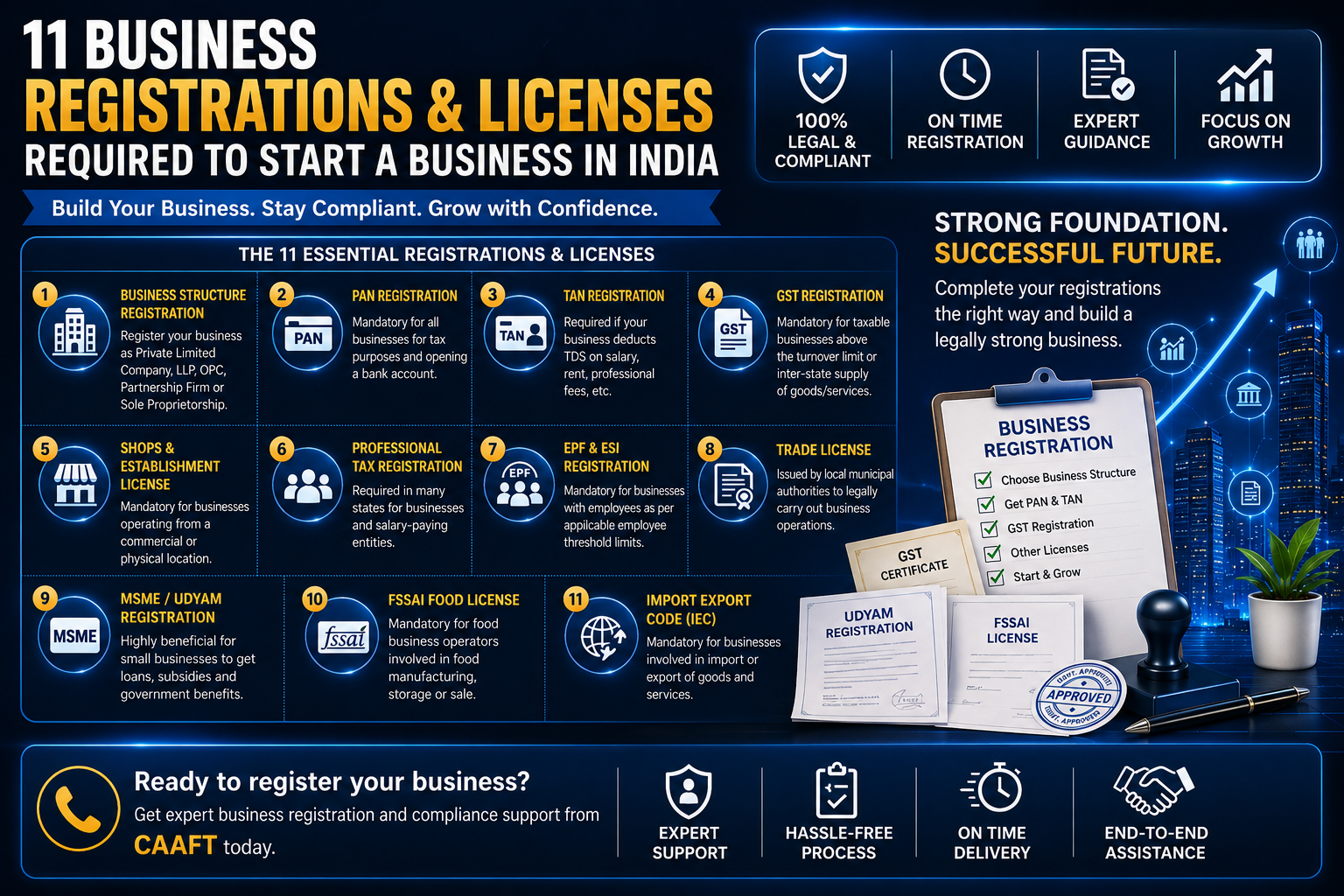
In this guide, we break down the 11 essential registrations and licenses required to start a business in India in 2026, explain who issues them, why they matter, and what founders should prioritize before starting operations.
Key Takeaways
- Business registration in India begins with selecting the correct legal structure such as a Private Limited Company, LLP, Partnership, or Proprietorship.
- Every business requires core registrations such as PAN, TAN, and tax-related compliance based on business activity.
- Additional licenses including GST, MSME, FSSAI, IEC, Trade License, and labor registrations, may apply depending on operations.
- Registration and licensing requirements vary depending on business size, industry, employee count, and state regulations.
- Completing registration is only the first step. Businesses must continue meeting annual compliance requirements after incorporation.
- Taking professional support early helps businesses avoid registration errors and long-term compliance issues.
What is Business Registration in India?
Business registration in India is the legal process of officially establishing a business entity under the applicable government authority so the business can operate legally.
Registration creates the legal identity of the business and allows it to:
- Open a business bank account
- Sign contracts legally
- Hire employees
- Pay taxes under the correct structure
- Raise funding or business loans
- Apply for additional government licenses and approvals
It is important to understand that registration and licensing are not the same.
Business registration creates the legal entity, while licenses provide permission for specific business activities such as food manufacturing, imports, exports, taxation, or employee-related compliance.
11 Essential Registrations and Licenses Required for Business Registration in India
1. Business Structure Registration
The first and most important step is registering your business under the correct legal structure.
In India, incorporation is regulated by the Ministry of Corporate Affairs for companies and LLPs.
Your chosen structure affects taxation, compliance burden, liability protection, and long-term business growth.
Common structures include:
Best suited for startups, growing businesses, and companies planning to raise investment.
Ideal for service-based businesses, agencies, consultants, and professional firms.
Suitable for solo entrepreneurs who want a separate legal business identity.
Useful for small businesses managed by multiple partners.
Simple structure suitable for freelancers and very small local businesses.
Choosing the right business structure early prevents legal restructuring problems later.
2. PAN Registration
A Permanent Account Number (PAN) is mandatory for every business operating in India.
Issued by the Income Tax Department, a PAN acts as the primary tax identity for the business.
PAN is required for:
- Opening a business bank account
- Filing income tax returns
- Conducting high-value financial transactions
- Registering for GST and other tax services
For companies and LLPs, PAN is generally issued during incorporation itself.
3. TAN Registration
A Tax Deduction and Collection Account Number (TAN) becomes necessary when a business deducts tax at source.
Businesses require a TAN when making payments involving:
- Employee salaries
- Contractor payments
- Rent payments
- Professional service payments
- Vendor payments requiring TDS deduction
Without TAN registration, businesses cannot legally manage TDS compliance requirements.
4. GST Registration
Goods and Services Tax Network GST registration is one of the most important registrations for businesses involved in the taxable supply of goods or services.
GST registration becomes mandatory when businesses cross prescribed turnover thresholds or operate in certain categories.
Businesses commonly require GST registration when:
- Annual turnover crosses legal threshold limits
- Selling products across multiple states
- Selling through e-commerce marketplaces
- Providing taxable professional services
- Running manufacturing businesses
GST compliance continues even after registration through regular return filing requirements.
5. Shops and Establishments License
Businesses operating from offices, shops, warehouses, commercial establishments, or physical workspaces usually require registration under the Shops and Establishments Act.
This registration is generally handled through state labor departments or municipal authorities.
It helps regulate:
- Employee working hours
- Business operating conditions
- Employee welfare provisions
- Weekly holidays and leave rules
This is often one of the earliest local registrations required after incorporation.
6. Professional Tax Registration
Professional Tax is imposed by certain state governments on businesses and salaried employees.
States such as:
- Tamil Nadu
- Karnataka
- Maharashtra
- West Bengal
commonly require businesses to register for professional tax compliance.
Once registered, businesses must regularly file professional tax returns according to state regulations. Private limited company registration
Failure to comply may attract penalties.
7. EPF and ESI Registration
Businesses hiring employees eventually become responsible for employee welfare compliance.
Two important registrations apply here.
EPF Registration
Employees’ Provident Fund Organisation EPF registration becomes mandatory once the employee count crosses the prescribed limits.
EPF ensures retirement benefit contributions for employees.
ESI Registration
Employees’ State Insurance Corporation ESI registration applies when businesses become eligible under employee insurance regulations.
ESI provides medical insurance and healthcare benefits to employees.
Businesses must regularly maintain payroll compliance after registration.
8. Trade License
A Trade License allows businesses to legally conduct commercial operations within a specific local jurisdiction.
Trade licenses are generally issued by municipal corporations or local government authorities.
It is commonly required for:
- Retail businesses
- Commercial establishments
- Manufacturing units
- Local service businesses
- Warehouses and operational facilities
Trade license rules vary depending on city and state regulations.
Obtaining this early prevents local compliance issues.
9. MSME or Udyam Registration
The Ministry of Micro, Small and Medium Enterprises MSME registration, also called Udyam Registration, is technically optional but highly beneficial for small businesses.
Benefits include:
- Collateral-free business loans
- Government subsidy schemes
- Priority in government tenders
- Lower interest loan opportunities
- Delayed payment protection under MSME law
Most growing small businesses benefit significantly from MSME registration.
10. FSSAI Food License
Businesses involved in food production or food-related activities require licensing approval from the Food Safety and Standards Authority of India.
This applies to businesses such as:
- Restaurants
- Food delivery businesses
- Food manufacturers
- Cloud kitchens
- Grocery sellers
- Food distributors
- Food storage facilities
Operating without proper food licensing can lead to penalties and operational shutdowns.
11. Import Export Code (IEC)
Businesses involved in international trade require an Import Export Code.
IEC registration is issued by the Directorate General of Foreign Trade.
IEC becomes mandatory for businesses involved in:
- Importing products internationally
- Exporting products globally
- Receiving foreign trade payments
- Customs clearance procedures
Without IEC approval, international business transactions cannot proceed legally.
Additional Registrations Some Businesses May Need
Depending on the business model and industry, additional registrations may also apply.
Common additional registrations include:
- Digital Signature Certificate (DSC) for online statutory filing
- Trademark Registration for brand protection
- 12A and 80G Registration for NGOs and charitable organizations
- Director Identification Number (DIN) for company directors
- Startup India Registration for eligible startups
Not every business requires these registrations immediately, but understanding future compliance needs is important.
Common Mistakes Entrepreneurs Make During Business Registration
Many founders rush through registration without understanding long-term compliance requirements.
Common mistakes include:
- Choosing the wrong legal structure
- Delaying GST registration unnecessarily
- Ignoring employee-related registrations
- Starting operations without local trade licenses
- Missing annual tax filing obligations
- Not understanding industry-specific licensing requirements
Small compliance mistakes early can create expensive legal problems later.
Professional guidance often helps businesses avoid unnecessary delays.
Compliance Requirements After Registration
Registering a business is only the beginning. Most businesses must continue meeting ongoing compliance obligations throughout the year.
Typical compliance requirements include:
- Annual ROC filing for companies
- GST return filing
- Income tax return filing
- Professional tax return filing
- Payroll compliance for employees
- Annual accounting and financial reporting
Missing compliance deadlines can result in penalties, interest charges, legal notices, and business disruptions.
Long-term growth depends not only on registration but also on staying compliant.
Ready to Register Your Business?
Starting a business in India involves much more than simply registering a company.
Entrepreneurs must understand which registrations and licenses apply to their business model, properly complete legal incorporation, obtain tax registrations, secure operational licenses, and maintain compliance throughout the life of the business.
The stronger your legal foundation in the beginning, the easier it becomes to scale without interruptions later.
Business registration should never be treated as a one-time task. It is the starting point of building a legally compliant and growth-ready business.
“Ready to register your business? Get expert business registration and compliance support from CAAFT today. “
Frequently Asked Questions
At the very least, every business needs a business structure registration (with MCA or local authority for proprietorships) and a PAN. GST registration becomes mandatory only after crossing the prescribed turnover threshold.
Yes, if your annual turnover is below the GST threshold (currently ₹40 lakh for goods and ₹20 lakh for services in most states, with lower limits for special category states). GST becomes mandatory once you cross this limit or engage in interstate/e-commerce trade.
Private Limited Company or LLP registration through the MCA portal typically takes 7–15 working days, depending on document readiness and government processing times.
No, it’s optional. However, it offers significant benefits like collateral-free loans, subsidies, and priority in government tenders, so most eligible small businesses choose to register.
An FSSAI Food License, issued by the Food Safety and Standards Authority of India, is mandatory for any business involved in manufacturing, storing, distributing, or selling food – including online food businesses.
No. Sole proprietorships aren’t registered with the MCA. Instead, they typically obtain a Shops and Establishments license, GST registration (if applicable), and other local licenses as needed.
Operating without mandatory registrations can lead to penalties, legal notices, blocked bank accounts, and in some cases, an inability to raise funding or bid for contracts, since most B2B and government processes require proof of compliance.