
Professional tax is a state-level tax imposed on individuals earning an income through employment, profession, or business, subject to the applicable state laws. For employers and businesses, compliance can involve Professional tax registration, timely tax payment, deduction and deposit of tax from employees, and tax return filing. In Greater Chennai Corporation limits, eligible individuals and businesses are assessed for Professional Tax on a half-yearly basis, with the current schedule reaching ₹1,250 per half-year for average half-yearly income above ₹75,001.
A Professional Tax Notice may be issued when a business fails to register, delays tax payments, submits incorrect returns, or does not comply with applicable state requirements. Ignoring such a notice can result in interest, penalties, additional tax liabilities, or further action by the concerned authority.
This guide explains the common reasons businesses receive professional tax notices, applicable penalties, how to respond, and the compliance steps businesses should follow to avoid future notices.
Key Takeaways
- A Professional Tax Notice may arise from non-registration, delayed Professional Tax Payment, incorrect deductions, late Professional Tax Return Filing, or mismatches in tax records.
- Professional tax compliance is state-specific, so applicable rates, deadlines, penalties, interest, and response procedures can differ across Indian states.
- Businesses should carefully review the notice, verify payroll and tax records, calculate any outstanding liability, and submit a complete response within the prescribed deadline.
- Maintaining valid Professional Tax Registration, making timely Tax Payment, and completing Tax Return Filing accurately can reduce the risk of penalties, interest, and future notices.
- Reconciling payroll deductions, challans, returns, and registration details regularly helps businesses identify discrepancies early and maintain consistent professional tax compliance.
What Is a Professional Tax Notice and Why Do Businesses Receive It?
A Professional Tax Notice is an official communication issued by the relevant state tax authority when a business or taxpayer is required to address a professional tax-related issue. The notice may relate to registration, unpaid tax, delayed returns, incorrect information, or other compliance requirements.
For employers, professional tax compliance generally involves determining whether the business is required to register, deduct the applicable tax from employees where required, make timely tax payments, and complete Professional Tax Return Filing within the prescribed timelines.
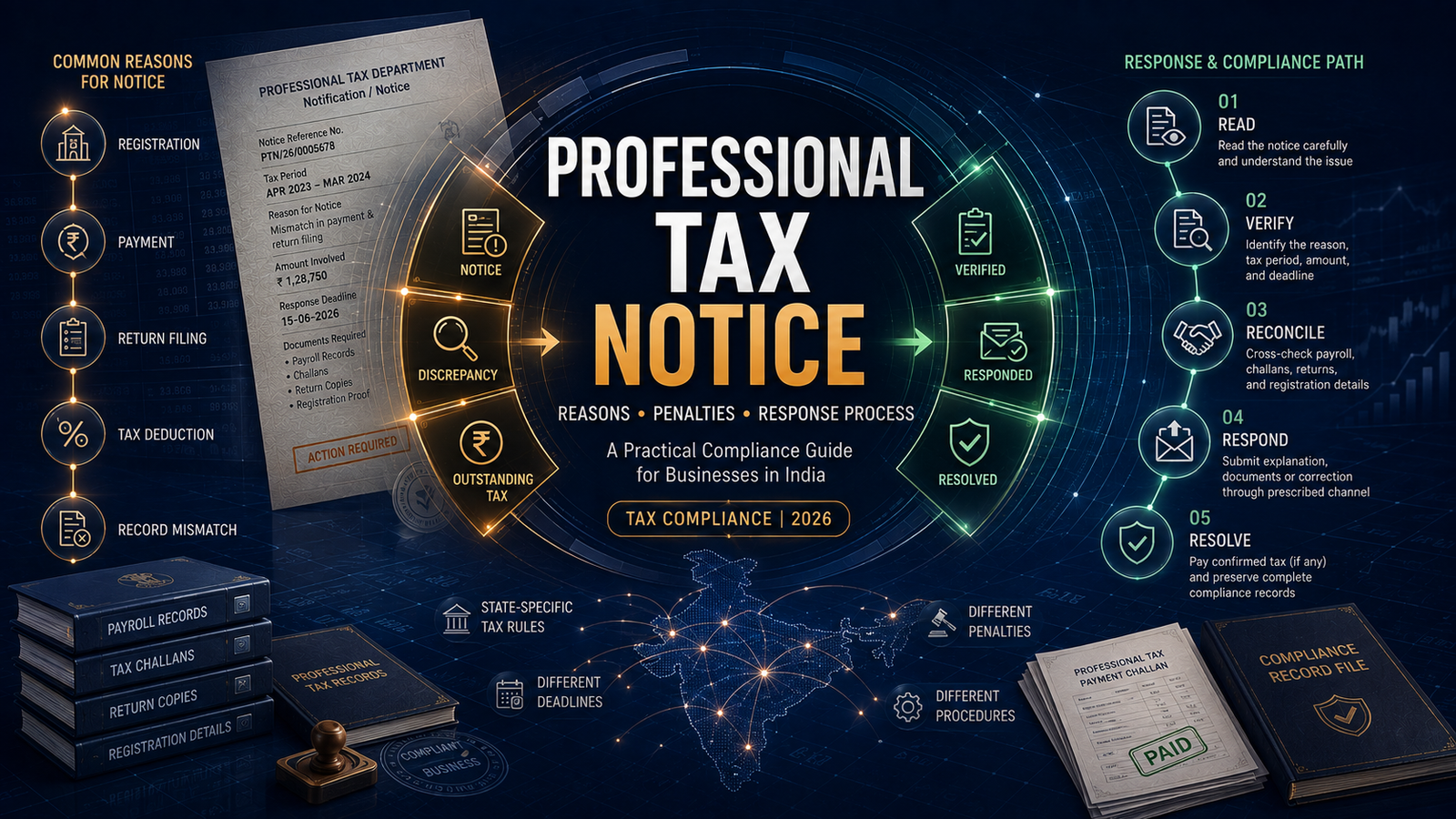
Common Reasons for Receiving a Professional Tax Notice
Businesses may receive a notice because of:
- Failure to obtain Professional Tax Registration where applicable.
- Delayed or non-payment of professional tax.
- Incorrect calculation or deduction of professional tax.
- Delayed Professional Tax Return Filing.
- Mismatch between tax payments and returns.
- Incorrect employee or business information.
- Outstanding professional tax liabilities.
- Failure to respond to an earlier communication from the tax authority.
Professional Tax Notice Reasons, Penalties, and Consequences of Non-Compliance
The consequences of professional tax non-compliance depend on the applicable state law and the nature of the default. Businesses may face penalties, interest, additional tax liabilities, or further proceedings for failing to complete Professional Tax Registration, make timely Professional Tax Payment, or complete Tax Return Filing.
| Reason for Professional Tax Notice | Potential Consequence | Recommended Compliance Action |
| Failure to obtain Professional Tax Registration | Registration-related penalty or outstanding liability | Check registration requirements and complete registration where applicable |
| Delayed Professional Tax Payment | Interest and applicable penalty | Calculate the outstanding amount and make payment within the prescribed timeline |
| Late Professional Tax Return Filing | Late filing penalty or compliance notice | File pending returns and maintain filing acknowledgements |
| Incorrect tax calculation or deduction | Additional tax, interest, or penalty | Reconcile payroll records and correct the tax calculation |
| Mismatch between returns and payments | Clarification request or additional liability | Reconcile challans, payroll records, and filed returns |
| Incorrect business or employee information | Notice seeking clarification or correction | Review registration and return details and submit corrections |
| Failure to respond to a notice | Further proceedings or enforcement action | Respond within the deadline with relevant explanations and documents |
Note: Professional tax is governed by state-specific laws, so applicable penalties, interest rates, filing deadlines, and compliance procedures can differ across states. Businesses should verify the rules applicable to their state before making payments or responding to a notice.
Why Timely Compliance Matters
Timely Professional Tax Payment and Tax Return Filing help businesses avoid unnecessary penalties and interest while maintaining accurate tax records. Regular reconciliation of payroll deductions, challans, and filed returns can also help identify discrepancies early and reduce the risk of receiving a Professional Tax Notice.
How to Respond to a Professional Tax Notice: Step-by-Step Process
Receiving a Professional Tax Notice does not necessarily mean that a business has committed a serious violation. The first step is to understand exactly what the authority has asked the taxpayer to clarify, pay, correct, or submit.
Step 1: Read the Notice Carefully
Check the notice number, tax period, reason for issuance, outstanding amount, response deadline, and documents requested.
Step 2: Identify the Compliance Issue
Determine whether the notice relates to registration, unpaid tax, late returns, incorrect information, or a mismatch between returns and payments.
Step 3: Verify Your Records
Compare the notice with your registration certificate, payroll records, payment challans, and Professional Tax Return Filing records.
Step 4: Calculate Any Outstanding Liability
If tax, interest, or penalty is genuinely payable, determine the correct amount based on the applicable state provisions.
Step 5: Submit a Response
Provide a clear response through the prescribed online portal or other method mentioned in the notice. Attach supporting documents wherever required.
Step 6: Make the Required Professional Tax Payment
If an outstanding liability is confirmed, complete the required Professional Tax Payment within the applicable timeline and retain the payment proof.
Step 7: Maintain the Complete Record
Keep a copy of the notice, response, supporting documents, payment receipt, and any communication from the authority for future reference.
Professional Tax Compliance Checklist for Businesses
Businesses can significantly reduce the risk of receiving a Tax Notice by following a consistent compliance process throughout the year.
| Compliance Area | Action Businesses Should Take |
| Professional Tax Registration | Check whether registration is mandatory in the applicable state |
| Employee deductions | Calculate and deduct professional tax correctly where applicable |
| Professional Tax Payment | Deposit the applicable tax within the prescribed deadline |
| Professional Tax Return Filing | File returns accurately and on time |
| Payroll reconciliation | Match employee deductions with payment and return records |
| Record keeping | Maintain challans, returns, registration details, and payroll records |
| Notice management | Respond promptly to communications from the tax authority |
| Periodic review | Check changes in state-specific rates, thresholds, and compliance rules |
A proactive compliance system makes it easier to identify errors before they result in notices. Businesses should also review their Professional Tax Registration details whenever there are significant changes to their business or employee structure.
Common Mistakes to Avoid After Receiving a Professional Tax Notice
Ignoring a notice or responding without verifying the underlying records can make the situation more complicated. Businesses should avoid:
- Missing the response deadline.
- Paying an incorrect amount without checking the notice.
- Submitting incomplete supporting documents.
- Failing to reconcile payroll and tax payment records.
- Ignoring discrepancies between returns and challans.
- Continuing non-compliance after receiving the notice.
- Assuming that professional tax rules are identical across all Indian states.
If the notice involves substantial outstanding liabilities or a disputed tax position, professional tax assistance can help businesses understand the applicable provisions and prepare an appropriate response.
Final Thoughts
A Tax Notice should not be ignored, even when the underlying issue appears to be a minor payment or filing discrepancy. Promptly reviewing the notice, reconciling payroll and tax records, completing any outstanding Professional Tax Payment, and submitting an accurate response can help businesses resolve compliance issues efficiently.
Going forward, maintaining valid Tax Registration, tracking state-specific deadlines, and completing Tax Return Filing on time can significantly reduce the risk of penalties and future notices. Since professional tax rules differ across states, businesses should register and verify the latest requirements applicable to their operations.
Frequently Asked Questions
A Professional Tax Notice is an official communication from the relevant state tax authority regarding a professional tax compliance issue. It may relate to registration, unpaid tax, late return filing, incorrect deductions, payment mismatches, or other statutory requirements. The notice should be reviewed carefully and answered within the specified deadline.
Businesses may receive a notice for reasons such as failure to complete Professional Tax Registration, delayed Professional Tax Payment, incorrect tax deductions, late Professional Tax Return Filing, or discrepancies between returns and payment records. The exact reason will generally be stated in the notice issued by the relevant authority.
First, verify the notice details, tax period, reason for issuance, and response deadline. Next, reconcile your registration, payroll, return, and payment records, determine whether any liability exists, and submit the required response with supporting documents. Any confirmed outstanding Professional Tax Payment should be completed within the applicable timeline.
Delayed professional tax payments can result in interest and penalties depending on the applicable state law and the nature of the default. Continued non-compliance may lead to additional notices or enforcement action. Businesses should therefore monitor payment deadlines and maintain evidence of every Professional Tax Payment.
No. Professional tax is a state-level levy, and the applicability of Professional Tax Registration depends on the relevant state’s legislation, the nature of the business, and the persons liable to pay or deduct the tax. Businesses should check the rules applicable in each state where they operate.
Businesses should maintain valid Professional Tax Registration, calculate deductions correctly, make timely Professional Tax Payment, and complete Professional Tax Return Filing within the prescribed deadlines. Regular reconciliation of payroll, payment challans, and returns can also help identify discrepancies before they trigger a notice.
Yes, depending on the nature of the notice and the applicable state procedure, a taxpayer may be able to submit a clarification, supporting documents, a correction request, or other prescribed response. Businesses should first understand the reason for the Professional Tax Notice and follow the response or appeal mechanism specified by the relevant authority.