

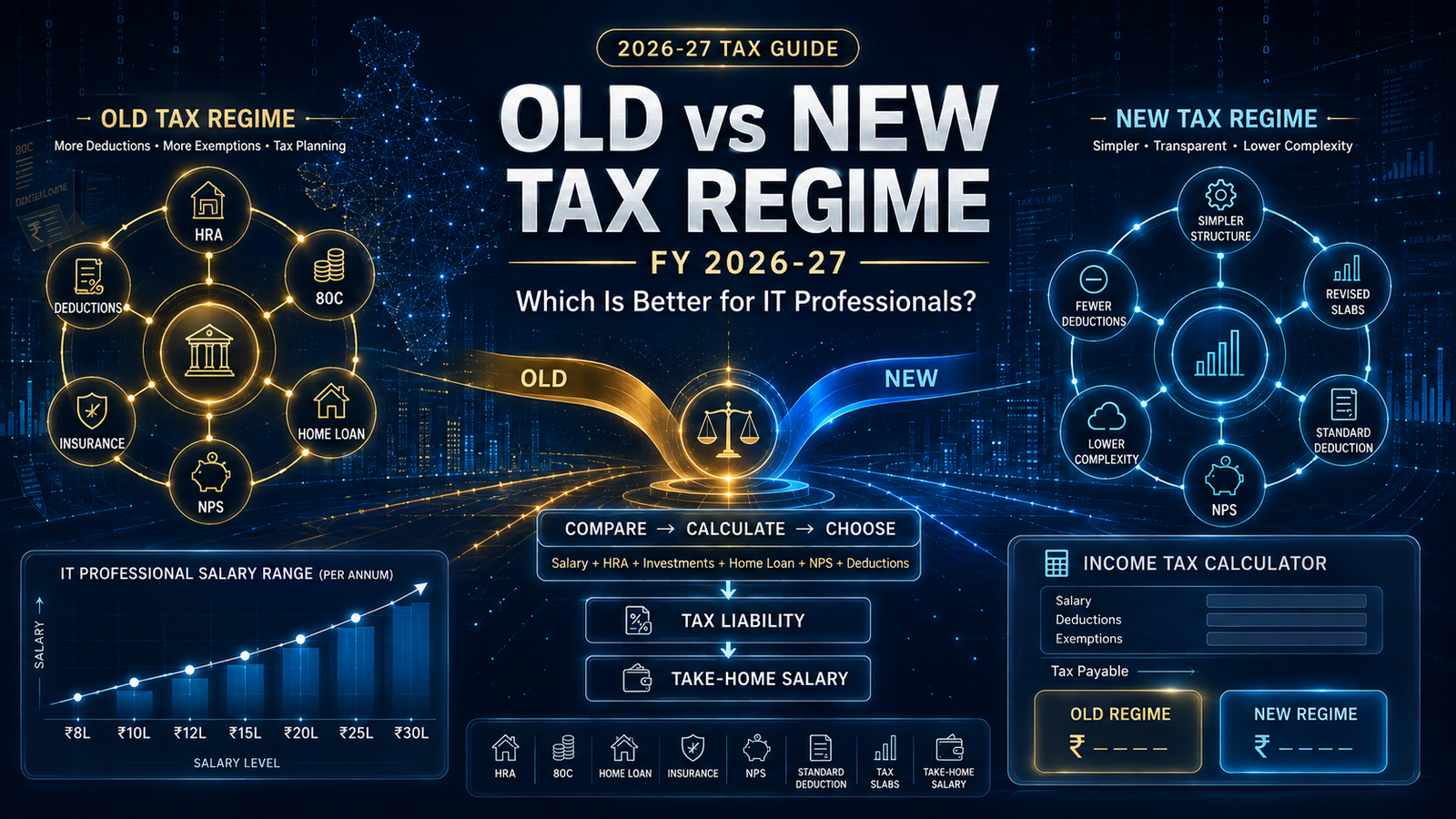
For Indian IT professionals, the selection of Old versus New Tax Regime may greatly affect the total tax burden for the year as well as the take-home salary. Which one is the better choice depends on various aspects such as salary, HRA, interest on home loans, etc. Employer NPS contributions can also help eligible IT professionals save up to ₹65,500 in tax annually, making NPS an important factor when comparing tax-saving options.
Comparison of the Old Tax Regime and New Tax Regime has become very significant due to the availability of different slab rates and simple deductions in the new tax regime, while the old tax regime provides various deductions and exemptions for eligible individuals. Thus, in order to decide which regime is better, IT experts need to consider their income as well as eligible tax benefits rather than going with just the salary figure.
Income Tax Calculator can be used to calculate the tax liability under both regimes.
Key Takeaways
- The Old vs New Tax Regime decision depends on salary, deductions, exemptions, investments, and individual financial circumstances.
- IT professionals claiming substantial HRA, home-loan interest, insurance, and eligible deductions may find the old regime more beneficial.
- The New Tax Regime may be preferable for professionals with fewer deductions because of its simplified structure and revised tax slabs.
- An Income Tax Calculator can help compare tax liability under both regimes before filing an Income Tax Return.
- Reviewing the two options every financial year can help IT professionals choose a tax regime that better supports their income and financial goals.
Old vs New Tax Regime: What Has Changed for FY 2026-27?
IT professionals can either go with the Old or New Tax Regime for FY 2026-27 depending upon the income, deductions, exemptions, and financials. In the old system, the deductions and exemptions are more, whereas the New Tax Regime emphasizes simpler taxes with changes to tax slabs. Comparison of both based on the actual salary and benefits will help in determining which is better.
What Is the Old Tax Regime?
In the Old Tax Regime, there are various types of deductions and exemptions available for taxpayers that include deductions pertaining to HRA, Section 80C investment, health insurance, home loan interest, and NPS. This regime is favorable for IT professionals who make use of tax-saving investments and salary-based exemptions.
What Is the New Tax Regime?
This is because The New Tax Regime comes with a tax system that is simple with changes in slab rates and few deductions and exemptions. This new tax regime would be appropriate for IT professionals with minimal investments aimed at tax saving.
Old Tax Regime vs New Tax Regime: Key Differences for IT Employees
The Comparison between Old Tax Regime and New Tax Regime largely depends on the structure of the employee’s income, allowable deductions, exemptions, and investments made. Given below is a comparison table that shows the factors to be considered while selecting a tax regime for FY 2026-27 by IT employees.
| Factor | Old Tax Regime | New Tax Regime |
| Tax structure | Higher rates with more deductions | Simplified rates with fewer deductions |
| Standard deduction | Available | Available |
| HRA exemption | Available subject to conditions | Generally not available |
| Section 80C benefits | Available | Generally not available |
| Home-loan interest benefits | Available subject to conditions | Restricted compared with Old Regime |
| Investment-linked deductions | Wider availability | Limited |
| Best suited for | Employees with substantial deductions | Employees with fewer deductions |
| Calculation approach | Requires consideration of exemptions and deductions | Simpler tax calculation |
Important: Tax rates, thresholds, deductions, and exemptions applicable for FY 2026-27 should be verified against the latest provisions before making a final tax decision.
Which Tax Regime Is Better for IT Professionals in FY 2026-27?
Making a choice between Old Tax Regime or New Tax Regime is determined by your salary structure, deductible expenses, exemptions, and investments. The appropriate choice will be made when you get an appropriate tax burden in the end.
Old Tax Regime May Be More Suitable If You:
- Claim significant HRA exemption.
- Make substantial Section 80C investments.
- Pay eligible health insurance premiums.
- Have an eligible home-loan interest deduction.
- Use multiple deductions and exemptions to reduce taxable income.
New Tax Regime May Be More Suitable If You:
- Have relatively few deductions or exemptions.
- Prefer simpler tax calculations.
- Do not claim significant HRA or investment-linked deductions.
- Have limited eligible tax-saving expenses.
- Want to benefit from the revised slab structure without relying on multiple deductions.
By using the Income Tax Calculator with your personal income figures, deductions, exemptions, and investments, you will be able to make comparisons between the two tax systems without having to look at the numbers alone.
Old vs New Tax Regime: Tax Payable at Different Salary Levels
The tax difference between the two regimes can vary significantly based on income and eligible deductions. The table below provides a quick illustration to help IT professionals compare their potential tax liability.
| Taxable Income | New Tax Regime | Old Tax Regime | Potential Difference |
| ₹8 lakh | Nil | ₹75,400 | ₹75,400 |
| ₹10 lakh | Nil | ₹1,17,000 | ₹1,17,000 |
| ₹12 lakh | Nil | ₹1,79,400 | ₹1,79,400 |
| ₹13 lakh | ₹78,000 | ₹2,10,600 | ₹1,32,600 |
| ₹15 lakh | ₹1,09,200 | ₹2,73,000 | ₹1,63,800 |
| ₹20 lakh | ₹2,08,000 | ₹4,29,000 | ₹2,21,000 |
| ₹25 lakh | ₹3,43,200 | ₹5,85,000 | ₹2,41,800 |
| ₹30 lakh | ₹4,99,200 | ₹7,41,000 | ₹2,41,800 |
Note: These figures are illustrative and should be verified using an updated Income Tax Calculator based on the taxpayer’s actual income, deductions, exemptions, and applicable FY 2026-27 provisions.
How to Compare Old and New Tax Regime Using an Income Tax Calculator
An Income Tax Calculator makes it easier for IT professionals to compare their estimated tax liability under both regimes. By entering actual income, exemptions, and eligible deductions, you can identify which option may result in lower tax.
For a meaningful comparison, enter:
- Annual salary income.
- Bonus and other taxable income.
- Standard deduction, where applicable.
- HRA and other eligible exemptions under the Old Regime.
- Section 80C investments.
- Eligible health insurance deductions.
- Home-loan interest, where applicable.
- Other eligible deductions.
- Income from other sources, if any.
Simple Tax Calculation Formula
Taxable Income = Gross Total Income − Eligible Deductions & Exemptions
Estimated Tax Payable = Tax on Taxable Income − Applicable Rebate + Surcharge + 4% Health & Education Cess
This calculator takes into account slab rates in relation to the old tax regime and new tax regime and computes your estimated tax liabilities for both regimes. The comparison of the final tax liabilities makes you a better decision-maker rather than going by the face value of tax rates alone.
Common Mistakes IT Professionals Should Avoid When Choosing a Tax Regime
Choosing a tax regime without reviewing your complete financial position can result in missed tax-saving opportunities or unnecessary tax payments.
| Common Mistake | Why It Can Be a Problem |
| Selecting a regime without comparing both options | May result in choosing a regime with a higher overall tax liability. |
| Ignoring eligible deductions under the Old Regime | Can lead to missed tax-saving opportunities. |
| Assuming the New Regime is always cheaper | The most beneficial option depends on individual income and eligible deductions. |
| Failing to account for HRA and home-loan benefits | May overlook significant tax benefits available under applicable provisions. |
| Not considering bonus and variable compensation | Can result in an inaccurate estimate of total taxable income. |
| Using outdated tax slabs or rules | May produce an incorrect tax calculation for FY 2026-27. |
| Relying on assumptions instead of calculating actual tax liability | Can lead to an unsuitable Old Tax Regime vs New Tax Regime decision. |
Using an updated Income Tax Calculator to compare both options annually can help IT professionals make a more informed tax decision as their salary, investments, deductions, and financial circumstances change.
“Choose your tax regime with confidence – Compare Old vs New Tax Regime and plan your taxes with CAAFT’s expert support”
Final Thoughts
The choice of the Old vs New Tax Regime is a vital financial choice for IT professionals in FY 2026-27. The old tax regime is favorable for those who have many deductions and exemptions in their income. But the new regime could be better for people who have few tax-saving options.
To make the right choice between the two regimes, do not base it only on your salary or any other assumptions; calculate your whole financial situation by using the Income Tax Calculator and look at all the deductions and exemptions.
Frequently Asked Questions
There is no single regime that is better for every IT professional. The Old vs New Tax Regime decision depends on salary, exemptions, deductions, investments, and other eligible benefits. Employees with substantial deductions may prefer the Old Regime, while those with fewer deductions may find the New Regime more suitable.
The Old Tax Regime vs New Tax Regime comparison mainly differs in tax rates and the availability of deductions and exemptions. The Old Regime generally allows more deductions, while the New Regime follows a simplified structure with fewer tax benefits. The appropriate choice depends on the taxpayer’s individual financial circumstances.
HRA exemption is generally associated with the Old Tax Regime and is subject to applicable conditions. IT professionals who receive HRA should compare the tax impact of claiming the eligible exemption under the Old Regime against the liability under the New Tax Regime before selecting an option.
Yes. An Income Tax Calculator can help compare estimated tax liability under the Old and New Regimes using salary, deductions, exemptions, investments, and other applicable information. Using an updated calculator with the applicable FY 2026-27 provisions can make the comparison more accurate.
Employees with substantial eligible deductions may find the Old Regime more beneficial because it generally provides access to a wider range of deductions and exemptions. However, the actual benefit depends on the individual’s income and total eligible deductions, so a direct calculation is recommended.
It can be. IT professionals who do not claim significant deductions or exemptions may benefit from the simpler structure of the New Tax Regime. Comparing the final tax liability under both regimes using actual salary and financial details provides a more reliable answer.
Start by calculating taxable income under both options using your salary, bonus, investments, exemptions, and eligible deductions. Then compare the resulting tax liability using an Income Tax Calculator. The regime producing the lower applicable tax liability, while meeting your financial preferences and circumstances, may be the more suitable choice.