
GST Composition Scheme refers to an easy way of taxing for those taxpayers who are eligible and wish to simplify GST compliance and adopt a simpler tax regime. As opposed to taxing their customers at the normal GST rates, eligible taxpayers will have to pay tax at the prescribed composition rate depending on their turnover.
It is crucial to understand the GST Composition Scheme turnover limit, eligibility criteria, rates of tax that apply, and restrictions prior to using the composition scheme. While the GST Composition Scheme might simplify taxation for eligible taxpayers, not every business or individual is eligible for such a tax regime.
This guide will explain everything you need to know about GST Turnover Limit, eligibility criteria, rates of tax that apply, restrictions, advantages, compliance requirements, and more.
Key Takeaways
- The GST Composition Scheme is an optional simplified taxation scheme designed for eligible small taxpayers who want to reduce GST compliance complexity.
- Understanding the GST Composition Scheme turnover limit, eligibility conditions, applicable rates, and restrictions is essential before opting for the scheme.
- Composition taxpayers generally cannot collect GST separately from customers or claim Input Tax Credit (ITC), while eligible regular GST taxpayers can generally claim ITC subject to applicable conditions.
- The Composition Scheme can offer simpler compliance and easier tax management, but businesses must consider restrictions on supplies, customer requirements, input costs, and business operations.
- Choosing between the Composition Scheme under GST and Regular GST should be based on turnover, business model, input costs, customer profile, ITC requirements, and future growth plans rather than tax rate alone.
What Is the GST Composition Scheme and How Does It Work?
GST Composition Scheme is one of the schemes provided under GST whereby the eligible taxpayers may opt to pay tax at prescribed rates based on their turnover under certain specified conditions. The scheme was developed in order to make the process of paying taxes under GST simple.
Under this scheme, companies cannot charge the GST separately from the buyers and do not have Input Tax Credit. Thus, before selecting the scheme, the company must consider their turnover, the nature of buyers, cost of inputs, and their business activities.
What Is the GST Composition Scheme Turnover Limit?
The GST Composition Scheme Turnover Limit helps in deciding whether a business can opt for this scheme. The relevant thresholds vary depending upon the category of taxpayer and GST rules.
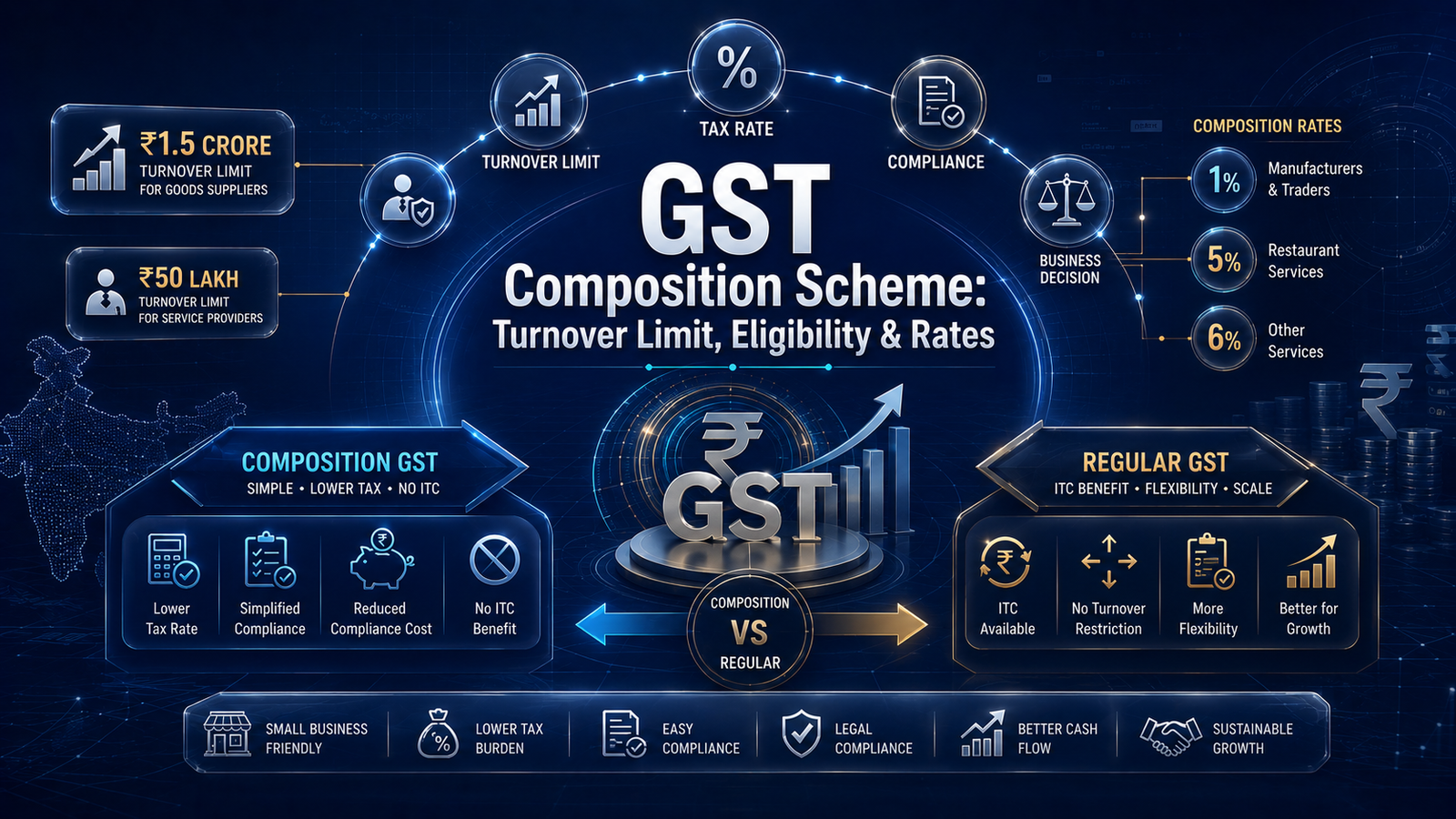
In most cases, the threshold turnover limit which generally applies to most of the eligible suppliers of goods is ₹1.5 crore, provided there are some conditions and state specific rules as well. While, for the eligible suppliers of services and mixed supplies, the limit is ₹50 lakh.
It must be noted that businesses have to consider the overall turnover in relation to GST rules, not just state turnover.
GST Turnover Limit at a Glance
| Business Category | General Turnover Threshold |
| Eligible manufacturers/traders | Up to ₹1.5 crore |
| Eligible service providers | Up to ₹50 lakh |
| Special category states | Subject to applicable prescribed limits |
“Applicable thresholds and conditions should be verified against the latest GST provisions before opting for the scheme.”
Who Is Eligible for the Composition Scheme Under GST?
The purpose of Composition Scheme under GST is mainly to benefit the eligible small taxpayers having their turnover not exceeding the prescribed GST Turnover Limit and fulfilling certain eligibility criteria.
| Eligible Taxpayer | Eligibility Overview |
| Small Manufacturers | Manufacturers having sales up to the prescribed level and satisfying composition criteria. |
| Traders | Traders involved in eligible goods and meeting all the conditions of GST. |
| Eligible Restaurants | Food service providers using restaurants, based on composition scheme criteria. |
| Certain Service Providers | Eligible service providers working under the specified turnover limit. |
| Eligible Goods Suppliers | Firms that provide qualifying products under the authorized restrictions and turnover levels. |
However, the eligibility will also depend on the kind of supplies and business activity. Those taxpayers who are involved in specific kinds of interstate business may not be eligible for the benefit.
GST Composition Scheme Rates for Different Businesses
The GST Composition Scheme offers a simplified tax structure for eligible small businesses.
The applicable composition rate depends on the type and nature of the business.
Instead of regular GST rates, taxpayers pay tax at a prescribed percentage of turnover.
Businesses should verify the latest applicable rate before calculating their GST liability.
- Traders: 1% of turnover
- Manufacturers: 1% of turnover
- Eligible Restaurants: 5% of turnover
- Eligible Service Providers: 6% of turnover
Note: Composition rates may vary based on the taxpayer’s business category and applicable GST notifications. Always verify the latest rules before calculating tax liability.
GST Composition Scheme vs Regular GST: Which Is Better for Your Business?
The decision regarding which GST scheme should be followed depends on the business itself. If the business is eligible to follow the Composition Scheme of GST, then that will be an easier way to pay GST, but if the firm wants to have more flexible ways, then regular GST should be chosen. The regular GST system is beneficial if the business needs ITC, issues tax invoice, or conducts business with many registered customers of GST.
| Factor | GST Composition Scheme | Regular GST |
| Eligibility | Available only to eligible taxpayers meeting prescribed conditions | Available to businesses required or eligible to register under GST |
| Tax Calculation | Tax is paid at a prescribed composition rate based on business activity | Tax is charged at the applicable GST rate on taxable supplies |
| GST Collection | Generally, GST cannot be collected separately from customers | GST can generally be collected separately from customers |
| Input Tax Credit | ITC is generally not available | Eligible businesses can generally claim ITC, subject to conditions |
| Invoice Type | Generally issues a Bill of Supply | Issues a Tax Invoice for taxable supplies |
| Compliance | Comparatively simpler GST compliance | More detailed returns, records, reconciliations, and reporting |
| B2B Customers | May be less suitable when customers require ITC | Better suited for B2B transactions where customers claim eligible ITC |
| Business Purchases | GST paid on purchases generally becomes a business cost | Eligible GST paid on purchases can generally be claimed as ITC |
| Business Flexibility | Subject to specific restrictions and conditions | Offers greater flexibility for different business operations |
| Best Suited For | Eligible small businesses with simple operations and limited ITC requirements | Businesses with higher input costs, B2B customers, ITC needs, or expansion plans |
Which GST Scheme Is Better for Your Business?
No single choice is best for all businesses. The GST Composition Scheme could prove useful in the situation where the main focus of a business is lowering complexity regarding compliance and there is no need for Input Tax Credit. However, Regular GST would be more helpful if the organization had high input costs, served GST-registered customers, needed invoices, or was more flexible in operations.
Organizations have to go beyond the consideration of the tax rate when they make such a choice. Turnover, Input Tax Credit needs, client expectations, purchasing costs, locations of supplies, as well as future expansion possibilities can all influence the GST choice of organizations. Considering all these aspects prior to choosing the Composition Scheme will help in avoiding problems with compliance.
Common Benefits and Limitations of the GST Composition Scheme?
GST Composition Scheme has been introduced to make life easy for eligible small businesses. The scheme will ease the compliance process and will make tax management more manageable, but businesses need to keep in mind its limitations while choosing it.
Advantages of the GST Composition Scheme
Businesses that are eligible for this scheme will gain ease of compliance and convenience in calculating and paying taxes based on the prescribed rate of composition GST.
GST Composition Scheme Limitations
Composition taxpayers generally cannot collect GST separately from customers or claim Input Tax Credit (ITC). The scheme also has eligibility conditions and restrictions on certain types of supplies and business activities.
Therefore, businesses should compare the benefits, applicable tax rate, turnover limits, eligibility conditions, and restrictions before choosing the GST Composition Scheme.
“Looking for an easier way to manage GST compliance? – Get expert support for GST Registration & complete GST compliance from CAAFT”
Final Thoughts
The GST Composition Scheme may prove to be a viable choice for small businesses that qualify for the same and seek easier compliance and simplified tax regime. The choice must not be made only because of the turnover limit and reduced compliance in GST Composition Scheme.
The taxpayers must assess themselves with regard to their eligibility for the scheme, the composition rate applicable, requirement of the input tax credit, type of customers, etc., before opting for the scheme. It is always beneficial for the taxpayers to have knowledge about the Composition Scheme in GST and the GST Turnover Limit.
Frequently Asked Questions
The GST Composition Scheme is an optional simplified taxation scheme for eligible small taxpayers. Instead of following the regular GST structure, qualifying businesses pay tax at prescribed composition rates based on turnover. The scheme also comes with specific restrictions and compliance conditions.
The GST Composition Scheme turnover limit generally allows eligible goods businesses with turnover up to ₹1.5 crore to opt for the scheme, subject to applicable conditions. Eligible service providers may have a separate ₹50 lakh threshold. Businesses should verify the latest GST provisions before applying.
Indicative composition rates include 1% for eligible traders and manufacturers, 5% for eligible restaurants, and 6% for certain eligible service providers. The applicable rate depends on the taxpayer’s business category and current GST provisions.
Generally, taxpayers registered under the Composition Scheme under GST cannot claim Input Tax Credit on their purchases. This is one of the key differences between the composition scheme and regular GST registration. Businesses with significant input costs should consider this factor before opting for the scheme.
Generally, a taxpayer under the GST Composition Scheme cannot collect GST separately from customers. Instead, the taxpayer pays tax under the prescribed composition mechanism and issues a bill of supply rather than a regular GST tax invoice.
No. Meeting the GST Turnover Limit alone does not guarantee eligibility. The business must also satisfy the applicable conditions and restrictions relating to its supplies and activities. Businesses should evaluate their customer base, input costs, interstate operations, and need for Input Tax Credit before opting in.
Yes, eligible taxpayers can move from the composition scheme to regular GST when they voluntarily opt out or become ineligible under the applicable rules. Businesses should complete the prescribed GST compliance and reporting requirements when changing their tax status.