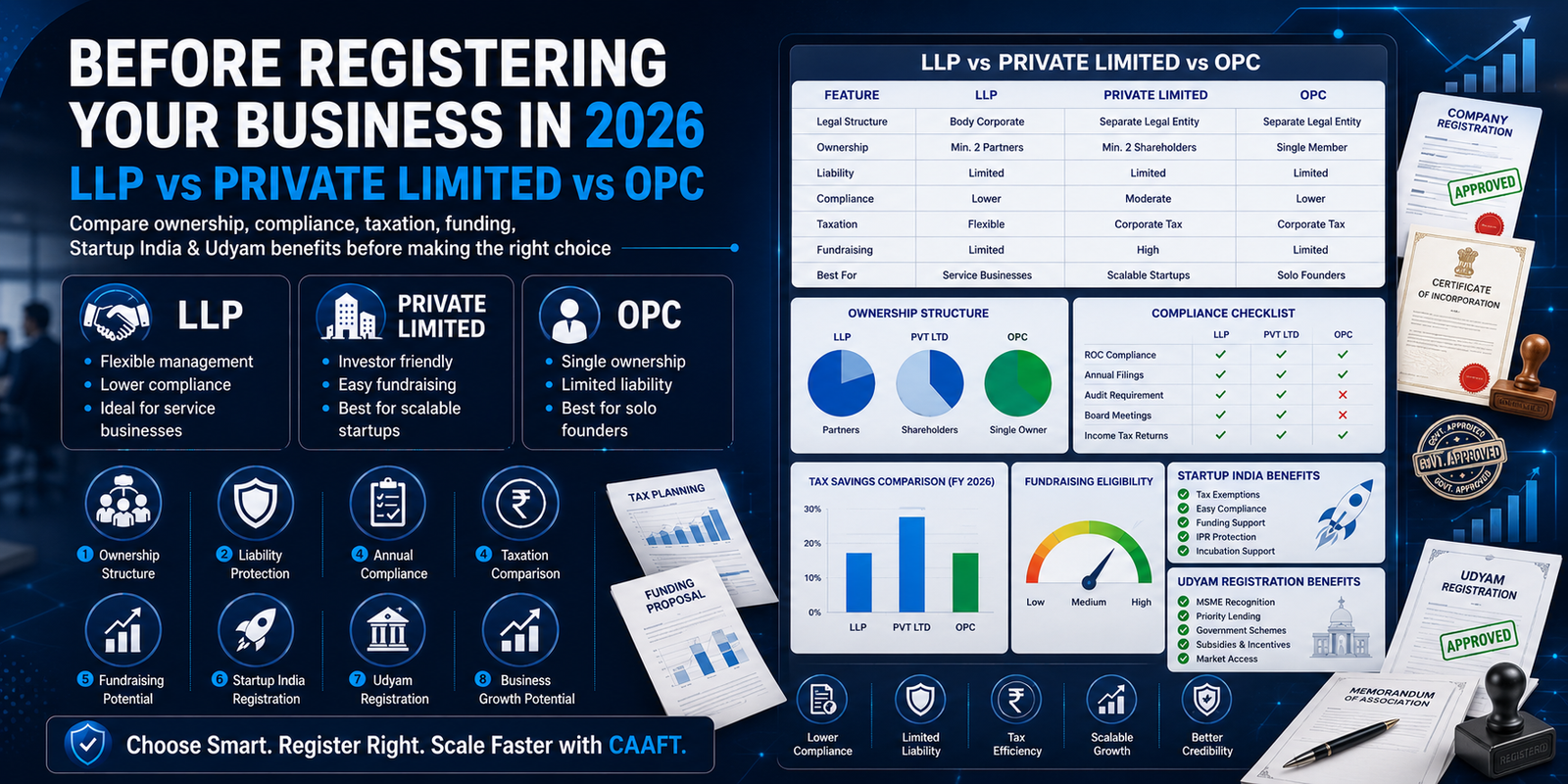
Choosing the right business structure in 2026 is one of the most important decisions you’ll make before starting a business. Whether you’re launching a technology startup, consultancy, e-commerce brand, manufacturing company, or professional practice, your choice between the Private Limited Company Registration, LLP Registration, and One Person Company (OPC) will influence your taxation, compliance, legal liability, fundraising opportunities, and future growth.
With India now home to over 2.23 lakh DPIIT-recognized startups, choosing the right legal entity has become more important than ever. Starting with the appropriate business structure can help you avoid unnecessary compliance issues and support long-term expansion. This guide compares LLP, Private Limited Company, and OPC based on ownership, compliance, taxation, investment potential, and government registrations like Startup India Registration and Udyam Registration, helping you choose the structure that best fits your business goals in 2026.
Key Takeaways
- Choosing the wrong business structure can increase compliance costs and limit future funding opportunities.
- Private Limited Company Registration is generally preferred for startups seeking investors and rapid business growth.
- LLP Registration offers operational flexibility with comparatively lower annual compliance requirements.
- OPC Registration is ideal for solo entrepreneurs looking for limited liability protection.
- Completing Startup India Registration and Udyam Registration, where eligible, unlocks valuable government benefits and business incentives.
What is an LLP?
A Limited Liability Partnership (LLP) is a business structure that combines the operational flexibility of a traditional partnership with the legal protection of a company. Registered under the Limited Liability Partnership Act, an LLP is a separate legal entity, meaning the business can own assets, enter into contracts, and continue its existence independently of its partners.
One of the biggest advantages of LLP Registration is that each partner’s liability is limited to their agreed contribution, protecting personal assets from business liabilities. Compared to companies, LLPs generally have lower compliance requirements, making them a popular choice for professional and service-based businesses.
Who Should Choose an LLP?
LLP Registration is best suited for consultants, architects, lawyers, chartered accountants, digital marketing agencies, IT service providers, family-owned businesses, and small-to-medium enterprises that want limited liability protection with simpler annual compliance. It is ideal for businesses that are not planning to raise external equity funding but need flexibility in management and operations.
What is a Private Limited Company?
A Private Limited Company (Pvt Ltd) is one of the most preferred business structures for startups and growing businesses because it offers a separate legal identity, limited liability protection, and greater credibility among investors, customers, and financial institutions. Under Private Limited Company Registration, the business is owned by shareholders and managed by directors, making it easier to raise equity funding, issue shares, and expand operations.
However, it involves higher compliance than an LLP or OPC, a Private Limited Company provides better scalability, structured governance, and long-term growth opportunities. Eligible companies can also apply for Startup India Registration to access government incentives and funding support.
Who Should Choose a Private Limited Company?
A Private Limited Company Registration is ideal for startups, technology companies, SaaS businesses, manufacturing units, e-commerce brands, and businesses planning to raise funds from angel investors, venture capitalists, or private equity firms. Entrepreneurs with ambitious growth plans and long-term expansion goals should consider this structure for its credibility and investment-friendly framework.
What is an OPC?
A One Person Company (OPC) is a business structure designed for solo entrepreneurs who want to enjoy the benefits of a company without requiring multiple shareholders. It provides a separate legal identity and limited liability, ensuring that the owner’s personal assets remain protected from business obligations. Unlike a sole proprietorship, an OPC offers greater credibility with banks, customers, and suppliers while allowing a single individual to retain complete ownership and control.
As the business grows, an OPC can be converted into a Private Limited Company if additional shareholders or investors are introduced. Eligible OPCs can also obtain Udyam Registration to access MSME benefits and government support.
Who Should Choose an OPC?
An OPC is best suited for freelancers, independent consultants, content creators, online sellers, professionals, and first-time entrepreneurs who want to start a business independently with limited liability protection. It is an excellent option for individuals who expect steady business growth and may later expand into a Private Limited Company as their operations scale.
Why Choosing the Right Business Structure Matters Before Registration
Choosing a business structure is one of the first and most important decisions an entrepreneur makes. It affects everything from taxation and legal liability to fundraising and future expansion. While changing your business structure later is possible, it often involves additional legal procedures, compliance costs, and operational disruptions.
Before registering your business, ask yourself these questions:
- Will you start the business alone or with partners?
- Do you plan to raise investment in the future?
- How much annual compliance are you willing to manage?
- Is long-term business expansion part of your plan?
- Will you be eligible for government startup benefits?
Answering these questions early makes it easier to decide between Private Limited Company Registration, LLP Registration, and OPC Registration, helping you build your business on the right legal foundation.
LLP vs Private Limited Company vs OPC: Key Differences
Although all three structures provide limited liability protection, they are designed for different business needs.
| Business Goal / Feature | LLP (Limited Liability Partnership) | Private Limited Company | OPC (One Person Company) |
|---|---|---|---|
| Ownership | Two or more partners | Two or more shareholders | One shareholder |
| Liability Protection | Limited | Limited | Limited |
| Compliance Level | Moderate | Higher | Moderate |
| Fundraising Potential | Limited | Excellent (VCs & Investors Prefer) | Limited |
| Best Suited For | Professional firms, consultants, and service businesses | Startups, scalable businesses, investor-backed companies | Solo entrepreneurs, freelancers, and individual business owners |
| Choose This If… |
|
|
|
Compliance, Taxation and Funding: What Entrepreneurs Should Know
Choosing the right business structure involves much more than comparing registration costs. While the initial incorporation fee is an important consideration, entrepreneurs should also evaluate the long-term responsibilities and opportunities associated with each entity type. Factors such as annual compliance, tax obligations, and the ability to raise funds can have a significant impact on your business’s growth, profitability, and operational efficiency. Understanding these aspects before registering your business helps you make a well-informed decision that aligns with your future goals.
1. Compliance Requirements
Every business structure comes with its own compliance obligations. These may include annual ROC filings, Income Tax Return (ITR) filing, maintaining proper books of account, statutory audits where applicable, and fulfilling director or designated partner responsibilities.
Choosing a structure with compliance requirements that match your business size and resources can save both time and costs.
2. Taxation Considerations
The way your business is taxed directly affects your overall profitability. Compare the corporate tax liability, taxation of partners or shareholders, dividend implications, and the deductions or exemptions available under each business structure before making your choice.
3. Funding and Growth Potential
If you plan to expand your business in the future, consider how easily each structure can attract investors or secure financing.
Private Limited Companies generally offer better opportunities for raising capital through angel investors, venture capital firms, share issuance, and bank funding, while LLPs and OPCs may have comparatively limited fundraising options.
Startup India Registration & Udyam Registration: Why They Matter
Registering your business is only the beginning. Many entrepreneurs miss out on valuable government schemes because they don’t complete additional registrations after incorporation.
1. Startup India Registration can help eligible startups with:
Startup India Registration offers a range of government-backed benefits designed to support innovative businesses. Eligible startups can access tax incentives, regulatory support, intellectual property assistance, and funding opportunities, helping them reduce costs and accelerate business growth.
Key Benefits:
- Tax exemptions
- DPIIT recognition
- Intellectual property support
- Government procurement opportunities
- Startup networking and funding support
2. Udyam Registration provides eligible MSMEs with:
Udyam Registration helps Micro, Small, and Medium Enterprises (MSMEs) access various government benefits that support business growth and financial stability. It simplifies access to credit, improves business credibility, and enables eligible enterprises to take advantage of schemes and incentives designed to strengthen the MSME sector.
Key Benefits:
- Easier access to bank loans
- Government subsidies
- Priority sector lending
- Delayed payment protection
- MSME scheme benefits
Completing these registrations after incorporation can improve your business credibility while unlocking financial and regulatory advantages.
Common Mistakes to Avoid Before Registering Your Business
Even a great business idea can face challenges if the registration process is not planned properly.
Avoid these common mistakes:
- Choosing a business structure based only on registration cost.
- Ignoring future funding requirements.
- Underestimating annual compliance obligations.
- Registering without checking trademark availability.
- Delaying GST registration when applicable.
- Missing Startup India Registration or Udyam Registration benefits.
- Seeking professional advice only after incorporation.
Taking time to evaluate your business goals before registration helps reduce compliance issues, avoid unnecessary costs, and create a stronger foundation for long-term growth.
Conclusion
Choosing between an LLP, a Private Limited Company, and an OPC depends on your business goals, ownership structure, compliance requirements, and future growth plans. Selecting the right entity from the beginning can save time, reduce compliance challenges, and support long-term success. If you’re eligible, completing Startup India Registration and Udyam Registration can further strengthen your business by unlocking government benefits, funding opportunities, and valuable incentives. Making the right choice today lays a solid foundation for sustainable growth in 2026 and beyond.
Frequently Asked Questions
The right choice depends on your business goals. LLP Registration is ideal for professional firms, consultants, and businesses looking for operational flexibility with comparatively lower compliance. Private Limited Company Registration is generally a better option for startups planning to raise investment, issue shares, or expand rapidly. Evaluating your long-term growth plans before registration helps you choose the most suitable business structure.
An OPC (One Person Company) is best suited for solo entrepreneurs, freelancers, consultants, and first-time business owners who want complete ownership along with limited liability protection. It offers greater credibility than a sole proprietorship while allowing a single individual to manage the business independently. As the business grows, an OPC can also be converted into a Private Limited Company.
Yes. An LLP can be converted into a Private Limited Company if the business plans to raise investment, onboard additional shareholders, or expand its operations. However, the conversion involves legal procedures, regulatory approvals, and compliance requirements. Choosing the right business structure at the beginning can help avoid unnecessary conversion costs in the future.
No. Startup India Registration is not mandatory, but eligible startups should consider applying for it to access government-recognized benefits such as tax exemptions, intellectual property support, easier participation in public procurement, networking opportunities, and funding initiatives. It is particularly beneficial for innovation-driven startups with long-term growth plans.
No. Udyam Registration is optional, but it is highly recommended for eligible Micro, Small, and Medium Enterprises (MSMEs). Registered businesses can benefit from government schemes, priority sector lending, subsidies, delayed payment protection, and easier access to credit. Applying for Udyam Registration can strengthen your business’s financial and operational growth.
Before registering your business, evaluate factors such as the number of owners, funding requirements, annual compliance obligations, taxation, liability protection, business scalability, and future expansion plans. Choosing the right legal structure ensures smoother operations and reduces the need for costly restructuring as your business grows.
Yes. Once your business is incorporated, you can apply for additional registrations based on your eligibility and business activities. Depending on your requirements, you may need GST Registration, Startup India Registration, or Udyam Registration to ensure regulatory compliance and access to various government benefits that support business growth.