

Starting a business is exciting, but choosing the right legal structure can determine how far your business grows in the future. Many entrepreneurs begin as sole proprietors or freelancers, but as revenue increases and business operations expand, moving toward private limited company registration becomes an important step.
India’s startup ecosystem is expanding at an unprecedented pace. As of March 2026, the Startup India initiative has recognized more than 2.23 lakh startups, creating over 23.36 lakh direct jobs, the highest annual increase since the initiative began. This rapid growth highlights the importance of choosing a business structure that supports long-term success and scalability.
In India’s rapidly growing startup ecosystem, registering your business as a private limited company offers several advantages, including legal protection, funding opportunities, tax benefits, and better credibility. Whether you are launching a startup or scaling an existing business, understanding these benefits helps you make the right decision.
Confused about whether to stay a sole trader or register as a limited company? The right choice depends on your current profits, tax obligations, and long-term business growth goals.
Key Takeaways
- A private limited company is a separate legal entity registered under the Companies Act, 2013, with liability limited to each shareholder’s investment.
- It needs a minimum of two directors and two shareholders, with no mandatory minimum paid-up capital.
- Investors, banks, and larger clients generally prefer dealing with a registered private limited company over a proprietorship or partnership.
- Benefits include limited liability, perpetual succession, easier fundraising, tax efficiency, credibility, and smoother startup India registration eligibility.
- It isn’t the right fit for everyone – compliance costs and disclosure requirements are real trade-offs to weigh.
What is a Private Limited Company Registration?
A Private Limited Company (Pvt Ltd) is one of the most popular business structures in India. It is a legally registered company under the Ministry of Corporate Affairs and governed by the Companies Act 2013.
Unlike a sole proprietorship business, a private limited company is considered a separate legal entity. This means the company and its owners are treated separately under the law.
Private limited company registration usually requires:
- Minimum 2 directors
- Minimum 2 shareholders
- Registered office address
- PAN and Aadhaar details of directors
- Digital Signature Certificate (DSC)
- Director Identification Number (DIN)
- Company name approval through the MCA portal
Once incorporated, the business can open a corporate bank account, issue invoices, hire employees, and raise funds legally.
When Should a Sole Trader Consider Becoming a Limited Company?
Plenty of businesses start life as a sole proprietorship because it’s fast and paperwork-light. But that simplicity comes at a cost: there’s no legal separation between you and your business, so business debts are personal debts. Here are the signals that it’s time to move to a private limited structure:
- Revenue is climbing and personal liability feels risky: If a bad debt, lawsuit, or contract dispute could threaten your house or savings, limited liability becomes non-negotiable.
- You’re planning to raise external funding: Angel investors and VCs almost exclusively invest in private limited companies, not proprietorships.
- You want to bring in co-founders or issue equity: A company structure makes shareholding, vesting, and ESOPs possible in a way a proprietorship can’t.
- Bigger clients are asking for your company registration details: Enterprise clients and government tenders often require vendors to be registered companies.
- You’re applying for Startup India recognition: DPIIT recognition under startup India registration is available to private limited companies, LLPs, and registered partnerships – not sole proprietorships.
- You want to protect your brand: As a company, you can pursue trademark registration in the company’s name, giving the brand the same continuity as the business itself.
If two or more of these apply to you, it’s worth running the numbers on incorporation.
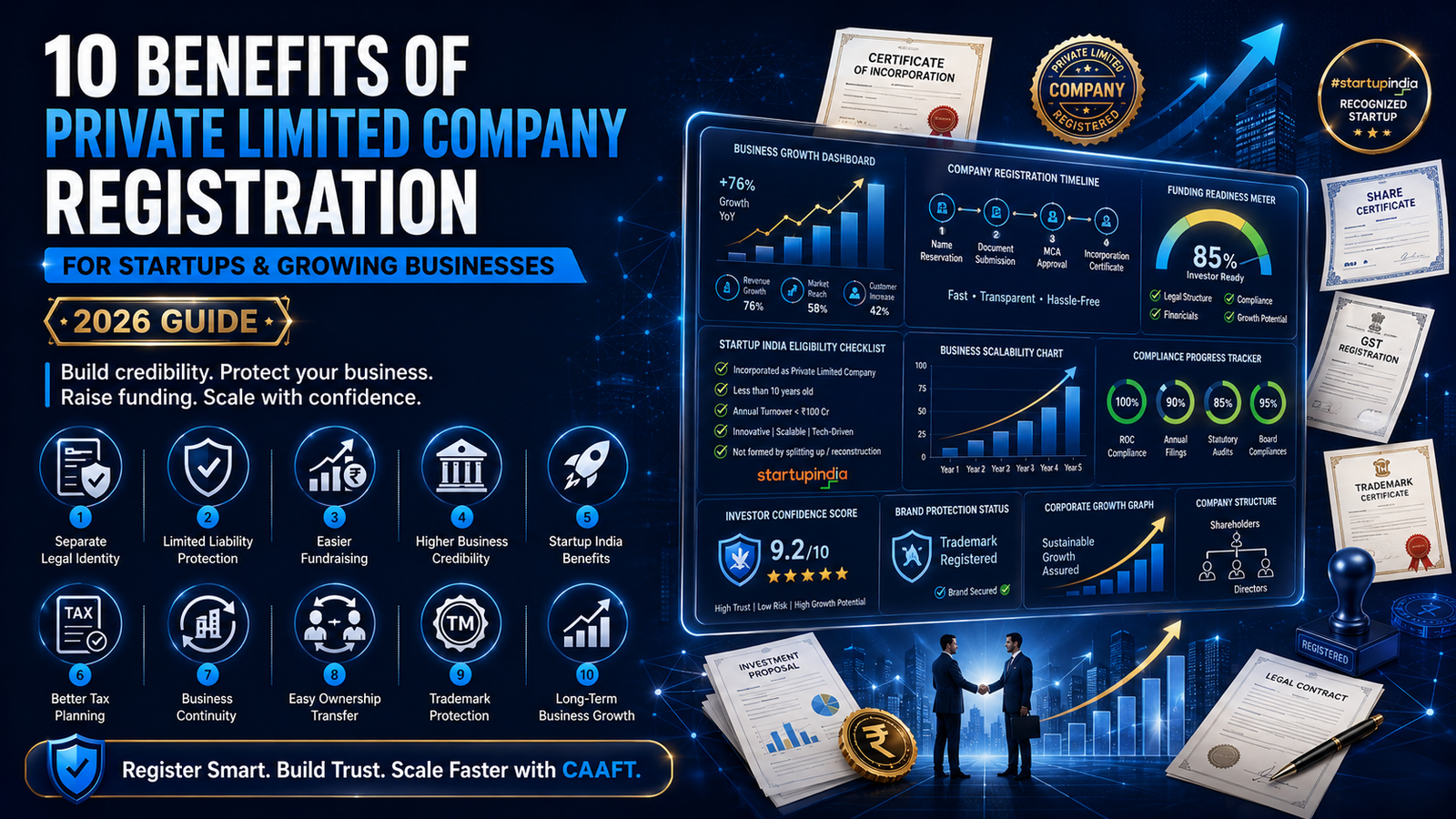
10 Benefits of Registering a Private Limited Company in India
1. Separate Legal Identity
One of the biggest advantages of private limited company registration is that the company becomes a separate legal entity.
This means:
- The company can own assets
- It can sign contracts independently
- It can sue or be sued independently
The owners and the business are legally distinct.
2. Limited Liability Protection
A private limited company protects founders from personal financial risk.
If the company faces debt or losses:
- Directors are not personally responsible beyond their shareholding
- Personal savings and assets remain protected
This reduces risk significantly compared to sole proprietorship businesses.
3. Easier Access to Funding and Investment
Investors, venture capital firms, and angel investors generally prefer registered private limited companies.
Benefits include:
- Equity investment opportunities
- Better chances of securing loans
- Easier fundraising rounds
Startups planning aggressive growth often choose this structure early.
4. Stronger Business Credibility
Customers, vendors, and corporate clients usually trust registered businesses more than unregistered businesses.
Private limited registration helps create:
- Professional image
- Higher trust in the market
- Better partnership opportunities
This credibility becomes valuable when competing in larger markets.
5. Startup India Registration Benefits
Many startups also apply for startup India registration under the government’s startup initiative.
Benefits may include:
- Tax exemptions
- Government funding opportunities
- Faster patent filing support
- Access to startup incubators
Combining private limited company registration with startup recognition creates stronger growth opportunities.
6. Better Tax Planning Opportunities
Compared to sole proprietorship structures, companies often have better tax planning flexibility.
Businesses can manage taxation through:
- Salary structures
- Business expense deductions
- Corporate tax frameworks
Additionally, many businesses also complete GST registration to legally collect and remit tax while claiming input tax credits.
You can explore registration support through GST Registration Services.
7. Business Continuity and Perpetual Existence
Unlike sole proprietorship businesses, private limited companies continue operating even if ownership changes.
This means:
- Business survives ownership transfer
- Shareholders can change without affecting operations
- Long-term stability improves
This makes scaling easier.
8. Easier Ownership Transfer
Private limited companies allow ownership transfer through share transfers.
Advantages include:
- Bringing new investors onboard
- Selling ownership stakes
- Easier succession planning
This flexibility supports future expansion.
9. Brand Protection Through Trademark Registration
As businesses grow, brand identity becomes increasingly valuable.
Many startups complete trademark registration alongside company registration to protect:
- Brand name
- Company logo
- Product identity
- Intellectual property
Trademark registration helps prevent competitors from copying brand assets.
10. Better Growth Potential for Scaling Businesses
A private limited company structure prepares businesses for long-term growth.
It becomes easier to:
- Expand operations nationally
- Hire larger teams
- Work with enterprise clients
- Build long-term valuation
Businesses aiming for serious growth usually move beyond sole proprietorship structures.
Is a Private Limited Company Right for You?
A private limited company isn’t automatically the best choice for every business. It comes with real trade-offs: mandatory annual audits, ROC filings, board meetings, and generally higher compliance costs than a proprietorship or LLP. Winding one up, if it ever comes to that, is also more involved than closing a sole proprietorship.
It tends to be the right fit if you:
- Plan to raise equity funding at some point
- Want liability protection as revenue grows
- Are you pursuing DPIIT/startup India recognition
- Need credibility with enterprise clients, government tenders, or foreign partners
- Are you building something you intend to scale, hire into, or eventually sell
It’s probably not necessary yet if you’re a solo freelancer or consultant with low risk exposure and no near-term plans to raise funding or bring on co-founders – an LLP or proprietorship may serve you better until those needs arise.
How To Register Your Private Limited Company With CAAFT
Weighing the benefits is the easy part – getting the paperwork, filings, and compliance right is where most founders get stuck. CAAFT handles end-to-end private limited company registration, from name approval and SPICe+ filing to GST registration, startup India registration, and trademark registration for your brand, so you can focus on building the business instead of chasing forms.
Get in touch with CAAFT to start your private limited company registration today.
Frequently Asked Questions
A private limited company offers limited liability protection, separate legal identity, better business credibility, easier fundraising, perpetual succession, and tax planning opportunities. It is one of the most preferred business structures for startups and growing businesses in India because it supports long-term scalability.
Startups often choose a private limited company because it allows them to raise investment, issue equity shares, and build greater trust with customers and investors. Unlike a sole proprietorship, the business exists as a separate legal entity, reducing the owner’s personal financial risk.
Yes. Most angel investors, venture capital firms, and institutional investors prefer investing in private limited companies because they can easily issue shares, define ownership, and comply with corporate governance requirements. This makes fundraising significantly easier than other business structures.
Yes. A private limited company provides limited liability protection, meaning shareholders are generally liable only up to the amount they invest. In most cases, personal assets such as a house, savings, or personal investments remain protected from business debts and liabilities.
Yes. Registering as a private limited company enhances your professional image with customers, suppliers, banks, and investors. It demonstrates that your business is legally registered and follows statutory compliance, making it easier to secure contracts, loans, and partnerships.
Private limited companies can claim eligible business expense deductions, depreciation, and other tax benefits available under the Income Tax Act. Depending on the company’s turnover and applicable tax regime, they may also benefit from competitive corporate tax rates and government incentives.
A startup should consider registering as a private limited companywhen it plans to raise funding, hire employees, onboard co-founders, protect personal liability, or scale operations. Registering early also helps establish a strong legal and financial foundation for future business growth.