

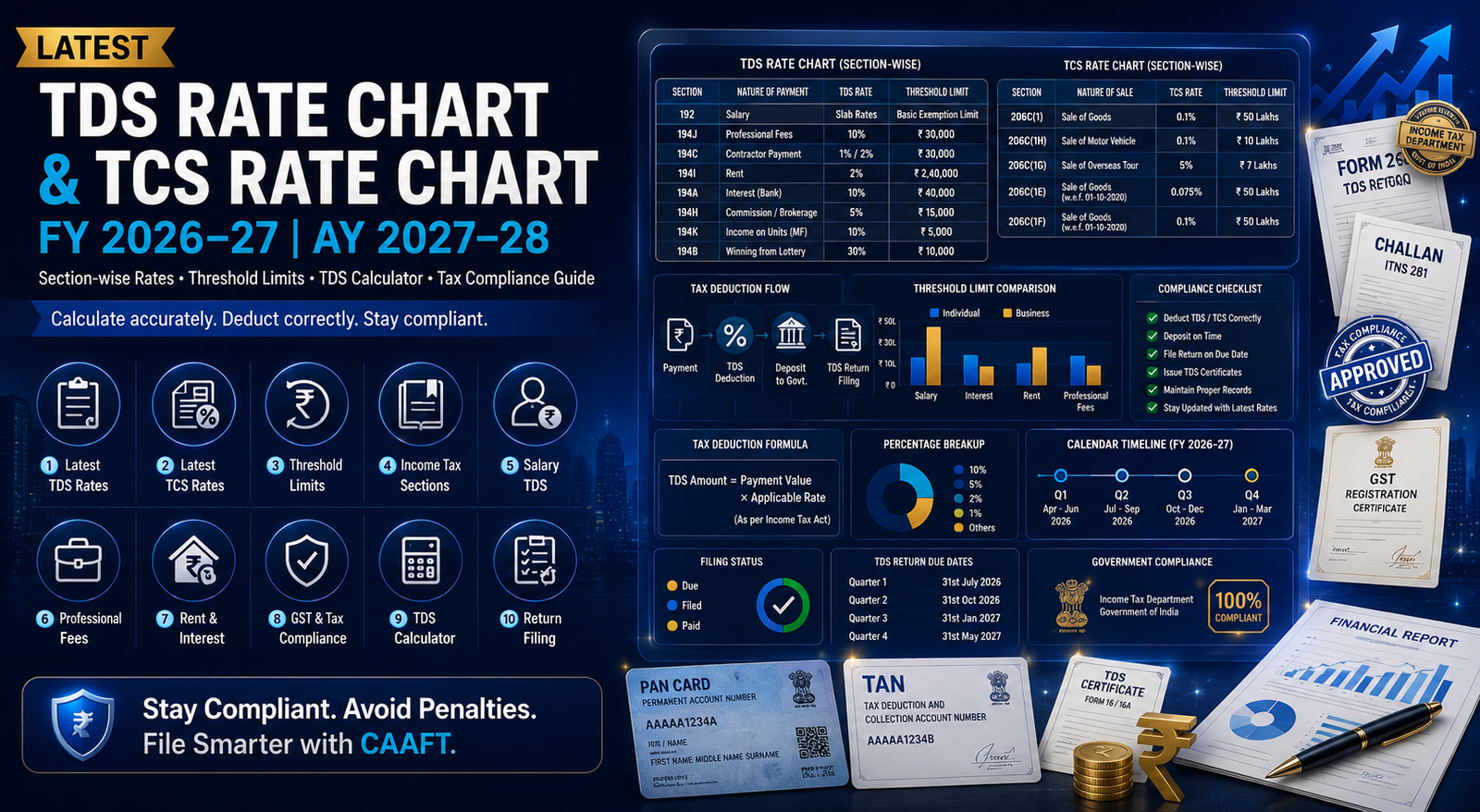
Tax Deducted at Source (TDS) and Tax Collected at Source (TCS) are essential components of India’s tax system, ensuring timely tax collection and improving compliance. Reflecting the growing importance of these mechanisms, India’s gross direct tax collections reached ₹22.78 lakh crore as of 10 February 2026, registering a 4.09% year-on-year increase. To ensure accurate tax compliance, businesses, employers, professionals, and taxpayers should refer to the latest TDS Rate Chart and TCS Rate Chart for FY 2026 before deducting or collecting tax. Applying the correct rates and threshold limits helps avoid interest, penalties, and notices from the Income Tax Department.
This guide covers the latest section-wise TDS and TCS rates, applicable threshold limits, relevant Income Tax sections, and a step-by-step guide to using a TDS Calculator. Whether you’re a business owner, accountant, finance professional, or taxpayer, this resource will help you stay compliant throughout FY 2026-27.
Key Takeaways
- Referring to the latest TDS Rate Chart and TCS Rate Chart for FY 2026-27 helps businesses apply the correct tax rates and remain compliant with the Income Tax Act.
- Understanding the applicable TDS/TCS sections, threshold limits, and tax rates reduces the risk of short deductions, incorrect tax collection, interest, and penalties.
- Using a TDS Calculator along with the latest rate chart improves calculation accuracy and simplifies tax deduction before making payments.
- Timely deposit of TDS/TCS, accurate return filing, and issuing the required tax certificates are essential for hassle-free tax compliance.
- Regularly reviewing CBDT notifications, Finance Act amendments, and updated TDS/TCS provisions helps businesses stay compliant and avoid costly reporting errors throughout FY 2026-27.
What Are TDS and TCS in FY 2026-27?
Understanding Tax Deducted at Source (TDS) and Tax Collected at Source (TCS) is essential for every taxpayer, employer, business owner, and professional in India. As per the Income Tax Act, 1961, these tax collection mechanisms help the government collect taxes at the source of income or specified transactions, ensuring better compliance and reducing tax evasion.
Before making payments or collecting taxes during FY 2026-27 (AY 2027-28), it is important to refer to the latest TDS Rate Chart FY 2026-27 and TCS Rate Chart FY 2026-27 to apply the correct tax rates and avoid interest, penalties, or notices from the Income Tax Department.
What is TDS (Tax Deducted at Source)?
Tax Deducted at Source (TDS) is a system where the payer deducts tax before making specified payments such as salary, interest, rent, contractor payments, commission, professional fees, and other notified transactions. The deducted amount is deposited with the government on behalf of the recipient and can be claimed as a tax credit while filing the Income Tax Return (ITR).
What is TCS (Tax Collected at Source)?
Tax Collected at Source (TCS) is a tax collected by the seller from the buyer at the time of selling specified goods or carrying out notified transactions under the Income Tax Act. The collected tax is deposited with the government and reflected in the buyer’s tax records for credit at the time of filing the income tax return.
What Are The Key Differences and Benefits Of TDS and TCS
| Aspect | TDS (Tax Deducted at Source) | TCS (Tax Collected at Source) | Benefit |
| Meaning | Tax deducted before making specified payments. | Tax collected by the seller on specified goods or transactions. | Ensures timely tax collection by the government. |
| Who Deducts/Collects? | Payer (Deductor) | Seller (Collector) | Clearly defines tax collection responsibility. |
| Who Pays the Tax? | Recipients of income bear the tax deduction. | The buyer pays the tax collected by the seller. | Promotes transparent tax compliance. |
| Applicable On | Salary, rent, interest, contractor payments, professional fees, commission, dividends, etc. | Sale of specified goods, overseas tour packages, foreign remittances (LRS), and other notified transactions. | Covers a wide range of taxable transactions under the Income Tax Act. |
| Relevant Sections | Sections 192, 194A, 194C, 194H, 194I, 194J, 194Q, etc. | Section 206C and related provisions. | Simplifies compliance with section-wise tax rates. |
| When is Tax Applied? | At the time of payment or credit, whichever is earlier. | At the time of sale or receipt of payment, as applicable. | Enables timely tax collection throughout the financial year. |
| Deposit with Government | Deductor deposits the deducted tax. | Collector deposits the collected tax. | Ensures regular revenue flow to the government. |
| Tax Credit | Available to the deductee and reflected in Form 26AS/AIS. | Available to the buyer and reflected in Form 26AS/AIS. | Makes claiming tax credit easy while filing the Income Tax Return (ITR). |
| Return Filing | Reported through TDS returns. | Reported through TCS returns. | Improves transparency and record-keeping. |
| Compliance Impact | Incorrect deduction may attract interest, penalties, and notices. | Incorrect collection may result in penalties and compliance actions. | Referring to the latest TDS Rate Chart FY 2026-27 and TCS Rate Chart FY 2026-27 helps avoid errors and ensures compliance. |
Latest TDS Rate Chart for FY 2026-27 (Section-wise)
The TDS Rate Chart serves as a ready reference for businesses, employers, finance professionals, and accountants responsible for deducting tax at source. It provides section-wise information on the applicable TDS percentage, threshold limits, and the nature of payments covered under the Income Tax Act.
Before deducting tax, businesses should identify the type of payment, verify whether the applicable threshold has been exceeded, and confirm the correct TDS rate. Applying an incorrect TDS percentage can lead to short deductions, excess deductions, additional interest, penalties, and reconciliation issues during tax audits.
| Section | Nature of Payment | Threshold Limit | TDS Rate |
| 192 | Salary | Basic exemption limit as per slab | As per slab rates |
| 193 | Interest on securities | ₹10,000 / ₹5,000* | 10% |
| 194 | Dividend | ₹10,000 | 10% |
| 194A | Interest other than securities | ₹50,000 (senior citizen) / ₹40,000 / ₹10,000 | 10% |
| 194B | Lottery, crossword, game winnings | ₹10,000 | 30% |
| 194BB | Horse race winnings | ₹10,000 | 30% |
| 194C | Contractor/subcontractor payments | ₹30,000 single / ₹1,00,000 aggregate | 1% / 2% |
| 194D | Insurance commission | ₹20,000 | 5% |
| 194DA | Life insurance payout (taxable portion) | ₹1,00,000 | 5% |
| 194G | Lottery ticket commission | ₹15,000 | 5% |
| 194H | Commission or brokerage | ₹20,000 | 5% |
| 194I | Rent (land/building/furniture) | ₹2,40,000 | 2% / 10% |
| 194IA | Purchase of immovable property | ₹50,00,000 | 1% |
| 194IB | Rent by individuals/HUF (not liable to tax audit) | ₹50,000 per month | 2% |
| 194IC | Joint development agreement | No threshold | 10% |
| 194J | Professional/technical services | ₹50,000 | 2% / 10% |
| 194K | Income from mutual funds/units | ₹10,000 | 10% |
| 194LA | Compensation on compulsory acquisition | ₹5,00,000 | 10% |
| 194M | Payments by individuals/HUF to contractors/professionals | ₹50,00,000 | 2% |
| 194N | Cash withdrawal from bank/co-op bank/post office | ₹1 crore / ₹20 lakh | 2% / 5% |
| 194O | E-commerce participant payments | ₹5,00,000 | 0.1% |
| 194Q | Purchase of goods | ₹50,00,000 | 0.1% |
| 194R | Benefit or perquisite from business/profession | ₹20,000 | 10% |
| 194S | Transfer of virtual digital assets (crypto, etc.) | ₹50,000 / ₹10,000 | 1% |
Latest TCS Rate Chart for FY 2026-27 (Section-wise)
The TCS Rate Chart provides businesses with the latest tax collection rates applicable to specified goods and notified transactions. Sellers responsible for collecting tax at source must ensure they apply the correct TCS rate once the prescribed threshold conditions are met.
Incorrect tax collection can lead to compliance issues, delayed filings, financial penalties, and disputes with tax authorities. Reviewing the latest TCS Rate Chart at the beginning of every financial year helps businesses stay aligned with the latest Income Tax provisions and government notifications.
| Section | Nature of Transaction | Threshold Limit | TCS Rate |
| 206C(1) | Alcoholic liquor for human consumption | No threshold | 2% |
| 206C(1) | Tendu leaves | No threshold | 2% |
| 206C(1) | Timber obtained under a forest lease | No threshold | 2% |
| 206C(1) | Timber obtained by any mode other than a forest lease | No threshold | 2% |
| 206C(1) | Any other forest produce (excluding timber and tendu leaves) | No threshold | 2% |
| 206C(1) | Scrap | No threshold | 2% |
| 206C(1) | Minerals (coal, lignite, iron ore) | No threshold | 2% |
| 206C(1F) | Sale of motor vehicle | Sale consideration exceeding ₹10 lakh | 1% |
| 206C(1G) | Overseas remittance under LRS (education/medical/travel, as applicable) | Amount exceeding prescribed limit | 2%* |
| 206C(1G) | Overseas tour programme package | No threshold | 2% |
| 206C(1H) (where applicable) | Sale of goods | As prescribed under the Income Tax Act | Applicable rate as notified |
“Note: The applicable threshold and rate for LRS remittances depend on the purpose of the remittance and the latest provisions notified under the Finance Act and CBDT guidelines. The Finance Act, 2026 introduced rationalized TCS rates for several transactions. “
How to Calculate TDS: Step-by-Step Guide Using a TDS Calculator
Accurate calculation of Tax Deducted at Source (TDS) is essential for businesses, employers, and deductors to comply with the Income-tax Act, 1961. Using the correct TDS rate, checking the applicable threshold limit, and depositing the deducted tax within the prescribed due dates help avoid interest, penalties, and compliance issues. While TDS can be calculated manually, an online TDS Calculator simplifies the process, improves accuracy, and reduces the risk of calculation errors.
Step 1: Identify the Nature of Payment
The first step is to determine the type of payment on which TDS is applicable. This could include salary, contractor payments, professional or technical fees, rent, commission, interest, dividends, purchase of goods, or any other payment covered under the Income Tax Act.
Step 2: Check the Applicable Threshold Limit
Before deducting TDS, verify whether the payment exceeds the prescribed threshold limit for the relevant section. If the payment is below the specified limit, TDS may not be applicable.
Step 3: Refer to the Latest TDS Rate Chart
Identify the applicable TDS section and verify the correct TDS rate using the Latest TDS Rate Chart for FY 2026-27 (AY 2027-28). Applying the correct rate ensures accurate tax deduction and compliance with the latest Income Tax provisions.
Step 4: Calculate the TDS Amount
Multiply the taxable payment amount by the applicable TDS rate after considering any exemptions, lower deduction certificates, or special provisions. This will give you the amount of tax to be deducted at source.
Step 5: Verify the Calculation Using a TDS Calculator
To eliminate manual errors, use a reliable TDS Calculator to verify the deducted amount. A calculator automatically applies the latest TDS rates and helps ensure accurate tax computation.
Step 6: Deposit the Deducted TDS
Once the tax has been deducted, deposit the TDS with the Central Government within the prescribed due date using the applicable tax payment challan. Timely payment helps avoid interest and late payment penalties.
Step 7: File the TDS Return and Issue the TDS Certificate
After depositing the tax, file the applicable quarterly TDS return within the due date. Once the return is filed, issue the appropriate TDS Certificate (Form 16 or Form 16A) to the deductee so they can claim tax credit while filing their Income Tax Return.
Why Use a TDS Calculator and TDS Formula?
A TDS Calculator is a quick and reliable tool that helps businesses, employers, accountants, and tax professionals calculate Tax Deducted at Source accurately. It minimizes manual calculation errors, saves time, ensures compliance with the latest TDS rates for FY 2026-27, and simplifies tax planning and return filing. For accurate results, always use the latest TDS Rate Chart along with an updated TDS Calculator before deducting tax. Here are the TDS formula
“TDS Amount = Taxable Payment Amount × Applicable TDS Rate (%)”
Common TDS and TCS Compliance Mistakes Businesses Should Avoid
Complying with TDS and TCS provisions is crucial to avoid interest, penalties, and notices from the Income Tax Department. Many businesses face compliance issues due to incorrect tax rates, delayed filings, or overlooking key provisions. Regularly referring to the latest TDS Rate Chart and TCS Rate Chart for FY 2026-27 can help ensure accurate tax deduction and collection.
Common Compliance Mistakes
- Applying an incorrect TDS or TCS rate.
- Using outdated TDS/TCS rates instead of the latest applicable rates.
- Ignoring the prescribed threshold limits before deducting or collecting tax.
- Selecting the wrong Income Tax section for the transaction.
- Delaying the deposit of TDS or TCS with the government.
- Filing TDS/TCS returns after the due date.
- Entering incorrect PAN, TAN, or deductee/collectee details.
- Not issuing TDS certificates (Form 16/Form 16A) within the prescribed timeline.
- Failing to reconcile TDS/TCS records with Form 26AS and accounting records.
Avoiding these common mistakes and using the latest TDS & TCS Rate Chart for FY 2026-27 helps businesses maintain accurate tax compliance, reduce reporting errors, and prevent unnecessary penalties.
“Need help with TDS or TCS compliance? Let CAAFT handle your tax calculations, return filing and compliance with confidence”
Final Thoughts
Keeping track of the latest TDS Rate Chart and TCS Rate Chart is essential for businesses and professionals responsible for deducting or collecting tax during financial transactions. Applying the correct TDS percentage, verifying threshold limits, and using a reliable TDS calculator can help reduce calculation errors, improve compliance, and prevent unnecessary penalties.
By reviewing the latest tax rates, following the correct deduction process, and filing returns on time, businesses can maintain accurate financial records and meet their statutory obligations with confidence. Regular compliance reviews and professional guidance further ensure that organizations stay updated with evolving tax regulations throughout FY 2026-27.
Frequently Asked Questions
The latest TDS and TCS Rate Chart for FY 2026-27 (AY 2027-28) provides the applicable tax deduction and collection rates, threshold limits, and relevant sections under the Income Tax Act, 1961. It helps businesses, employers, and taxpayers apply the correct tax rates and stay compliant with the latest Income Tax provisions.
To determine the correct TDS rate, first identify the nature of the payment, such as salary, rent, professional fees, contractor payments, or interest. Then, verify the applicable threshold limit and refer to the relevant section in the TDS Rate Chart for FY 2026-27 to apply the prescribed rate.
Tax Deducted at Source (TDS) is deducted by the payer before making specified payments, whereas Tax Collected at Source (TCS) is collected by the seller from the buyer on notified goods and transactions. Both are tax collection mechanisms under the Income Tax Act that help improve tax compliance and reduce tax evasion.
TDS and TCS rates are not necessarily revised every financial year, but the Government may introduce changes through the Union Budget, Finance Act, or CBDT notifications. Businesses should always refer to the latest TDS & TCS Rate Chart for FY 2026-27 before deducting or collecting tax.
Incorrect deduction or collection of TDS or TCS may result in interest, penalties, late fees, and notices from the Income Tax Department. It can also create mismatches in tax credits for the deductee or buyer, making timely correction and compliance essential.
Yes. An online TDS Calculator helps calculate the correct TDS amount by applying the latest TDS rates, threshold limits, and applicable Income Tax provisions. It minimizes manual errors, saves time, and improves the accuracy of tax deductions and return filing.
Referring to the latest TDS and TCS Rate Chart for FY 2026-27 ensures that businesses apply the correct tax rates, comply with the latest Income Tax regulations, and avoid errors in tax deduction or collection. It also helps streamline return filing, improve compliance, and reduce the risk of penalties and tax disputes.