Starting a new business in Chennai is one of the most important decisions an entrepreneur can make. Chennai ranks among India’s top business destinations, with thriving sectors in IT, automobile manufacturing, logistics, healthcare, retail, and consulting. The city is home to the ROC (Registrar of Companies), Tamil Nadu & Pondicherry, operating under the Ministry of Corporate Affairs (MCA).
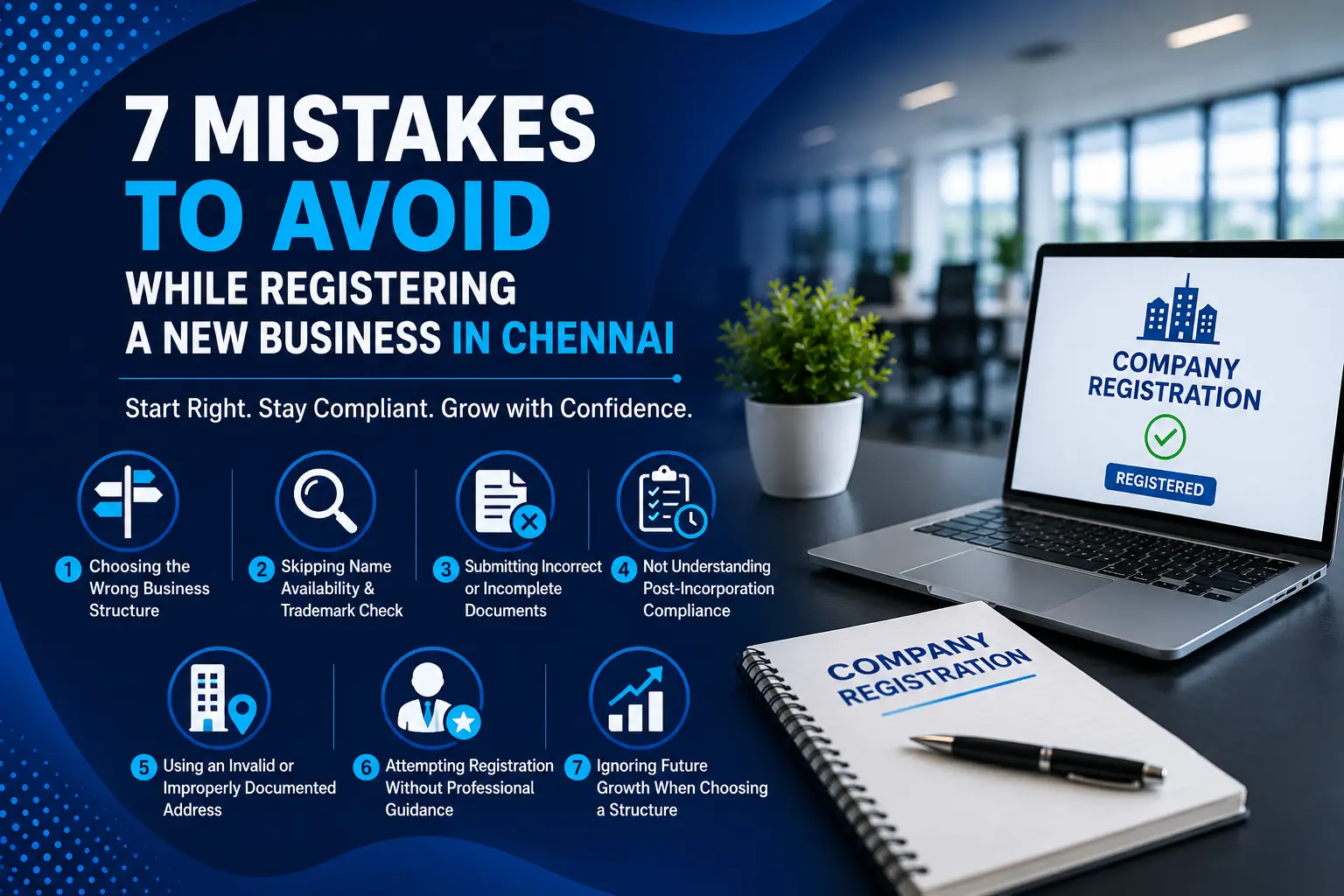
However, a single mistake during company registration can trigger delayed approvals, compliance penalties, GST issues, or expensive legal restructuring. This guide covers the seven most common registration mistakes – and exactly how to avoid them.
Key Takeaways
- Choosing the wrong business structure increases future compliance costs and limits funding options.
- MCA name availability and trademark checks must be done before filing SPICe+ Part A.
- Document mismatches are the leading cause of registration rejection at ROC Chennai.
- Post-incorporation compliance (GST, ROC annual filing, Director KYC) is mandatory, not optional.
- A valid registered office address with NOC and utility bill is required for GST verification and bank account opening.
- Professional CA or CS guidance reduces errors and ROC objections significantly.
- Planning for future growth prevents costly conversion from proprietorship or partnership to Private Limited Company later.
Business Structure Comparison
| Business Structure | Best For | Compliance Level | Investor-Ready | Liability Protection |
| Sole Proprietorship | Freelancers, small traders | Low | No | No |
| Partnership Firm | Family businesses, 2–20 partners | Medium | Limited | No |
| LLP | Service firms, professionals | Medium | Moderate | Yes |
| One Person Company (OPC) | Solo founders with limited liability | Medium | No | Yes |
| Private Limited Company | Startups, scalable businesses | High | Yes | Yes |
Mistake 1: Choosing the Wrong Business Structure
Many entrepreneurs register their business without evaluating which legal entity fits their goals. This creates tax inefficiencies, compliance burdens, and funding barriers later.
What each structure actually means for your business:
- Sole Proprietorship – No separate legal identity, unlimited personal liability. Suitable for small traders and freelancers with annual turnover below ₹20 lakh.
- Partnership Firm – Governed by the Indian Partnership Act, 1932. No limited liability. Best for family-run businesses with trusted partners.
- LLP – Registered under the Limited Liability Partnership Act, 2008. Offers limited liability with lower compliance than a Private Limited Company. Annual filing fees start from approximately ₹500.
- Private Limited Company – Registered under the Companies Act, 2013 with ROC Chennai. Minimum 2 directors and 2 shareholders required. Authorized capital minimum is ₹1 lakh. Best for startups seeking investor funding.
- One Person Company (OPC) – Introduced under Section 2(62) of the Companies Act, 2013. Suitable for solo entrepreneurs who want limited liability without a co-founder.
Before registering, evaluate: ownership structure, funding requirements, expected annual turnover, tax obligations under the Income Tax Act, and five-year business goals.
Many Chennai-based IT and logistics startups choose Private Limited Company registration because it supports ESOP issuance, FDI eligibility, and investor participation – benefits unavailable to LLPs or proprietorships.
Mistake 2: Skipping Company Name Availability and Trademark Checks
Hundreds of registration applications are rejected at ROC Chennai each month because of name conflicts or violations of MCA naming guidelines under Rule 8 of the Companies (Incorporation) Rules, 2014.
Before filing SPICe+ Part A, you must:
- Search the MCA21 portal (mca.gov.in) for existing company names
- Check the IP India trademark database (ipindia.gov.in) for conflicting trademarks
- Avoid names that include restricted words such as “National,” “Bank,” “Insurance,” “Government,” or “Bharat” without prior approval
- Avoid names too similar to existing companies (phonetically or visually)
- Verify domain name availability if you plan to operate online
Under SPICe+ Part A, you can propose up to two names. If both are rejected, you must file again – adding 3–5 working days to the process.
A registered trademark also protects your brand under the Trade Marks Act, 1999, and prevents competitors from using your business identity.
Mistake 3: Submitting Incorrect or Incomplete Documents
Incorrect documentation is the single most common reason for ROC objections and registration delays in Chennai. Even a minor spelling mismatch between your PAN card and Aadhaar card can trigger rejection.
Documents required for Private Limited Company registration in Chennai:
- PAN card and Aadhaar card of all directors and shareholders
- Address proof (bank statement, electricity bill, or telephone bill – not older than 2 months)
- Passport-size photographs of all directors
- Digital Signature Certificate (DSC) – Class 3, obtained from authorized certifying agencies such as eMudhra or NSDL
- Director Identification Number (DIN) – applied through SPICe+ Part B
- Registered office proof: rental agreement + latest electricity bill + NOC from property owner
- Memorandum of Association (MoA) and Articles of Association (AoA)
Common errors that cause rejection:
- Name mismatch between PAN and Aadhaar
- Expired rental agreements (must be current)
- DSC not linked to the correct director’s PAN
- Missing NOC from building owner for the registered office address
- Improperly drafted MoA subscriber sheets
Founders must file the entire SPICe+ form (Part A + Part B + AGILE-PRO-S) together for new incorporations. Errors at any stage require resubmission.
Mistake 4: Not Understanding Post-Incorporation Compliance
Many first-time founders believe the process ends when they receive the Certificate of Incorporation (CoI) from ROC Chennai. In reality, incorporation triggers a series of ongoing legal obligations.
Mandatory post-incorporation steps for a Private Limited Company:
| Compliance | Deadline | Penalty for Default |
| GST Registration | Before crossing ₹20 lakh turnover (₹10 lakh for NE states) or on first interstate sale | ₹10,000 minimum penalty |
| Opening a Current Bank Account | Within 30 days of incorporation | Operational restriction |
| Appointment of First Auditor | Within 30 days of incorporation (Board resolution required) | ₹300/day fine under Section 139 |
| Commencement of Business (INC-20A) | Within 180 days of incorporation | ₹50,000 penalty for company; ₹1,000/day for directors |
| Director KYC (DIR-3 KYC) | Annually by September 30 | DIN deactivation |
| ROC Annual Filing (AOC-4 + MGT-7) | Within 60 days of AGM | ₹100/day late fee |
Additional registrations that may apply to Chennai businesses include: MSME/Udyam Registration (for priority lending benefits), Professional Tax Registration under the Tamil Nadu Professional Tax Act, Import Export Code (IEC) from DGFT for international trade, and Shops and Establishment Registration under the Tamil Nadu Shops and Establishments Act, 1947.
Mistake 5: Using an Invalid or Improperly Documented Registered Office Address
The registered office address is the legal address of your company. ROC Chennai, GST authorities, income tax departments, and banks communicate exclusively through this address.
What counts as a valid registered office address:
- Residential or commercial property in Tamil Nadu (or anywhere in India)
- Valid rental agreement or ownership proof in the company’s or director’s name
- Latest utility bill (electricity, water, or telephone – not older than 2 months)
- No Objection Certificate (NOC) from the property owner if the premises are rented
Problems that arise from an invalid address:
- GST verification failure – GST officers conduct physical verification for new registrations. An incorrect or unoccupied address leads to immediate rejection
- Bank account opening denial – banks require proof of registered office
- ROC notices going unserved – can lead to company strike-off proceedings under Section 248 of the Companies Act, 2013
- License rejections for Shops and Establishment or FSSAI
You can use a residential address as your registered office. Many Chennai entrepreneurs use their home address initially and update it after securing commercial premises. Companies can file the address change through Form INC-22.
Mistake 6: Attempting Registration Without Professional Guidance
Online portals have made DIY company registration appear straightforward. However, business registration in India involves legal, financial, and compliance-related decisions that have long-term consequences.
What a qualified CA (Chartered Accountant) or CS (Company Secretary) can do for you:
- Select the most tax-efficient business structure for your specific industry
- Prepare error-free SPICe+ filings, MoA, and AoA
- Obtain DSC and DIN for all directors
- Advise on authorized capital vs. paid-up capital to minimize stamp duty
- Handle ROC objection responses if your application receives queries
- Set up your accounting and compliance calendar from Day 1
Approximate professional fees for company registration in Chennai (2025):
- Government fee for Private Limited Company: ₹0 (nil for authorized capital up to ₹15 lakh under the current fee structure) to ₹2,000+ depending on capital
- Stamp duty on MoA and AoA: Varies by state; Tamil Nadu charges stamp duty based on authorized capital
- Professional fees: ₹4,000–₹15,000 depending on service provider and complexity
Attempting to save on professional fees often costs significantly more in penalty payments and resubmission delays. ROC objections that require legal responses can extend timelines by 3–6 weeks.
Mistake 7: Ignoring Future Business Growth When Choosing a Structure
Many entrepreneurs register a business based only on their current needs. When the business grows, they discover that their current structure blocks investor funding, limits ownership transfer, or creates avoidable tax liabilities.
Common conversion scenarios that could have been avoided:
- Proprietorship → Private Limited Company: Required when seeking bank loans above ₹25–50 lakh or approaching angel investors. Conversion involves a fresh incorporation, asset transfer, and sometimes GST migration.
- Partnership → LLP: Requires filing Form 17 with ROC and can take 30–60 days.
- LLP → Private Limited Company: Requires approval under Section 366 of the Companies Act, 2013 and can cost ₹20,000–₹50,000 in professional and government fees.
Register Your Business in Chennai – The Right Way Avoid costly mistakes, ROC objections, and compliance penalties. Get expert guidance from a qualified CA/CS who knows Tamil Nadu registration inside out.
Final Thoughts
Registering a new business in Chennai requires careful planning across five critical areas: business structure, name selection, documentation, post-incorporation compliance, and registered office validity. The registration process itself – from DSC application to receiving the Certificate of Incorporation – typically takes 7 to 15 working days when done correctly.
The mistakes covered in this guide are all avoidable with the right preparation and, where needed, qualified professional guidance from a CA or CS registered with ROC Chennai. The cost of getting registration right is always lower than the cost of fixing errors, responding to ROC objections, or restructuring a business that outgrows its legal form.
Frequently Asked Questions
Common mistakes include choosing the wrong business structure, submitting incorrect documents, selecting an unavailable company name, and overlooking post-registration compliance. These errors can delay approvals, increase costs, and lead to unnecessary legal complications.
The ideal business structure depends on your ownership model, funding requirements, tax implications, liability protection, and future growth plans. Comparing options such as Sole Proprietorship, Partnership, LLP, OPC, and Private Limited Company before registration helps you make an informed decision.
Accurate documentation is essential for smooth business registration and MCA approval. Incorrect identity proofs, address proofs, or incorporation documents can result in application rejection, repeated resubmissions, and delays in starting your business.
After business registration, companies must comply with annual ROC filings, Income Tax regulations, GST requirements, statutory record maintenance, and other applicable legal obligations. Ignoring post-registration compliance can lead to penalties and affect your company’s legal status.
Yes. Professional consultants assist with business structure selection, company name approval, document verification, MCA filings, and post-incorporation compliance. Their expertise minimizes registration errors, speeds up approvals, and ensures your business is legally compliant from day one.
Business registration generally takes between 7 and 15 working days, depending on the business structure, document accuracy, company name approval, and MCA processing timelines. Working with experienced consultants can help reduce avoidable delays.
CAAFT offers end-to-end business registration services, including Private Limited Company, LLP, OPC, Partnership Firm, and MSME registration. From company incorporation and GST registration to ROC compliance, accounting, and taxation, experienced Chartered Accountants provide comprehensive support to help businesses start and grow with confidence.