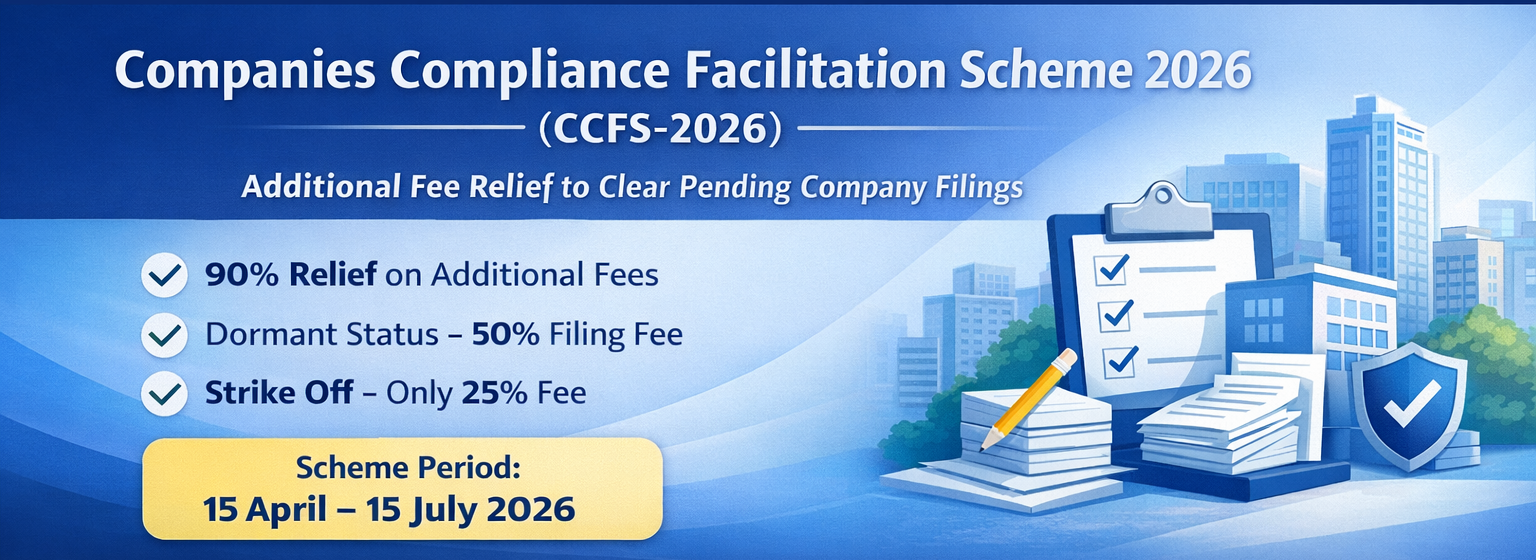
The Ministry of Corporate Affairs (MCA) has introduced the Companies Compliance Facilitation Scheme, 2026 (CCFS-2026) through General Circular No. 01/2026 dated 24 February 2026.
The Scheme provides a one-time opportunity for defaulting companies to complete pending statutory filings by paying significantly reduced additional fees.
Under the Companies Act, 2013, companies must file their Annual Returns and Financial Statements with the Registrar of Companies. Delays in filing attract an additional fee of ₹100 per day without any maximum limit under Section 403 of the Act. Under the ordinary rules, companies missing filing deadlines for their Annual Returns (Form MGT-7) or Financial Statements (Form AOC-4) attract an additional fee of ₹100 per day. There’s also the fixed penalty of ₹50,000 applicable. As a result, over months or years of non-compliance, this amount often grows into lakhs of rupees.
The Scheme aims to improve compliance levels, reduce litigation, and allow inactive companies to either regularise filings, obtain dormant status, or close their operations at reduced cost.
When Does the CCFS Scheme Apply?
The Scheme will remain in force from:
15 April 2026 to 15 July 2026
After this period, normal penalties and legal consequences will apply.
Which Forms Are Covered Under the CCFS Scheme?
Forms under Companies Act, 2013
- MGT-7 – Annual Return
- MGT-7A – Annual Return (OPC & Small Companies)
- AOC-4 – Financial Statements
- AOC-4 CFS – Consolidated Financial Statements
- AOC-4 NBFC (Ind AS) and AOC-4 CFS NBFC (Ind AS)
- AOC-4 (XBRL) – Financial Statements in XBRL
- ADT-1 – Appointment of Auditor
- FC-3 and FC-4 – Foreign Company filings
Legacy Forms under Companies Act, 1956
- Form 20B, Form 21A – Annual Returns
- Form 23AC and 23ACA – Financial Statements
- Form 23AC-XBRL and 23ACA-XBRL
- Form 66 – Compliance Certificate
- Form 23B – Appointment of Auditor
What can companies do under CCFS 2026?
1. Filing Pending Annual Filings with Reduced Additional Fees
Companies can complete pending filings by paying:
- Normal filing fee – 100%
- Additional fee – only 10% of the total additional fee
This effectively provides about 90% relief on additional fees.
2. Apply for Dormant Company Status
Companies may apply for Dormant Status under Section 455 by filing Form MSC-1.
Fees payable: Only 50% of the normal filing fee
Dormant companies remain registered but have minimal compliance requirements.
3. Striking Off of Company
Companies that wish to close operations may apply for strike-off by filing Form STK-2.
Fees payable: Only 25% of the normal filing fee
This provides a cost-effective exit option for inactive companies.
What Immunity from Penalties Does the CCFS 2026 Scheme Provide?
The Scheme provides conditional immunity from penalties in certain cases.
For filings under Sections 92 and 137:
- No penalty will apply if filings are made before the notice from the adjudicating officer, or
- Within 30 days after receiving the notice.
If the penalty order has already been passed, the penalty will still remain payable.
For certain other forms, immunity from future penal action will apply if no prosecution or show-cause notice was issued before filing under the Scheme.
“Take advantage of the CCFS-2026 scheme before the deadline and avoid heavy additional fees.“
“Check your eligibility and start your compliance process“
Which Companies Are Covered Under the CCFS Scheme?
The Scheme applies to most companies with pending filings, except the following companies:
- Companies already issued final strike-off notice under Section 248
- Companies that have already applied for strike-off
- Companies that applied for dormant status before the Scheme
- Companies dissolved through amalgamation
- Vanishing companies
Conclusion
The Companies Compliance Facilitation Scheme, 2026 provides a valuable opportunity for companies to regularise pending filings, reduce additional fees, or close inactive entities at a lower cost.
Companies should review their compliance status and take advantage of the Scheme before 15 July 2026, after which strict enforcement and penalties may apply.
Frequently Asked Questions
The Companies Compliance Facilitation Scheme (CCFS) 2026 is a one-time initiative introduced by the Ministry of Corporate Affairs (MCA) to help eligible companies regularize pending statutory filings at significantly reduced additional fees. The scheme encourages compliance while making it easier for businesses to update their corporate records.
The scheme primarily benefits defaulting companies that have pending ROC filings, such as annual returns and financial statements. It is especially useful for startups, MSMEs, and inactive companies looking to restore compliance or regularize their legal status under the Companies Act.
CCFS 2026 covers several pending statutory forms, including AOC-4, MGT-7, MGT-7A, ADT-1, and certain other eligible ROC filings. The scheme allows companies to complete overdue filings at substantially reduced additional fees, making compliance more affordable.
The scheme offers significant relief by allowing eligible companies to pay only a fraction of the additional filing fees for delayed ROC filings. It also provides options for dormant status or company strike-off at concessional fees, helping businesses resolve long-pending compliance issues.
Companies that fail to take advantage of the scheme may continue to face regular additional filing fees, penalties, and regulatory action for non-compliance. Completing pending ROC filings within the scheme period helps reduce future legal and financial risks.
Companies generally need audited financial statements, annual return details, statutory registers, Board resolutions where applicable, auditor information, and supporting compliance documents. Maintaining accurate records helps ensure faster processing and successful ROC filings.
Professional compliance experts review pending ROC filings, prepare the required documents, calculate applicable fees, file eligible forms through the MCA portal, and ensure complete compliance within the scheme timeline. Their support minimizes filing errors, reduces compliance risks, and helps companies make the most of the CCFS 2026 opportunity.