
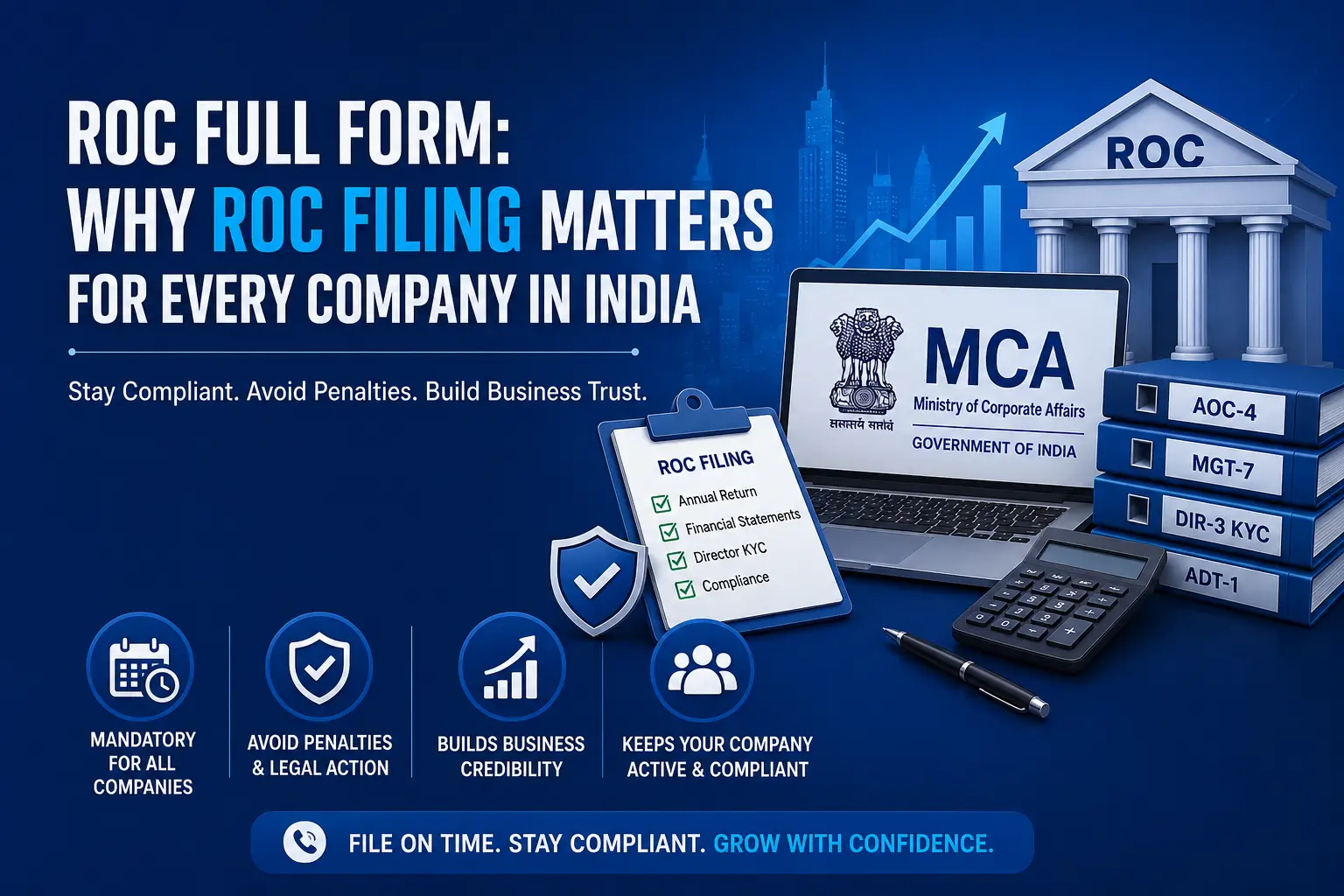
Every registered company in India is legally required to file certain documents with the government on a regular basis. The Ministry of Corporate Affairs (MCA) oversees the ROC filing process under the Companies Act, 2013. Understanding ROC compliance is essential for business owners, directors, and finance professionals to avoid penalties and keep their company in good standing.
Key Takeaways
- ROC stands for Registrar of Companies – a government authority under the MCA.
- ROC filing is mandatory for all companies registered in India.
- Every registered company in India must submit its annual returns and financial statements to the Ministry of Corporate Affairs (MCA) each financial year.
- Late ROC filing attracts penalties of ₹100 per day and can lead to legal action.
- Timely ROC compliance improves business credibility and investor trust.
- Non-compliance can result in director disqualification or company strike-off.
What is the ROC Full Form?
ROC stands for Registrar of Companies. It is a statutory authority operating under the Ministry of Corporate Affairs (MCA), Government of India. The Registrar of Companies is responsible for registering companies and LLPs (Limited Liability Partnerships) and ensuring they comply with the provisions of the Companies Act, 2013.
Each state or union territory in India has its own ROC office. For example, companies incorporated in Tamil Nadu fall under the jurisdiction of the ROC, Chennai. The ROC acts as the primary regulatory body that maintains all official records of registered companies and monitors their annual compliance.
What is ROC Filing?
ROC filing is the process where companies submit important legal documents, including annual returns, financial statements, and other mandatory forms, to the Registrar of Companies through the MCA portal.
Who must file: If your company was incorporated under the Companies Act, 2013, you’re on the list. That means private limited companies, public limited companies, one-person companies, and small companies all have to comply.
When to file: Most companies wrap up their filings after Companies must hold the AGM within six months of the financial year-end. So realistically, the bulk of ROC filings land somewhere between September and November each year.
And just to be clear – this isn’t something you do once and forget. It comes back around every single year.
Who Needs ROC Filing?
Every company registered under the Companies Act, 2013 must comply with ROC filing obligations. This includes:
- Private Limited Companies – the go-to structure for founders, SMEs, and foreign subsidiaries operating in India.
- Public Limited Companies – covering both exchange-listed corporations and those that have not yet gone public.
- One Person Companies (OPCs) – solo-founder setups that come with slightly simpler filing requirements.
- Small Companies – these can use the MGT-7A form, which is a bit more straightforward.
- Limited Liability Partnerships (LLPs) – they follow the LLP Act, but ROC filing still applies.
Here’s something a lot of people get wrong: if your company sat completely idle for the year – no revenue, no transactions – you still have to file. The only way out is if your company has been officially registered as dormant under Section 455 of the Companies Act. Just being inactive on paper doesn’t count.
Why is ROC Filing Important for Companies?
Some business owners treat ROC filing as a routine formality. But the truth is, it matters a lot more than most people realise.
- Maintains active company status – Fall behind on filings and The ROC could mark your company as a defaulter. Let it go long enough and the ROC can strike it off the register completely.
- Avoids penalties and legal action – The ₹100-per-day late fee adds up quickly. Beyond the money, directors can personally face legal action if the company stays non-compliant.
- Ensures transparency – Everything you file goes into a public database. Stakeholders, partners, and regulators can see it, which means your compliance record directly reflects on your reputation.
- Supports funding and audits – Before any bank, investor, or auditor signs off on anything, they’ll look up your filing history. Gaps in compliance raise immediate red flags.
- Builds investor and partner trust – Consistent, clean filings quietly communicate that your business is well-managed and reliable.
- Protects directors – Directors of non-compliant companies can be disqualified from holding directorships elsewhere. Staying current protects you personally.
One missed year might seem harmless, but the penalties compound, the scrutiny increases, and getting back into good standing becomes a much bigger ordeal than it needed to be.
Functions of the Registrar of Companies (ROC)
The ROC performs several critical functions in the Indian corporate ecosystem:
- Company and LLP registration – Processes incorporation applications and issues the Certificate of Incorporation.
- Maintaining public records – Keeps an official, publicly accessible database of all registered companies.
- Monitoring compliance – Tracks whether companies are meeting their annual filing obligations.
- Approving statutory filings – Reviews and approves forms submitted by companies, such as changes in directors or registered address.
- Regulatory oversight – Initiates action against companies that fail to comply, including strike-off proceedings.
Note: Issuing notices – Sends legal notices to defaulting companies and directors.
Mandatory ROC Forms for Companies
Different filings require different forms. Below are the key forms every company should be aware of:
| ROC Form | Purpose |
| AOC-4 | Filing financial statements (Balance Sheet, P&L) |
| MGT-7 / MGT-7A | Annual return filing (company overview, shareholding) |
| DIR-3 KYC | Director KYC compliance (annual verification) |
| ADT-1 | Appointment or change of statutory auditor |
| DPT-3 | Return of deposits and outstanding receipts of money |
Note: MGT-7A is a simplified annual return form applicable to OPCs and small companies. Other companies use MGT-7.
ROC Filing Due Dates
Missing due dates is the most common – and most avoidable – compliance mistake. Here is a quick reference:
| Form | Due Date |
| AOC-4 | Within 30 days of AGM |
| MGT-7 / MGT-7A | Within 60 days of AGM |
| DPT-3 | 30th June every year |
| DIR-3 KYC | As notified by MCA (typically September 30) |
| ADT-1 | Within 15 days of AGM |
Since most companies hold their AGM by September 30, the bulk of ROC filings fall due in October and November. Mark these dates on your compliance calendar well in advance.
Penalty for Late ROC Filing
The cost of missing ROC deadlines adds up quickly. Here is what non-compliance can lead to:
- Additional fees of ₹100 per day for each day of delay, with no upper cap for most forms.
- Director disqualification under Section 164(2) of the Companies Act if a company defaults on annual filings for three consecutive years.
- Legal notices and prosecution by the Registrar of Companies for persistent non-compliance.
- Company strike-off – the ROC can remove the company from the register, effectively shutting it down.
- Difficulty in closing the company – a company with pending filings cannot be voluntarily wound up or struck off under the Fast Track Exit (FTE) route.
The penalty structure is designed to make late filing increasingly expensive. Filing on time is always cheaper than paying arrears.
Step-by-Step ROC Filing Process
Filing ROC returns is straightforward when done systematically. Here is a step-by-step overview:
Step 1 – Prepare financial statements Close your books of accounts for the financial year (April–March) and get them audited by a Chartered Accountant.
Step 2 – Conduct the AGM Hold the Annual General Meeting within the prescribed time limit (within six months of year-end for most companies). Present Shareholders approve the audited financials.
Step 3 – Download ROC forms from the MCA portal Visit and download the relevant e-forms (AOC-4, MGT-7, etc.).
Step 4 – Fill the forms and attach required documents Complete the forms with accurate company, director, and financial details. Attach required documents such as audited financial statements, board resolutions, and the directors’ report.
Step 5 – Attach Digital Signature Certificate (DSC) All ROC filings must be digitally signed by an authorised director using a valid Class 3 DSC.
Step 6 – Upload forms on the MCA portal Log in to the MCA21 portal and upload the completed and signed forms. Verify all details before submission.
Step 7 – Pay the filing fees Pay the prescribed government fees online. Fee amounts vary based on the company’s authorised share capital.
Once submitted and approved, The MCA portal generates an acknowledgment (SRN) after submission.
Benefits of Timely ROC Filing
Staying on top of ROC compliance pays off in multiple ways:
- Avoid compounding penalties – Every day of delay adds to the cost; timely filing eliminates this entirely.
- Maintain a clean compliance record – Visible in the MCA public database and reviewed by banks, investors, and partners.
- Easier access to business funding – Lenders and VCs check compliance history before approving loans or investments.
- Improved business credibility – A compliant company signals professionalism and reliability.
- Smooth operations – No legal notices, no disqualified directors, no disruptions to business banking or contracts.
- Eligibility for government tenders – Many government procurement portals require a clean compliance certificate.
Common ROC Filing Mistakes to Avoid
Even well-intentioned businesses make avoidable errors during ROC filing. Watch out for these:
- Missing deadlines – The single most common mistake. Set calendar reminders well in advance.
- Selecting the wrong form – For example, using MGT-7 instead of MGT-7A for a small company, or vice versa.
- Using an expired or wrong DSC – All signatories must have a valid, up-to-date Digital Signature Certificate.
- Incomplete or incorrect documentation – Missing attachments or wrong figures will result in rejection or resubmission.
- Ignoring inactive company filings – Dormant companies must still file annual returns unless formally converted to dormant status under the Companies Act.
- Not updating director information – Changes in directors, addresses, or DIN details must be reflected and updated before filing annual returns.
Conclusion
ROC filing is a fundamental legal obligation for every company incorporated in India. Staying compliant not only helps you avoid monetary penalties and director disqualification – it also strengthens your company’s credibility with investors, banks, and business partners. With the right preparation, an organised timeline, and accurate documentation, the process is entirely manageable.
Make ROC compliance a priority, not an afterthought. Need professional assistance with ROC filing? Our experts can help you stay compliant, file on time, and avoid costly penalties.
Get in touch today for a free compliance consultation.
Frequently Asked Questions
ROC stands for Registrar of Companies, a statutory authority under the Ministry of Corporate Affairs (MCA). The ROC is responsible for registering companies, maintaining corporate records, and ensuring businesses comply with the Companies Act, 2013 through timely statutory filings.
ROC filing is mandatory because every registered company must submit annual financial statements, annual returns, and other statutory forms to the MCA. Timely compliance helps companies maintain legal status, avoid penalties, and demonstrate transparency to investors, lenders, and regulatory authorities.
The most common ROC forms include AOC-4 for financial statements, MGT-7 or MGT-7A for annual returns, ADT-1 for auditor appointment, and DIR-3 KYC for director compliance. Filing these forms on time ensures your company remains compliant with MCA regulations.
Failure to file ROC returns can result in additional filing fees, financial penalties, director disqualification, legal action, and difficulties in obtaining loans or attracting investors. Regular ROC compliance protects a company’s legal standing and business reputation.
Every Private Limited Company, One Person Company (OPC), Public Limited Company, and certain LLPs registered under the Companies Act must complete applicable ROC filings, regardless of whether the business generated revenue during the financial year.
Businesses should maintain updated financial records, conduct audits on time, track MCA filing deadlines, and prepare statutory documents well in advance. Working with experienced Chartered Accountants helps minimize filing errors and ensures complete ROC compliance throughout the year.
CAAFT offers end-to-end ROC compliance services, including AOC-4 and MGT-7 filing, annual returns, MCA compliance, company secretarial support, and ongoing regulatory advisory. Experienced Chartered Accountants help businesses meet statutory deadlines, avoid penalties, and maintain full compliance with MCA requirements.