

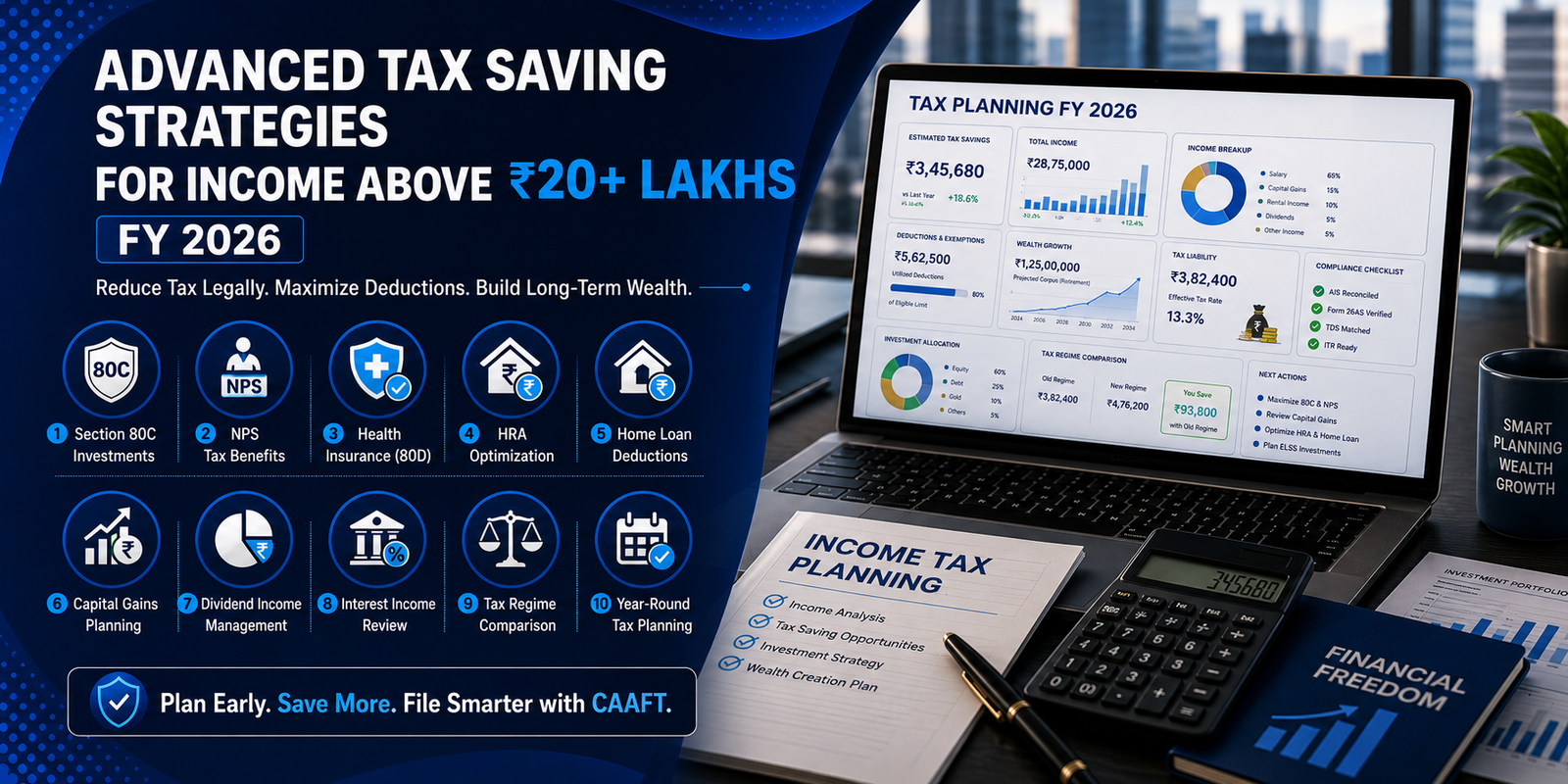
Earning more than ₹20 lakhs annually is a significant financial milestone, but it also comes with increased tax responsibilities. As income rises, taxpayers often move into higher tax brackets, face additional compliance requirements, and encounter more complex financial transactions involving investments, property, business income, and capital gains. The Income Tax Department recently identified 15,000–20,000 cases where taxpayers claimed incorrect deductions or exemptions, highlighting the growing use of data analytics and the importance of accurate tax planning and compliance.
Many earners above ₹ 20 lakhs focus on filing their Income Tax Return (ITR) correctly but overlook a more important aspect – strategic tax planning. Effective tax planning also helps simplify the income tax filing process and ensures accurate income tax return filing, reducing the likelihood of reporting errors and compliance issues.
Whether you are a salaried professional, entrepreneur, consultant, doctor, IT professional, investor, or business owner, understanding available tax-saving opportunities can help you preserve wealth, improve cash flow, and achieve long-term financial goals.
Key Takeaways
- Above ₹20 lakh earners can reduce tax liability significantly through proactive tax planning instead of last-minute tax-saving investments.
- Choosing the right old or new income tax regime is essential to maximize tax savings and avoid paying excess tax.
- Proper planning of capital gains, dividends, rental income, and interest earnings helps improve tax efficiency and compliance.
- Tax-saving options such as Section 80C, NPS, HRA, health insurance, and home loan benefits can optimize taxable income when used effectively.
- Regularly reviewing AIS, Form 26AS, and financial records ensures accurate Income Tax Return filing and reduces the risk of income tax notices.
- Professional tax planning helps identify legal tax-saving opportunities while ensuring full compliance with current tax regulations.
What is tax planning?
Tax planning is the process of managing your income, investments, expenses, and deductions in a way that helps reduce your tax liability legally. It involves using available tax-saving provisions, exemptions, and deductions under the law to optimize your taxes. Effective tax planning helps improve cash flow, supports long-term wealth creation, and ensures better financial management. It also reduces the risk of penalties, tax notices, and compliance errors while keeping you aligned with tax regulations.
Why Tax Planning Becomes More Important Above ₹20 Lakhs
For individuals wondering about the 20 lakh income tax applicable in FY 2026, the actual tax payable depends on factors such as the selected tax regime, eligible deductions, exemptions, and income sources. Two taxpayers earning the same annual income may have significantly different tax liabilities depending on their financial planning strategy.
Above ₹20 lakh earners typically have multiple sources of income, such as:
- Salary and bonuses
- Rental income
- Dividend income
- Interest income
- Capital gains
- Business profits
- Freelance or consulting income
Each source is taxed differently and requires proper planning to optimize tax efficiency.
Tax planning helps to:
- Reduce taxable income legally
- Improve investment efficiency
- Maximize eligible deductions
- Manage capital gains strategically
- Avoid unnecessary penalties and notices
- Build long-term wealth more effectively
Understanding Tax Liability for Above ₹20 lakh Earners
Many taxpayers earning above ₹20 lakhs underestimate how multiple income streams impact their tax position.
For example:
A salaried professional may earn:
- Annual salary of ₹24 lakhs
- Dividend income from stocks
- Interest from fixed deposits
- Rental income from a second property
- Capital gains from mutual funds
If your annual package is around ₹20 lakhs, understanding the tax on 20 lakh salary requires more than simply checking the applicable tax slab. Components such as HRA, retirement contributions, performance bonuses, capital gains, and deductions can substantially influence your final tax liability.
Best Tax-Saving Strategies for Above ₹20 lakh Earners in India (FY 2026)
If your annual income exceeds ₹20 lakhs, tax planning should become an ongoing financial strategy rather than a year-end task. Those earning ₹20 lakh to ₹30 lakh often have multiple sources of income, including salary, rental income, capital gains, dividends, and business profits, making tax planning more complex. The following strategies can help you legally reduce your tax liability while improving your overall financial efficiency.
1. Maximize Section 80C Benefits
Section 80C remains one of the most effective ways to reduce taxable income under the old tax regime. Although the deduction limit is fixed, many taxpayers still fail to utilize it fully. Planning your investments early in the financial year helps maximize tax savings while supporting your long-term financial goals.
You can claim deductions through eligible investments such as:
- Public Provident Fund (PPF)
- Employees’ Provident Fund (EPF)
- Equity-Linked Savings Schemes (ELSS)
- Tax-saving Fixed Deposits
- Life Insurance Premiums
- Principal repayment of eligible home loans
Instead of making last-minute investments before the tax filing deadline, spread your investments throughout the year to improve financial discipline and avoid unnecessary pressure.
2. Take Advantage of Additional NPS Benefits
The National Pension System (NPS) is one of the most valuable tax-saving and retirement planning options available to earners above ₹ 20 lakh. In addition to helping you build a retirement corpus, NPS offers extra tax deductions beyond the benefits available under Section 80C.
Regular contributions to NPS not only lower your taxable income but also encourage long-term wealth creation. For salaried professionals, consultants, and business owners, including NPS as part of your overall tax planning strategy can provide both immediate tax benefits and future financial security.
3. Claim Health Insurance Deductions
Health insurance plays an important role in protecting both your health and your finances. Premiums paid for yourself, your spouse, dependent children, and parents may qualify for deductions under Section 80D.
Apart from reducing taxable income, adequate health insurance helps safeguard your savings against rising medical costs. Above ₹20 lakh earners should review their health insurance coverage every year to ensure it meets both their family’s needs and their tax planning objectives.
4. Optimize Home Loan Benefits
If you own a house with a home loan, you may be eligible to claim tax deductions on both the principal repayment and the interest paid, subject to applicable provisions of the Income Tax Act.
Many taxpayers overlook these benefits or fail to maintain the required documentation. Keeping home loan statements, interest certificates, and repayment records organized helps ensure you claim every eligible deduction during tax filing and improves your overall tax efficiency.
5. Plan Capital Gains Strategically
Capital gains from stocks, mutual funds, exchange-traded funds (ETFs), real estate, and other investments can significantly increase your tax liability if transactions are not planned properly.
Before selling any investment, consider factors such as:
- Whether the gain qualifies as short-term or long-term
- Available exemptions under the Income Tax Act
- Opportunities to offset gains with eligible capital losses
- The timing of the transaction within the financial year
Strategic capital gains planning can reduce taxes, improve after-tax returns, and help you preserve more of your investment profits.
6. Review Dividend and Interest Income Regularly
Many taxpayers concentrate only on salary income while overlooking dividend income and interest earned from savings accounts, fixed deposits, bonds, or other investments. These earnings are generally reflected in your Annual Information Statement (AIS) and Form 26AS.
Reviewing these records periodically helps ensure that all income is reported accurately in your Income Tax Return. This reduces the risk of income mismatches, delayed refunds, or notices from the Income Tax Department.
7. Optimize House Rent Allowance (HRA)
For salaried professionals living in rented accommodation, House Rent Allowance (HRA) can provide substantial tax savings under the old tax regime. To claim this exemption successfully, you should maintain proper documentation, including rent receipts, rental agreements, and your landlord’s PAN details wherever applicable.
Reviewing your HRA eligibility every financial year ensures that you maximize the available exemption while remaining fully compliant with tax regulations.
Old Tax Regime vs New Tax Regime: Which Is Better?
One of the most frequently asked questions by high-income taxpayers is which tax regime is better for 20 lakhs. The answer depends on your investment pattern, home loan benefits, insurance premiums, HRA eligibility, and the deductions you claim during the financial year. Comparing both regimes before filing your return helps identify the option that minimizes your tax liability legally.
| Criteria | Old Tax Regime | New Tax Regime |
|---|---|---|
| Section 80C Deductions | Yes | Limited |
| HRA Exemption | Yes | No |
| Home Loan Deductions | Yes | Restricted |
| Simplicity | Lower | Higher |
| Best For | Deduction-heavy taxpayers | Low-deduction taxpayers |
The new income tax regime offers lower tax rates but removes or limits many common deductions and exemptions available under the old regime. Taxpayers earning above ₹20 lakhs should calculate their tax under both regimes every financial year before making a decision, as the better option varies based on individual financial circumstances.
Tax Planning for Business Owners and Consultants
Business owners, consultants, freelancers, and professionals earning above ₹20 lakhs face additional compliance obligations.
Important areas requiring attention include:
- Advance Tax Planning – Failure to estimate tax liability accurately can result in interest and penalties.
- TDS Compliance – Proper monitoring of tax deductions helps avoid mismatches and reporting issues.
- GST Compliance – Businesses crossing prescribed turnover thresholds must manage GST registrations, return filings, and ongoing compliance obligations carefully.
- Expense Documentation – Maintaining proper records supports legitimate business deductions and improves tax efficiency.
High-income professionals should view tax planning as an ongoing business process rather than a year-end exercise.
Common Tax Planning Mistakes Above ₹20 lakh Earners Make
Many taxpayers unknowingly increase their tax burden through avoidable mistakes.
Common examples include:
- Delaying tax planning until the filing deadline
- Ignoring capital gains tax implications
- Choosing the wrong tax regime
- Missing deduction opportunities
- Failing to reconcile AIS and Form 26AS before income tax filing
- Under-reporting interest or dividend income
- Maintaining incomplete financial records
These mistakes can result in higher tax liability, delayed refunds, and unnecessary compliance scrutiny.
How to Build a Year-Round Tax Planning Strategy
The most successful taxpayers do not wait until March or the ITR filing deadline to review their finances.
A proactive strategy includes:
- Quarterly Reviews – Monitor income, deductions, investments, and capital gains throughout the year.
- Investment Planning – Align investments with both financial goals and tax-saving opportunities.
- Compliance Monitoring – Review AIS, Form 26AS, TDS records, and GST obligations regularly.
- Professional Guidance – Complex income structures often require expert review to identify tax-saving opportunities and ensure compliance.
Regular planning provides greater flexibility and allows taxpayers to make informed financial decisions before deadlines become restrictive.
Final Thoughts
Earning above ₹20 lakhs creates both opportunities and responsibilities. While higher income can accelerate wealth creation, it also requires a more strategic and proactive approach to tax planning. The most effective tax-saving strategies are data-driven, aligned with your long-term financial goals, and implemented throughout the financial year rather than at the last minute. By reviewing your income sources regularly, optimizing eligible deductions, managing investments carefully, and maintaining proper tax compliance, you can significantly improve tax efficiency and ensure a smooth Income Tax Return (ITR) filing.
Whether you are evaluating the new income tax regime, estimating the tax on a ₹20 lakh salary, calculating your 20 lakh income tax liability, or comparing which tax regime is better for ₹20 lakhs, making informed tax planning decisions can help you legally reduce your tax burden while remaining fully compliant with the latest Income Tax regulations. For above ₹20 lakh earners, expert tax planning is not just about saving tax today-it is about building long-term wealth through smarter financial decisions.
“Maximize your savings and minimize tax stress – get expert income tax return filing, ITR filing, and tax planning support from CAAFT.“
Frequently Asked Questions
Above ₹20 lakh earners can reduce taxable income through eligible deductions, retirement planning, health insurance benefits, capital gains planning, and strategic investment decisions. Effective planning throughout the year usually delivers better results than last-minute tax-saving efforts.
The right choice depends on your deductions, investments, home loan benefits, insurance premiums, and financial goals. Taxpayers should compare both regimes annually before making a decision.
Popular options include ELSS funds, PPF, NPS, life insurance premiums, tax-saving fixed deposits, and retirement-focused investments. The ideal portfolio depends on risk tolerance and long-term objectives.
Capital gains from investments such as stocks, mutual funds, and property can significantly increase tax liability. Proper planning helps manage gains efficiently and avoid unnecessary taxes.
Yes. Business owners often face additional obligations related to GST, TDS, advance tax, expense documentation, and regulatory compliance, making structured tax planning particularly important.
Quarterly reviews are generally recommended. Regular monitoring helps identify tax-saving opportunities and address compliance issues before they become costly problems.
Professional tax planning improves reporting accuracy, reconciles financial records, and ensures compliance with current tax regulations, significantly reducing the risk of notices and filing errors.